For about fifteen years the same dream has come back to me. A council fire is lit, and I am led to a great round room under a sky full of stars. I take my seat among ancestors from every corner of the earth: dry farmers and reindeer herders, healers and ocean navigators, the keepers of deserts and forests and steppes. Scientists and engineers sit among us and listen. Everything brought to that fire is weighed against one question. Does this honor the generations not yet born?
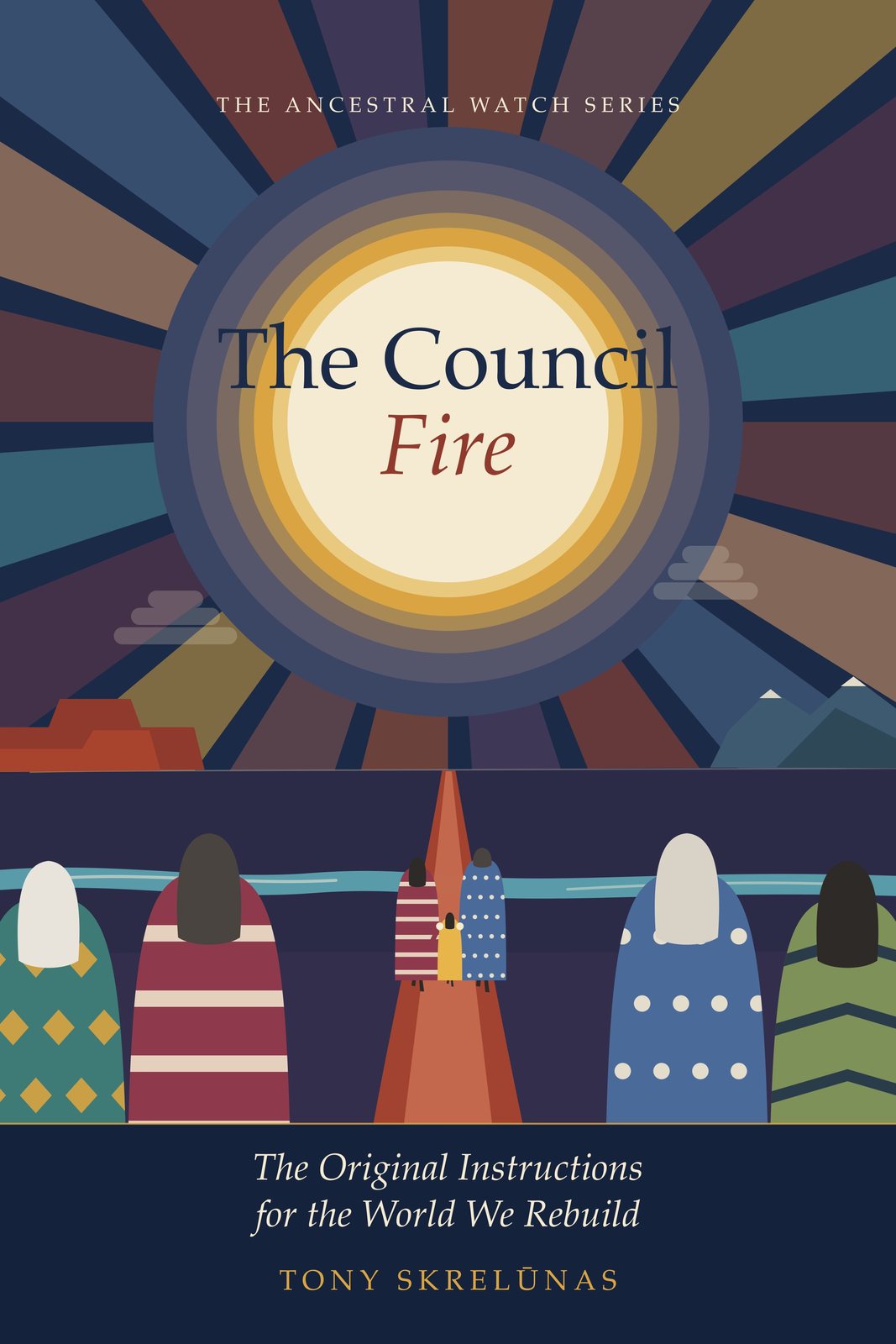
That dream has carried most of my work since. It is why I went back for the doctorate, why I sit at tables with tribal nations and with the people building our newest technology, and why I wrote The Council Fire. This past week the book was released with a new cover, and I want to tell you plainly what it is. It is more than a story.
Reading the country
A far messenger reads the country before crossing it, so I read the world every morning. Some of what I read is hard, and I will not pretend otherwise. The World Meteorological Organization confirmed that 2024 was the warmest year ever measured, and the oceans took in more heat in 2025 than in any year on record. This fall a super El Niño is building in the Pacific, likely the strongest since records began in 1950. My parents never heard the words super El Niño. Neither did my aunts. Ask any elder the last time there was weather like this, and they will tell you it was when the people were banished from the Third World.
Work is changing too, as artificial intelligence reaches into almost 40 percent of jobs worldwide, and hundreds of millions of people still go without enough to eat. Many of us carry all of it in our bodies, as a low hum of alarm that never quite switches off. In one national poll, 43 percent of American adults said they were more anxious than the year before.
Here is the good news, and it is just as true. There is a path through, and it has been walked before. Our own ancestors met hard seasons on every continent and in every language, and they came through still singing. They left the instructions in the body, in the story and in the song. We did not lose them. We stopped reading them, and we can pick them back up.
The new cover carries that. I wanted elders with their backs to us and a horizon visible under the fire, the path in the red of Sedona, the mesa on one side and the mountains on the other. Then came one last change, and that was the one. The figures on the path became a family, a man and a woman with a child walking between them and holding both their hands, on their way to the river.
More than a story
Before there was an internet, there was a body that could cross a desert with a library inside it. For most of human history everything that mattered moved one way, inside a trained human being. The far messengers of the deserts carried what the people needed across hard country. The far messengers of the oceans found one island in a sea with no end in sight by reading the swell. The far messengers of the mountains ran the stone roads above the clouds. And the far messengers of time carried a people’s whole knowing to a great-grandchild they would never meet. Every people on earth raised them, and every one of us has them in our line.
A 76-second film for The Council Fire. The far messengers of the deserts, the oceans, the mountains, and of time.
The book follows twelve keepers on six continents, none of whom has heard the others speak. Käthe keeps the pumps under the Ruhr that can never be switched off. Illary carries her seeds up the Andes ahead of the heat. Nizhoní, who is Diné, comes home to learn the rest of what her grandmother knew. They find each other, they make the words for what is happening, and then they build.
What they build is an ark, and it is not a boat. It is a method, a way of making certain that what a people knows survives the passage, held in the body, in the story, in the song, and in twelve small objects handed from one pair of hands to the next. Every valley its own fire. Every fire its own keeper.
On the far side they rebuild deliberately, out of what already worked. Wealth is counted in four kinds instead of one, financial, relational, cultural and natural, and the ledger is read aloud to the whole community at the winter solstice. An economy is built so that it cannot leave town. And one question is asked of everything before it is built, the same question from my dream: does this honor the great-grandchildren?
Let me say plainly that this is also a funny book. Käthe, in her kitchen with the river in the street, telephones the office and gets a recording saying it will reopen on Monday at eight. Two men from a ministry come out to register a herd that is walking north, and the younger one writes nomadic in a little box. The keepers laugh in the councils and through the hard winters, because joy is how the surviving is done.
The keepers are invented. Almost nothing under them is. The last hard-coal mine in Germany did close four days before Christmas, and the water under the Ruhr does have to be pumped forever. The ways forward are real too: a community that owns its sun instead of renting it, wealth counted in four kinds, a council that asks one question of everything it builds.
Underneath all of it is a single aim. It is to raise people whole enough to cross, settled in the body, clear in the mind, able to carry what matters through a hard passage and arrive with it undamaged. That is what the healing is for. Not comfort. Capacity. This is a book about rebuilding two generations at once, ours and the one that comes after, so that when it is their turn to build, they build from knowledge instead of from panic.
Who it is for
The book is built to be told out loud. It opens by putting a stone in your hand, and the back of it holds the stone breath in full, a way to run a reading circle as a council instead of a book club, and a crossing to play standing up. Each section is sized for one evening and one voice.
It was written for the ones who already carry something for other people, the grandmother keeping the language at the kitchen table, the engineer who stays after the work has gone, the young one who came home to learn what the summers only showed them the edge of. It was written for the ones on their way to becoming that, too. If that is you, you will know it within a few pages.
The Council Fire runs about 110,000 words, with a glossary of the old words and working appendices at the back. It is direct on Payhip for $20 at payhip.com/b/GB2eg, and the book page at ancestralwatch.com carries an excerpt and the twelve keepers with their peoples.
The first voice in the book belongs to someone seven generations down, holding all twelve tokens, who says of the world the keepers made: “It is hard here, and it is good.”
Come, sit at the fire. There is room. There is always room.
Tony Skrelūnas is Diné (Navajo) and Lithuanian. He writes The Ancestral Watch — Stone Breath, The Amber and the Stone, The Council Fire and The Far Messengers — and the working reader, Living as a Far Messenger. He is a PhD candidate; his dissertation looks at human and organizational performance through Diné and Lithuanian ancestral knowledge and the Japanese practices he has long studied. He holds a faculty appointment at 1440 Multiversity, where teaching is the center of the work now. He runs at dawn and hikes with a corgi named Roper.
Last reviewed October 2026.