This summer a phrase came to me that I have not been able to set down: decolonizing wellness. A few days later I talked it through out loud, and it took me straight to our own communities, to how often people who share a language, a ceremony and a family tree end up tearing each other up, and to what that does inside a home.
What I said next is still, to me, the center of the whole matter. You cannot hate, you cannot think bad about others, and have a regulated nervous system. The body does not keep one room for the feeling you aim at a neighbor and another room for the feeling you live in. Whatever you send out across the fence, you are also sitting in.
There is research that points the same way. In 2006 three researchers, Jos Brosschot, William Gerin and Julian Thayer, proposed in the Journal of Psychosomatic Research that a hard moment is often too short to do the body lasting harm. The replaying is what does it, they argued. Going back over the thing keeps the stress response running long after the moment has passed. A grudge is that kind of replay, carried for years.
Everybody had a role
A long time ago, the people who could govern their own emotions and their own thoughts, who held to positive thought on purpose, were the ones who made the stories, the songs and the teachings that kept a community resilient. That is how knowledge of health, of the climate, of food systems and agriculture was passed. You could not write it down. You had listening and observation, and that was all.
So the state of the home mattered as much as the knowledge itself. My great-grandmother raised me in a hogan on Big Mountain, with no electricity and no running water, and almost nothing came to me there as explanation. I watched, and I listened, and I was corrected, and over the years the knowledge arrived. That only works in a house where a child is calm enough to take it in.
And everybody had a role. There was the watcher, reading the weather and the land. There was the far messenger, who crossed what could not be crossed, received another people’s world, and carried it home whole. There was the medicine person, the farmer, the builder. A community was not a crowd of individuals each working on themselves. It was a set of roles, held by people, for each other.
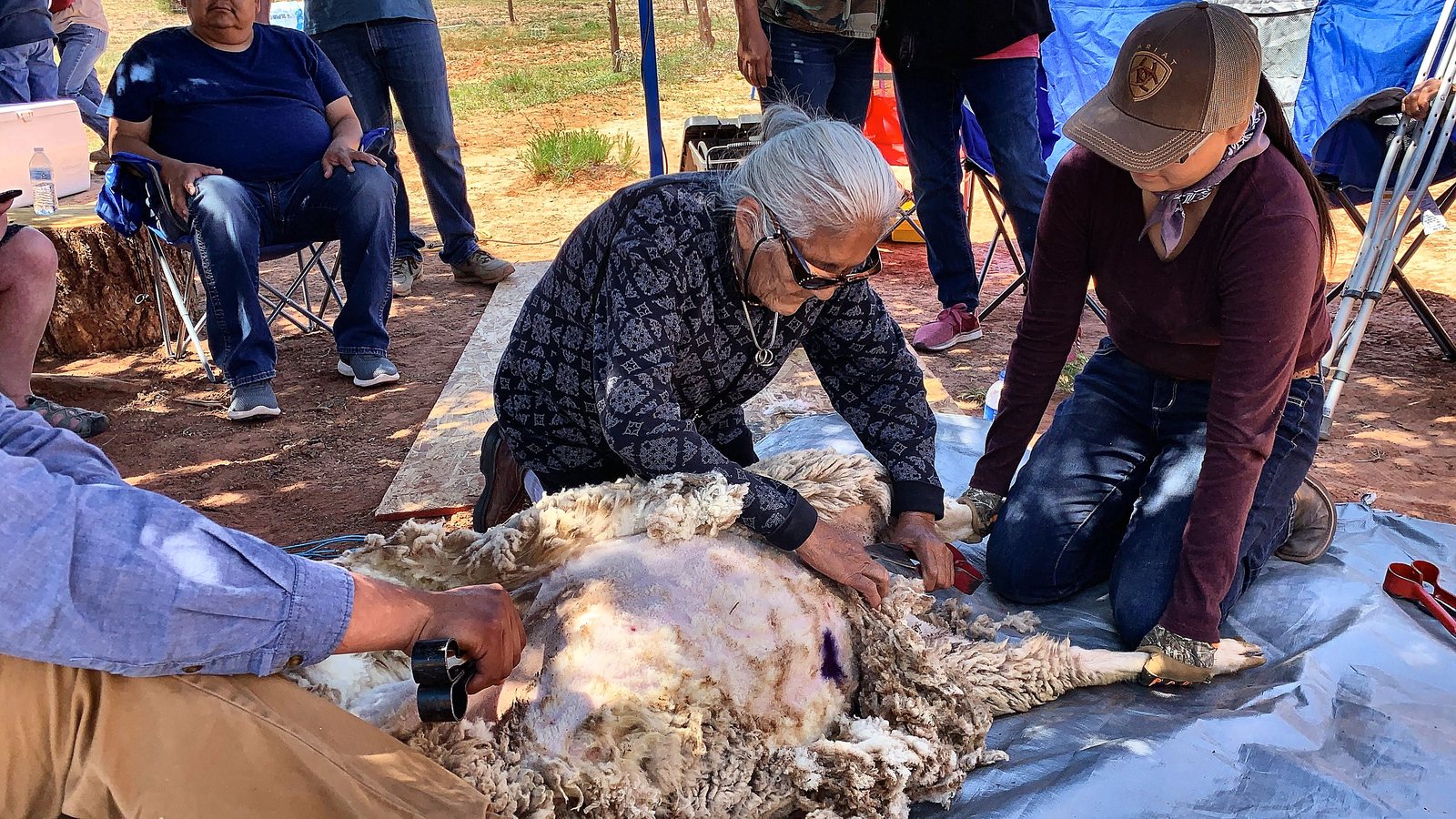
To raise any of those people you needed a certain kind of home. It had to be a home with calmness, where knowledge could be passed calmly and happily, because a child braced for the next argument is not watching how the corn goes in. And it had to be a home with sharing, so your neighbors would come and help you at shearing or at harvest, and share in the bounty when it came.
That is what I mean by decolonizing wellness. Wellness was never something a person did alone in a room to feel better. It was the condition of a home that could teach, and of a community whose roles were filled. In The Far Messengers, a radio host tells Rasa, a Lithuanian song keeper, that what she describes sounds close to what the self-improvement industry sells. She pauses a long time. “They sell the tools with the people removed.”
The breath, the state, the affirmation are all real, she says, and she uses most of them, but none of it was ever meant to be done alone. It came out of circles with elders in them, where each person carried a role for the others. Decolonizing wellness, as I mean it, is putting the people back.
What pulls a person back
So what are the things that stop you, that pull you back from becoming a far messenger? Thinking bad about others. Talking bad about them. Spreading rumors. Going looking for negative news, which has never been easier, since it waits in your pocket every morning. And under those, older ones: having an ego, and being ultra competitive for the wrong reasons, so that a neighbor’s good year registers as your loss.
One of the first steps is that people can look at themselves honestly. The second is to know where this comes from. Colonization pressed many peoples hard for a long time, and a people pressed like that eventually turns against itself, because it is the only place left to turn. That belongs to no single family or nation. It is an inheritance, handed down the way habits are handed down in a home.
Meanwhile, the ones who did the colonizing have mostly moved on. Many of them do not think they colonized anyone. They are living happily in their ten-bedroom homes and riding their boats. There is a lesson in that. We could have the same outlook. We finally have our freedoms, and we can build our own communities and our own stories.
It is easy to stay in the dark spaces, the negative spaces, and many of us do, in every part of the world. We have to move beyond that, and it can start right away, in yourself first, then your family, your home, your community. Catch the bad thought about a neighbor while it is still a thought, before it becomes a sentence at the dinner table and then a rumor.
Each catch is a small moment where the old inheritance gets passed on or gets set down. The roles are still waiting. Somewhere in every family is a child who will be the watcher, or the builder, or the one who goes out and brings something home whole. What that child needs first is not a technique. It is a home calm enough to teach in, and neighbors who come to help and stay to share the bounty.
Tony Skrelūnas is Diné (Navajo) and Lithuanian. He writes The Ancestral Watch — Stone Breath, The Amber and the Stone, The Council Fire and The Far Messengers — and the working reader, Living as a Far Messenger. He is a PhD candidate; his dissertation looks at human and organizational performance through Diné and Lithuanian ancestral knowledge and the Japanese practices he has long studied. He holds a faculty appointment at 1440 Multiversity, where teaching is the center of the work now. He runs at dawn and hikes with a corgi named Roper.
Last reviewed October 2026.