
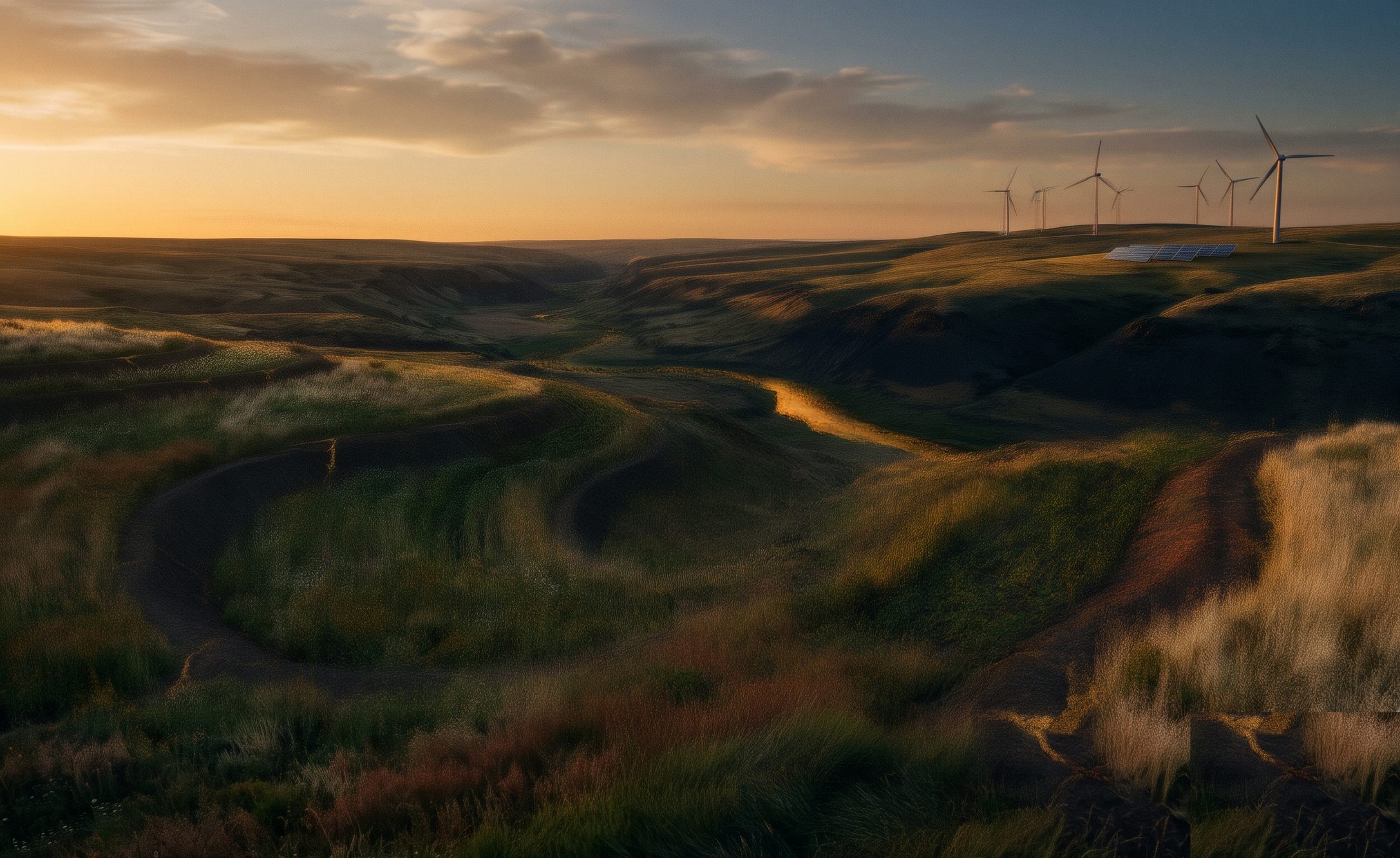
My grandfather herded sheep every day of his life, grew most of what he ate, and reached one hundred and three in what I can only call ultimate happiness. He never had money. He was never poor a day in his life.
Those two sentences sit next to each other without any tension at all, and the fact that they look like a paradox in most rooms I walk into is the thing I want to write about.
Four kinds of wealth
My people count four. There is the money, and I am not going to pretend that one does not matter, because I have spent a career helping communities get more of it and I have watched what its absence does. But there are also the relationships, and the culture, and the land. Four accounts, and a life is solvent or not across all four.
What that framework makes visible, and what a single-column ledger cannot, is the most common financial event of our era: growing one account by quietly draining the other three. A person takes the better job in the far city and the relationship account pays for it. A community leases its ground and the land account pays. A family works the hours that the money account demands and the culture account, which is the slowest to show damage, pays last and pays most.
On one column that reads as growth. On four it reads as what it is.
Wanting narrows the eye
Here is the part I did not understand until recently, and it is not a moral claim. It is closer to a physical one.
You perceive less while wanting more.
Wanting is a narrowing instrument. It has to be, because its whole function is to pick one thing out of a field and hold it there, and the cost of holding one thing in the center is that everything else goes soft at the edges. That is useful when you are tracking an animal or closing a deal. It is ruinous as a way to live, because a person in a permanent state of wanting is a person whose eye has been narrowed for years, and what falls outside a narrowed eye is most of a life.
This is why the abundance question is so often answered badly. People hear it as a question about how much they have, and go and count, and the counting does not help, because the problem was never the size of the pile. The problem is the aperture.
Two states hold most people now, and I have written about them at more length elsewhere: comfort, which is fed and half asleep, and alarm, which is braced and half awake at three in the morning. Neither one can see what is already present. One is too dull and the other is too busy scanning for the threat.
Gratitude is optics
Every old practice I know of begins with gratitude, before anything is asked for, and I used to think that was manners. Put the thanks first, then the request, the way you would with a person whose help you needed.
I no longer think it is manners. I think it is a lens change, performed deliberately, at the start, because the practice will not work through a narrowed eye and the old people knew it.
Gratitude widens the aperture. That is the entire mechanism. It is not positive thinking, which asks you to believe something rosy, and it is not a reward you have earned by having a good year. It is optics. You are adjusting what you are able to perceive before you go looking, and the adjustment is available in about four seconds, for free, on the worst morning of your life.
Test it against your own experience rather than mine. Think of a stretch when you badly wanted one specific thing. Now try to recall what else was happening that month, who was in the room, what the weather did, what your children said. For most people the record is thin, and it is thin because the eye was narrow, not because the month was empty.
The table
The way I say it now is that abundance is what you bring to the table, not what is waiting on it. You can walk in already full, before the plate.
That is not resignation and it is not an argument against wanting things. I want a great deal. I want the books read in countries I will never visit, and I want the communities I work with to own their own power instead of renting it, and I want my grandchildren to know the songs. Wanting is not the enemy. Living permanently inside it is.
My grandfather at one hundred and three had a narrow material life and an extraordinarily wide eye. He could tell you what the sky had been doing for a week. He knew which juniper had offered itself and which had not. He knew every one of those sheep, and every relative within a day's ride, and the order of a ceremony that takes longer to sing than most people now spend on anything.
He was not poor. He simply kept his accounts in four columns, and he opened his eye every morning before the day could narrow it.
Tony Skrelūnas is Diné (Navajo) and Lithuanian. He writes The Ancestral Watch — Stone Breath, The Amber and the Stone, The Council Fire and The Far Messengers — and the working reader, Living as a Far Messenger. He is a PhD candidate; his dissertation looks at human and organizational performance through Diné and Lithuanian ancestral knowledge and the Japanese practices he has long studied. He holds a faculty appointment at 1440 Multiversity, where teaching is the center of the work now. He runs at dawn and hikes with a corgi named Roper.
Last reviewed September 2026.