For most of human history, every people on earth kept a special kind of person.
The one who went out. Who crossed what could not be crossed, received another people’s world, and carried it home whole.
Sand, sea, stone, song. The far messenger is why any of us knows anything.
The first teaching
Before the crossings, before the breath count, before any of the seven disciplines at the back of the book, there is one teaching that comes first. Everything else is built on it, and almost nobody wants to hear it.
Do not wish.
Wishing is wanting from a position of lack. It feels like hope and it is not hope. It is a statement, made over and over by your own body, that what you have is insufficient and what you need is elsewhere — and a body that believes that cannot cross anything.
The far messenger governs his own thoughts. Not suppresses them — governs them. He notices what the mind has started saying and he decides whether it stays. That is a trainable skill and it is the first one taught, because a messenger alone on hard ground with an ungoverned mind is already lost, whatever his legs can do.
And he does not carry envy. Envy is the most expensive thing a person can put in a pack. It looks at another man’s water and forgets its own. In the old sanction it was not a moral failing so much as a practical one: the envious messenger arrives with a divided mind, and a divided mind reads the ground wrong.
Energy frequency
What replaces all of it is what I have come to call the abundance frequency — and I mean something specific by it, not a mood and not optimism.
It is the state a person is broadcasting before they speak. Everyone can read it and nobody can name it. Walk into a room carrying scarcity and the room knows within seconds, and it closes. Walk in with enough — genuinely, not performed — and the room opens, and people tell you things they had not planned to tell you.
The mechanism is not mystical. Calm widens perception. Wanting narrows it. A person who needs the room never sees it. That is why the discipline sits first: not because wanting is shameful, but because wanting makes you blind at exactly the moment you need to see.
The test is not the good day
Anyone can hold an abundance frequency on a mild afternoon with the work going well. That is not the practice. The practice is holding it where it costs something:
- On the hottest dayThe one where the water is short and the shade is gone and the body has started making its case for panic. Sand. This is where you find out whether you actually stored anything.
- In a major sea stormWhere you cannot see, cannot stop, and cannot be certain of the direction. The old navigators did not out-argue the storm. They kept the frequency and read what could still be read.
- Hiking up a mountainThe slow grinding one, where nothing dramatic is happening and the whole difficulty is that it does not end. Stone. Most people fail this one, not the storm.
Three crossings, one discipline. And it is the same discipline in a hard meeting, a bad diagnosis, or a year when the money does not come.
My great-grandmother did not teach me this as philosophy. She taught it standing at the door before sunrise, naming what was real and giving thanks for it, on days when there was very little to give thanks for. That is not gratitude as a nicety. That is calibration. She was setting the frequency for the day before anything else got to set it for her.
Five crossings
They were not all the same crossing, and the training was not all the same training. Three of them are in the list above, because the first teaching is tested on the same ground the messengers crossed.
- SandThe desert. Panic kills you and calm carries you, and there is no third option. Everything I teach about the nervous system starts here, because this is where the stakes are unambiguous.
- SeaThe swell read through the spine. The stars held in mind for weeks with no instrument but attention. A navigator lay in the hull of a canoe at night and felt the shape of an island a hundred miles off in the way the water moved under the wood.
- StoneAltitude. The slow heart at the pass. A body that does not spend what it cannot replace.
- SongThe country itself, in order, sung. The map was the song. You did not carry a chart; you carried the sequence, and the sequence was the land.
- The obliviousLiving among people who cannot yet see it. This is the crossing we are all making now, and it is the hardest of the five because nothing about it looks like a desert. The Sámi herder is on this one — taught properly, entirely correct, and standing on ice.
What we actually lost
Then we built a world that could move the message without the messenger.
It was a miracle. I want to be careful here, because it genuinely was. But we kept the cargo and lost the carry — the trained body, the settled listening, the arrival, the one night at the fire.
Information without a carrier does not land. That is why we know everything and hear nothing.
Two trances hold people now. Comfort — the fed, half asleep. And alarm — the braced, half awake at three in the morning. Neither one made anybody bad. They made people unable.
It was never a failure of information. It was a failure of state.
Why the old discipline still works
The body was the vessel. A messenger arrived with one night to pour in everything he had crossed for — no second chance, no recording, no follow-up email. So they did not train the message. They trained state itself. Slow heart. Open eyes. Settled listening.
And the mechanisms turn out to be real, which is the part I spend my doctoral hours on:
- The vagal brake. An extended exhale halts panic. State is trainable, and it trains in the ordinary days, not the emergency.
- Sensory gating. Calm widens perception. Wanting narrows it. A person who needs the room never sees it.
- The internal map. Allocentric memory — the kind no blackout deletes, because it is not stored the way a phone stores it.
The nervous system was their instrument. It is the oldest operating system on earth, and it is still in you, unmodified, waiting.
This weekend, in the redwoods
I am teaching this at 1440 Multiversity this weekend — Friday and Saturday both, with a good room, and our cooks, which matters more than people expect. You cannot teach a nervous system anything on bad food.
I hold an adjunct faculty appointment there, and the course is called Ancestral Practice and Human Performance. Six sessions, in an order, each the ground the next stands on. The breath count comes first because everything else is downstream of state.
There is a reader that goes with it, made for this first fire — Living as a Far Messenger. I have written about it below.
Seventy-five acres of redwoods, purpose-built for learning. It is one of the most respected adult-education campuses in the country, and what it teaches me is reach — how these disciplines travel to people with real influence over how the next twenty years go.
What the room takes home
There is a book that goes with the weekend, and it exists because of it.
Living as a Far Messenger is the working reader — seventy illustrated pages, made in commemoration of this first retreat. Two books bound as one. The Telling is the teaching, readable in a sitting: the messenger at the dry well, the Pacific navigator who carried no map because he was the map, the Stone Breath in full, the seven disciplines, the abundance code, and the hardest chapter, on the fire that turns inward. The Crossing is eleven write-in worksheets meant to be dated and returned to at solstices and birthdays — beginning with The Ones Who Carried You, where you name the far messenger in your own family line. Most people find one within three generations.
It ends with The Pact: the one sentence you want to survive you, signed and dated.
 Living as a Far Messenger
The Oldest Discipline of Mind, Body, and Soul. Read it in a sitting. Write in it for a year.
Living as a Far Messenger
The Oldest Discipline of Mind, Body, and Soul. Read it in a sitting. Write in it for a year.
Everyone who sat at that first fire holds this edition. Everyone who reads it afterwards carries the book that began there. That is not a marketing frame — it is simply what happened, and I would rather say it plainly than dress it up.
The book
The Far Messengers is book four of The Ancestral Watch, and it is the one where the idea stops being background and becomes the subject. A near future where the ice is gone. A World Congress on Human Continuity. Two featured speakers — a song keeper from the Baltic and a navigator from the Pacific — carrying the oldest human knowledge into a room that has run out of newer answers.
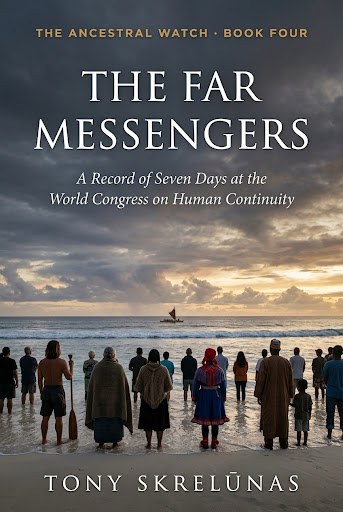
Seven days. A record of them. And the question underneath every session: who is still able to carry anything, and did we raise them.
Stone Breath is the practice, carried as story. The Amber and the Stone is the crossing. The Council Fire is what gets built afterwards. The Far Messengers is the role itself.
The seven disciplines
At the back of The Far Messengers there is an appendix, and it is carried into the reader as well — it is the part I expect people to actually use. Nothing in it is new. Every practice was spoken by somebody at the Congress or carried into it across a desert or an ocean. It is only a way to find them again when you need them, set down in the order a person grows into them.
- The calm is not made out thereThere is no calm available at the dry well, at the sixtieth kilometre, at the phone call in the night. You can only spend what you already stored, on days when nothing was wrong, in a practice that felt pointless at the time. That is exactly when it was working.
- The one who does not startleWhen the old navigators chose the child who would be trained for a decade to carry a people across open ocean, they did not choose the fastest or the strongest. They watched to see which child, when something went wrong, turned toward it instead of away — and turned slowly. Every small alarm you meet without startling teaches your body the answer to the large one.
- The stone and the breathA small river-worn stone in the hand, its coolness imagined resting on the tongue — and the mouth waters, and a dry-mouthed panic eases. It is not magic. It is a way of reaching the nervous system through the body when the mind is too frightened to help. The stone goes in the hand; the image goes on the tongue. That is the whole practice, and it is enough.
- Read the weather, not the insultThe ocean does not care that you are tired — and he meant it kindly. It is not a punishment and not a verdict. It is weather. That is not despair, it is the beginning of power, because weather can be read, and what can be read can be crossed.
- Sleep, movement, food, people, and a body not runningA person can have a perfect protocol and a nervous system in permanent alarm, and they will fall apart on schedule, confused, having done everything right. That is the entire list. The rest is decoration.
- Carry it homeThe messenger does not only cross. They return, and rejoin what they learned to the circle of their own people. The song sung with others. The practice shared. Going out and coming home are one motion, and the crossing is only half the work.
- Teach one, feed the keepers, accept the unfinishedKeep the practice. Teach one person all the way through — completely, not many people partway. Support the others keeping the same fire. And make peace with dying in the middle of the job. The sad part is only in thinking you were supposed to finish.
Those are the disciplines of the ones who crossed. They were carried to you across more ground than you can imagine, by people who paid more for them than you will ever know.
What I am building
Here is the part I have not written down publicly before.
I am building a Far Messenger Institute — a sanctuary for global leadership — and the shape of it is not a campus. It is a season, carried across several field stations, because no one place can teach all five crossings.
These are not venues I rent. Each is world-class in its own field, and each teaches something the others cannot:
- Prescott CollegeThe academic anchor. Sixty years of experiential, community-rooted education, and the doctoral spine. It already runs two global centers on exactly this model — Kino Bay since 1991, Dopoi since 2004. Teaches rigor, and the standing that makes the rest count.
- The Field Station — Kindness Ranch, on the Agua FriaHome ground. The only running camp on the eighty-mile Black Canyon Trail, on ground carrying two thousand years of habitation and close to a thousand hand-built stone terraces — the working record of a people who read a collapse and engineered their way through it. Horses too, which are honest mirrors: an animal reads your state before you have admitted it to yourself. Teaches regenerative practice on ground that already proved it.
- 1440 MultiversitySeventy-five acres of redwoods, purpose-built for learning, with a national audience of executives and practitioners already coming for depth. Teaches reach.
- Rancho La PuertaThree thousand acres in Baja, six decades of organic farming, a global reputation in regenerative agriculture. Its guests arrive already willing to be changed, which is half the work. Teaches the international room, and food as a living system.
- The Dopoi Center — Maasailand, KenyaThe rarest of them: a place where the container is still intact. Ceremony, age-group mentorship, an education that begins before birth, and a restorative justice system the Kenyan state now recognizes. Founded by Maasai leadership, run by Maasai teachers. Teaches what the modern world deleted, still running.
A word about how settled any of this is, because the list above reads more finished than it is. Prescott, the Field Station, 1440 and Rancho are real — I teach at two of them already, and next year I am on the faculty for Wisdom Week at Rancho La Puerta.
Dopoi is the Kenya station, and Kenya is a possibly. A term there is the piece I want most and the piece furthest from done — a great deal has to happen first, and I am not going to describe it as more settled than it is. The season is a working brief. Some of it is signed and some of it is a conversation, and saying which is which is the only way any of it stays worth reading.
There is one more thread, and it is the one I am most curious about. In August I sat down for an hour under the papel picado at Rancho with Tom Blue Wolf, a Muskogee Creek elder who has run EarthKeepers since 1970 and has never owned a phone. He teaches young people in the forest — what is food, what is not food, what is medicine, and then the song of the food. He is in his eighties and still crossing.
What he and I do together is not defined yet. International work, perhaps a book, perhaps a station. We are in no hurry to define it. But a man who was handed the far messenger idea by his grandfather as fact, meeting a man who wrote it as fiction, is not a coincidence I intend to waste. I wrote that hour down here.
But read the calendar as one crossing and you can see the shape: home ground in the cold months, when the desert teaches rather than punishes. California and Baja as the season turns. East Africa through the spring. The same method, carried across several places and three cultures inside a single season — which is how a personal practice becomes a body of knowledge.
Why me, and why now
I was raised by my great-grandparents on Black Mesa. No electricity. Four hundred sheep. A ceremony every dawn.
My great-grandmother Masan held that dawn practice every morning of her life without exception, and she did not call it a practice. She called it survival. It was both. I learned to read by kerosene lamp, and by that same lamp I read the philosophy of Japan, which I have studied ever since, and whose disciplines I have taken into my own practice. My Lithuanian grandfather drove twenty-five miles of dirt road to sit in that hogan and hand on a tradition that had survived Soviet suppression.
Three traditions. Diné and Lithuanian by blood. Japanese by long study. And one lesson underneath all three: the tools were never lost. They were set down.
I did not understand for a long time that I had been trained for a role that had a name. I spent a career in governance and economic development, restructuring how a nation makes decisions, and the whole time the thing I was actually doing was carrying something from one world into another and trying to arrive with it whole.
We are in a crossing, and nobody is being raised for it.
That is the argument, and it is why the institute matters more to me than any single room I will ever teach. Two hundred years from now somebody will be sitting in the dark needing exactly what we are holding right now. Their stories come from us, or from nowhere.
We are the far messengers now.
Your job is not to finish the crossing. It is to carry your stretch of it well, and hand it off warm.