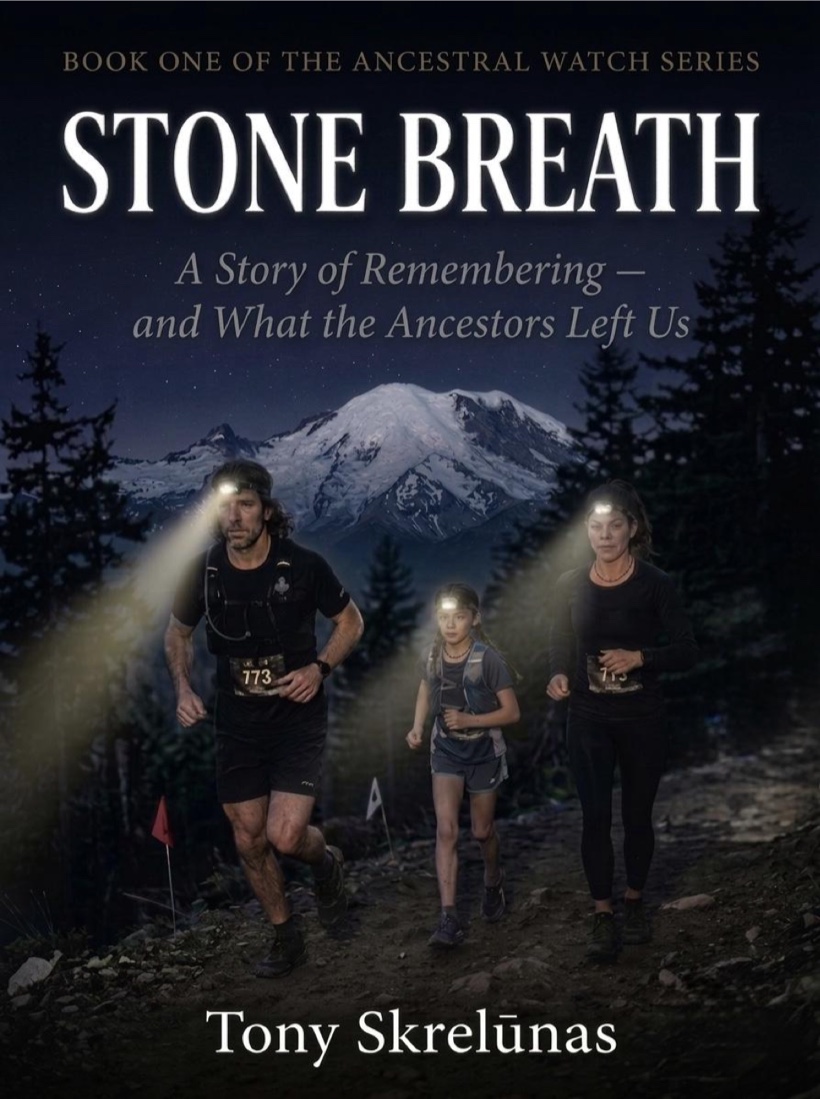
This week Stone Breath entered worldwide distribution. A reader in Berlin can find it at Thalia. A reader in Sydney can order it through Angus & Robertson, the oldest bookseller in Australia. It is on Apple Books and Kobo in every territory they serve, it is entering the catalogs that public libraries draw from, and over the coming days it finishes arriving at the remaining stores.
One link now reaches all of it, and it will route you to whichever store is yours:
The book found its first readers this summer through a single page on my own site. Now the doors are everywhere.
I want to tell you where this book came from.
Where it came from
I was raised in a hogan on Big Mountain, learning by lamplight after the chores were done. What I learned at sheep camp was not called wellness, and nobody would have thought to call it a practice. It was how you got the day done: how you breathed when the work was long, how you started a morning so the morning did not start you, how you sat at a table with people so that everyone left it stronger.
The old ones carried all of it in stories. Nobody handed you instructions. They told you what happened to someone, and the teaching was inside the telling, and years later, standing in some difficulty they never saw, you would find the story waiting there ahead of you.
We had no electricity on that mountain and no television, so my TV was books and my imagination, which turned out to be the right training for the storyteller I would become. By kerosene lamplight I studied Japan and Switzerland and imagined their worlds, out of books that came up the mountain by mail.
The one who raised me, above all, was my great-grandmother, Masan. She told me about her father, Keh Yazh, a runner they called Sore Foot, who ran with a small stone to keep his breath steady and won races no one thought he could win. He passed the knowledge of the stone to Masan. Masan passed it to me. The Masan in the novel carries her name.
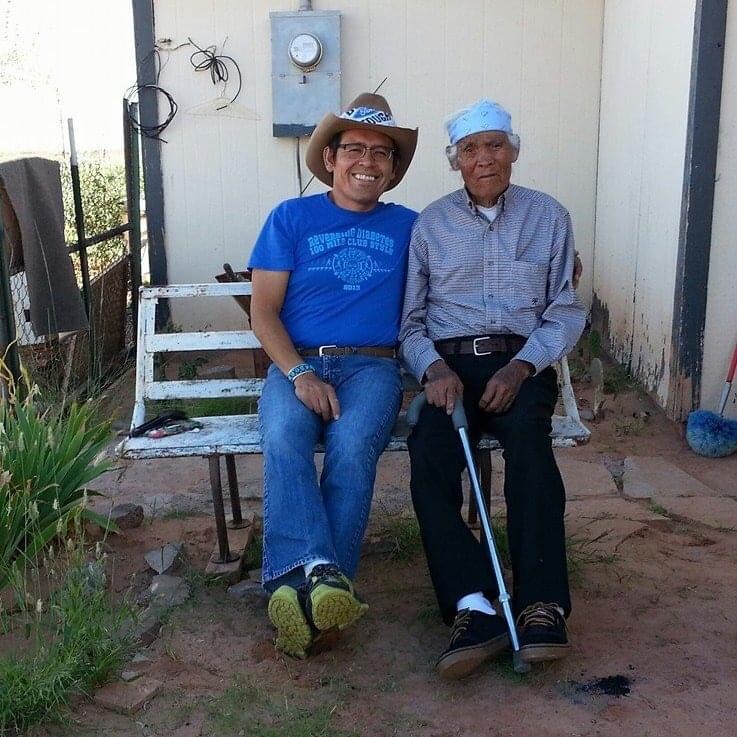
Before there was an internet, there was a body that could cross a desert with a library inside it. Every people on earth once raised them: the calm ones, trained from childhood to carry what mattered across ground that would kill an ordinary person, and to arrive with it whole. They were never couriers. They held the most honored role a people could raise.
We are the first civilization without them, and most of us are on alarm before the day starts.
Stone Breath began in the space between those two facts.
What it is
It is a novel. Tonas Yazzie has everything the world measures. When his grandfather dies, he carries a book of old songs to a Lithuanian village he has never seen. The village in the book is drawn from a real one, Antalieptė, and the songs are the dainos, the songs my Lithuanian family carried across an ocean the way other families carried silver.
What Tonas finds there is Austėja: a chef trained in the kitchens of Paris, a coach who conditions elite athletes, a runner who owns every dawn, a woman who stayed when everyone left and does not need him.
Two people successful by every measure the world keeps, except the oldest measure there is. That of a far messenger: the one who can carry what matters across hard ground, stay calm the whole way, and arrive with it whole.
Around that story the book carries its real cargo. Twenty-two tools, one to a chapter, from three peoples who never met and arrived at the same answers: Diné, Lithuanian, Japanese. The stone breath. The morning alignment. The shared table. The museum of proof. They cost nothing. They have been tested for a thousand years. They are still here, and the elders who carried them this far are still here, and the book is my accounting of what they handed me.
People ask why I wrote it as fiction. The answer is in the sheep camp. The teachings were never delivered as lectures, because a lecture asks the mind for agreement and a story asks the whole person to walk somewhere. You learn the stone breath in this book the way I learned it, by watching someone you have come to love use it on a night when everything is at stake. That is the old delivery system. It still works.
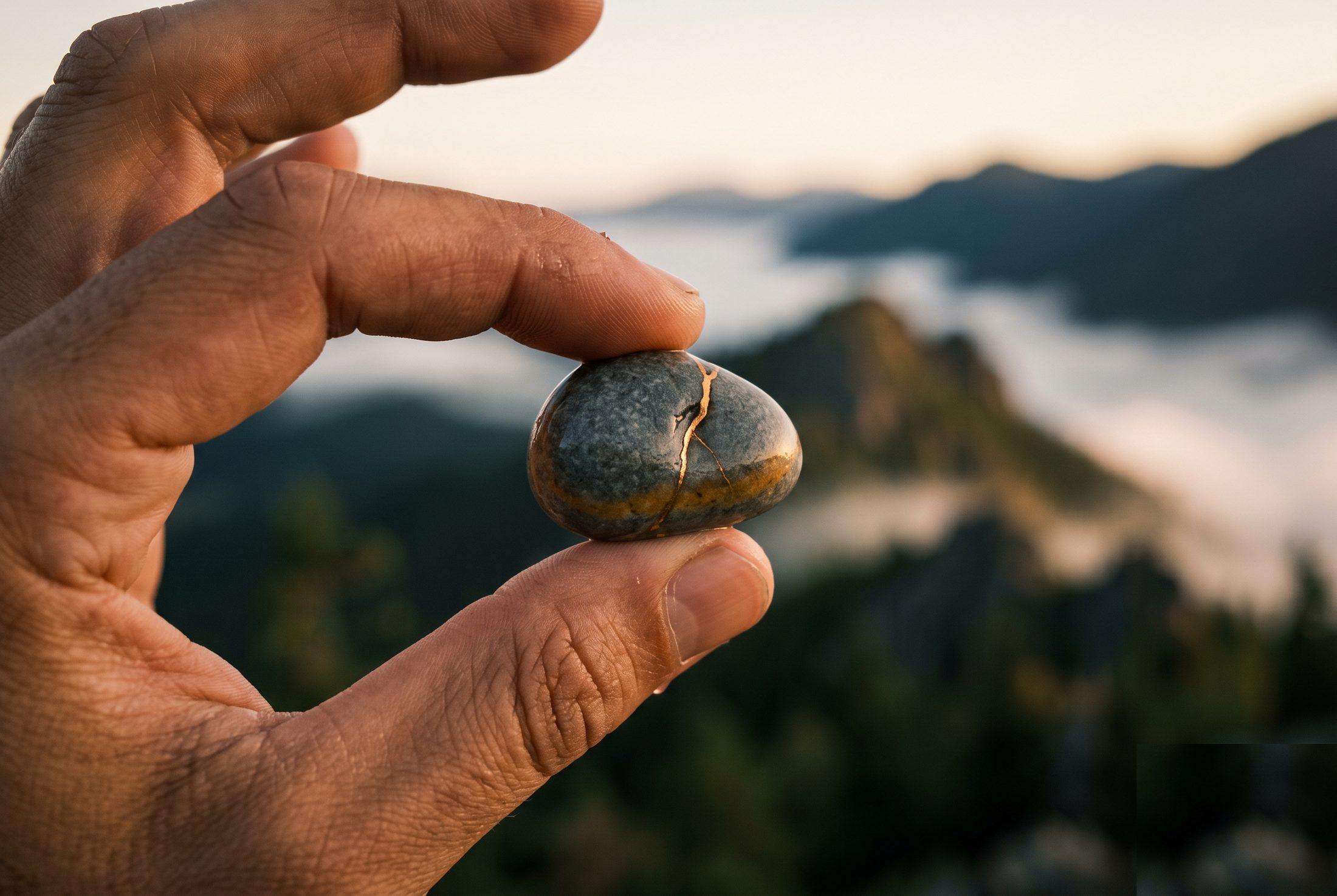
The stone breath itself is the first thing in the book. It is printed whole at the front, before the story begins, and it closes with a line written for ordinary days: “Your ancestors crossed deserts on it. You can cross a Tuesday.” In the novel it comes down the same family line to Tonas, who keeps a small creek stone in his pocket and presses one into a frightened stranger’s palm before the first chapter is out.
The Stone Breath
A stone held in the hand and a four-part breath, for when the world gets loud: before a meeting, after a difficult conversation, during a moment of doubt. The stone never goes in your mouth. It stays in your hand.
- Find a small, smooth stone, the kind a river leaves on its banks, and keep it in your pocket.
- When the world gets loud, hold it lightly in your palm and feel how that simple act softens your jaw and relaxes your face.
- Breathe in, light and easy, through your mouth and nose for four counts.
- Hold for four. Breathe out, slow, for six. Hold for four.
- Repeat five times. That is one minute. Return the stone to your pocket.
From Stone Breath, chapter “The Book,” and the full practice printed at the front of the book
The canyon and the call
The novel opens in red rock country, not in Lithuania. Tonas lives on a dirt road close to Oak Creek in Sedona, a couple of hours from the reservation and from his grandmother Ada, and once a year he brings a circle of leaders there for three days: a woman who runs a fund in London, a founder from São Paulo, a man from a Tokyo trading house, a software chief out of Lagos, and, sitting among them as equals, a schoolteacher who emptied a modest savings account to be there and a young man who paid nothing at all.
He takes them down into the canyon before dawn, single file behind his headlamp, because you go down into the dark before you are allowed anywhere near the light. At the bottom, in the cool blue shadow, he has them look up at walls carved by wind and water and time. He did not bring them down to fix them, he says; nothing is broken. They came to read the walls. “What looks like it happened to this canyon,” he tells them, “was happening for it.”
And he is teaching it while carrying a block of his own. Somewhere along the way his dawn run became a workout and the stone breath became a technique, and he knew the tools “the way you know the words of a song you no longer feel.” That night by the fire his phone lights up with a country code he rarely sees. His Lithuanian grandfather has died in his eighties, at the far end of a long and good life, and the old songs are his to carry now.
So he goes. He rides a bus out of Vilnius through pine and birch with his grandfather’s small, worn book of dainos on his lap, wrapped in a storm-pattern blanket Ada wove years ago, black and white and gray. The village at the end of the road is Antalieptė: a white church spire, wooden houses with carved trim, the Šventoji River curving around the town, and a heritage center in an old stone mill whose water wheel no longer turns. He stands at the shelter a moment before he moves, reading the land the way Masan taught him, and the land reads back “old, patient, full of things not said aloud.” The mesa, he thinks, says the same thing in a different language.
Austėja, Ona, and Ugnė
Austėja sees him first, from the heritage center window, and decides he is tired, not in the body but in the soul. She is thirty and has spent all but four of those years in the village. She runs the ridge before dawn every morning. She has run five kilometers in under seventeen minutes, with top-ten finishes in road races across Europe; she consults on footwork and conditioning for the Lithuanian Olympic basketball team; she trained three years in Kyoto and cooked in Michelin-starred kitchens after culinary school in Paris.
Then she came home, and she stayed. She keeps the heritage center in the old mill and records the songs, and the amber at her throat, rough and unpolished, was a gift from her grandmother Ona the morning she came home from Vilnius. The book says it plainly before the story starts: “She doesn’t need him. She chooses him. That’s the difference.”
What the book cares about most is why she stayed. Her mother waited years for a husband who never came home and gave her whole self to that one person, and when there was no one left to wait for, she had nothing else to stand on, though Ona had tried to teach her the songs, the forest walks, the breathing. Austėja decided at twelve to stay close to the things that could not leave. Driving home in the dark with her daughter asleep in the back seat, she tells Tonas, “I stayed because the things that keep me alive are here. A person can leave. A song stays.”
That is where healing across generations so often begins: one person deciding to carry the tools forward, so the next one does not have to stand alone.
Ona is seventy-four and still walks to the forest every morning. She has kept a wooden box of letters from Tonas’s grandfather, tied in bundles by decade, fifty years of them, written from a kitchen in Oregon, and he wrote about the weather the whole time; she has never been to Oregon and could tell you what November does there. In a clearing in the forest she sings Tonas a daina, the oldest kind of song they have, about a boy who crossed the water and never returned. The boy in the song is his grandfather.
The Daina Practice
A song carried in the body rather than on a recording, for the times you are afraid, alone, or holding something you do not want to lose. The book’s whole case for it fits in two lines: “The song does not survive in a recording. It survives in a throat.”
- Find a song that carries meaning for you. It does not have to be ancient or in another language. It just has to hold something true.
- Learn it. Not perfectly, just enough to carry it.
- Sing it for yourself. Sing it to the trees, in the car, when you are afraid.
- Teach it to one other person.
From Stone Breath, chapter “The Song”
Tonas does not bury the book. Austėja walks him for hours through forest with no path to an oak his great-grandfather planted when his grandfather was born, three meters around, scarred by lightning and still alive, and that night he understands that the songs belong in throats, not in the ground. In the cold first light he hands the book to Austėja to take to Ona, so Ona can teach the songs to Ugnė. Among the roots he sets a piece of turquoise from the land where Masan raised him, and Austėja sets a piece of Baltic amber beside it.
When the roof of the heritage center comes down one night, Austėja calls a talka, the old Lithuanian work gathering where nobody is paid and everybody eats, and forty-seven people come from the village and half a dozen smaller ones, with tools and food and children. Before anyone picks up a hammer they stand in a circle around the mill and breathe together. On the third day the old women sing, Tonas teaches the yard the Skip Dance from home, and when Austėja chooses him for a dance and he asks what he owes her, she names her price: “Stay.”
Ugnė is eleven when he meets her, with dark hair and serious eyes, and the first time Tonas kneels to say hello she stares at him and runs back into the house. Austėja calls her shy. “She’s careful,” Tonas says. “There’s a difference.” Ugnė draws oak trees. She keeps score at the evening basketball games on the cracked village court with the rigor of a referee, calls traveling on Tonas in front of everyone, and her statistics grow more elaborate every week.
She is Lithuanian and Japanese both. Her father, Kenji, a champion swimmer who wrote songs on the guitar, is gone, and one morning on the porch she asks her mother to tell her how he lived. Austėja does, and tells her he lives on in her lungs, her stubbornness, the way she draws oak trees without being taught. “That’s not loss,” she says. “That’s inheritance.”
When Ugnė turns twelve, the elders around her sit down to design her passage together: Ona at the head of the table, Ada on a speakerphone from Arizona, a tea teacher named Michiko on a tablet from Kyoto. Ugnė, as Ada puts it, carries three bloodlines into a future none of them can see. They name seven parts any family could use: a physical challenge, a circle of witnesses, a purification, a deliberate moment of joy, a walk that names one gratitude at every footfall, food made by hand, and a giveaway.
So she runs at dawn, at noon and at sunset with the village running behind her, grinds corn with a stone for a honey cake that bakes all night in the coals, and in the morning gives every piece away without eating a bite herself. Then she hands each person a sunflower seed: “Plant this. When it blooms, remember that I imagined you here. And imagine me somewhere, doing something good.” That evening she leaves the second eye of her daruma doll unpainted. “A future isn’t finished. It’s imagined. Then built. Then imagined again.” Readers of The Council Fire meet her again there, grown, keeping the old songs and teaching a new circle of girls the hard third voice.
By lamplight, toward Japan
The Japanese thread in the book begins where my own began, with a boy, a kerosene lamp, and books that came a long way to find him. Tonas sends away for his with money saved from herding and carries them home from the trading post like something alive: Miyamoto Musashi’s The Book of Five Rings, and Bushidō: The Soul of Japan. In one of them he finds a way of breathing from the center, low in the belly, below the navel, and he tries it that night by the lamp.
It is the first breathing practice he ever learns on purpose, and he does not know yet that Masan has been teaching him the same thing at dawn, in a different language, “with a stone instead of a sword.” Letters cross the water too. On a boy’s dare he writes to a village under the Swiss Alps, and a mountain boy named Urs writes back, weeks each way, year after year, and walks beside him for the rest of his life.
At twenty-two Tonas goes to Japan on a scholarship, and to make rent he works for an old gardener who tends temple gardens and needs a strong back for the heavy stone. He grew up where there was no garden store within a hundred miles. “He had memorized gardens he had never seen, in a hogan where the only water was hauled in by the barrel.” Now he is on his knees in the real thing, being told over and over by a man with little English to wait.
The first winter nearly breaks him, and not because of the work. Anyone who has left home for school will know the feeling. There is no long red line of desert on the horizon, no mountain standing up against the sky to tell him where he is. Then, raking gravel one gray afternoon, he remembers the old man Hastiin pointing back at the mountain on a walk when he was a boy and telling him it was never really behind him: “You have been carrying it since the day you were born.” From then on, every morning, he closes his eyes and calls up Dook’o’oosłííd and the high country of home, and stands inside them for one quiet minute.
The Mountain Within
A ritual for leaving sacred ground and still feeling held, for anyone who must leave a mountain, a mesa, a homeland, and carry it with them.
- Before you leave, go to your place one last time. Walk it. Touch it. Be silent with it.
- Find a small stone from that place, one that has already come loose on its own, and leave something in return: a few drops of water, a breath of gratitude.
- Make the promise, aloud or silently: “I carry you with me. Not as weight—as witness.”
- In your new home, give the stone a small place of its own: a windowsill, a shelf, a corner.
- Each morning, touch the stone, close your eyes, breathe three times, and see the place in your mind. Let it hold you. Then go.
From Stone Breath, chapters “The Book” and “The Japanese Thread”
Years later he goes back to Kyoto with Austėja and Ugnė. He gives a lecture without reaching for his notes and tells the hall about ichigo ichie, one lifetime, one meeting, the discipline of knowing that this moment will never come again. In the temple garden Ugnė crouches by the pond watching the koi, and Michiko stops before a broken stone lantern with a small fern rooted in the crack. “In Japan,” she says, “we do not hide the cracks. We fill them with gold.”
Red rock and Big Mountain
Later in the book Tonas brings Austėja and Ugnė home to Arizona, north from Phoenix and up, until the brown flats give way to green and then, all at once, to red rock that looks lit from the inside. Austėja has crossed oceans for work, never for this, and under the wonder runs a quieter fear that she might not belong in his world the way he so plainly belongs in it. He takes her hand in the car and has her say the centering, holding her thumb: “I am safe. I am calm. My mind is quiet.”
His house sits low among the cottonwoods on a dirt road close enough to Oak Creek that you can hear the water from the porch, with a kayak turned over on the bank and firewood stacked under the eave. His uncle Kee is waiting, takes Austėja’s hand in both of his, and tells her she is family now. Within ten minutes Ugnė is down at the water with her shoes off, shrieking at the cold.
The next morning Tonas kneels at the creek, drinks from his cupped hands, sprinkles a few drops back, and asks three questions he says will travel to any ground that holds you: Am I taking only what is given? Am I leaving enough for the next season? Am I offering something in return? Ugnė promises to remember the place and to tell her children about it. Then he gives them the country the way it was given to him: West Fork, where the trail crosses and re-crosses the creek a dozen times, and a night in Sycamore Canyon with stories by the fire under stars poured thick across the black.
Then they make the longer drive, up out of the red rock onto the high desert and up to Big Mountain, to the sheep camp where Masan raised him and where Ada keeps the old ways. Ada looks Austėja over. “She’s almost as tall as you,” she says, and when Tonas explains that Austėja trains a basketball team, Ada answers only “Hm,” which seems to settle several questions at once. Before dawn she sends them running east toward the mesa, and tells them not to stop until they see the sun.
At the top the sun clears the horizon and the red rock runs out to forever. “This is where Masan ran,” Tonas tells her, breathing hard. “Every morning of her life, before the light.” Austėja closes her eyes and says she can feel the land remembering. It is the same country where Keh Yazh trained in the late 1800s, running east every morning, then working a large flock and fields of corn, and once riding for days with his family to a twenty-mile race against men who had traveled for weeks to be there.
It is from Ada’s porch that evening that Tonas takes a call from Lukas, a quiet teenager back in the village who had sat in the back row of the village meeting without a word because, he said, nobody wanted to hear what he thought. They have been running together at four-thirty in the morning. Lukas has just raised his hand in class, voice shaking, and answered a question. “Now start your Museum of Proof,” Tonas tells him: a notebook where you write down every time you wanted to quit and did not.
Months later Lukas flies six thousand miles to run a half marathon with Tonas in the high desert, the stone in one pocket and the notebook in the other. “It’s not a pep talk,” Tonas tells him before the start. “It’s evidence.” At mile eleven the wall hits the boy first. Tonas tells him to open the notebook anywhere and read one line out loud, and in a voice with almost nothing left in it, Lukas reads his own handwriting: “Ran ten miles. First time. Cried at eight. Kept going.” He finishes, and Tonas crosses the line half a step behind him and never mentions it.
The Museum of Proof
A written record of every hard thing you have already come through, kept for the moment doubt arrives: before a hard meeting, after a setback, at three in the morning. The conclusion is always the same. You have done hard things before. You can do this one.
- Create a museum: a notebook, a digital folder, a shoebox.
- Collect proof. Every time you wanted to quit and didn’t, write it down.
- Date it. Be specific.
- Keep it close.
- When the doubt comes, open it anywhere and read one line out loud.
From Stone Breath, chapters “Where Two Lands Meet” and “The Stillness Before Storm”
The headlamp in the dark
The last race in the book begins as a dare over coffee. Austėja slides a flyer across the table: the Swiss Alps 100, a hundred miles through the Oberwallis, ten thousand meters of climbing, a cutoff of forty-eight hours, and a photograph of runners crossing a high pass at night, “headlamps strung like a constellation against the snow.” “That’s not a race,” Tonas says. “That’s an ordeal.” “Same thing.” Austėja smiles into her coffee. “Different name.” Ugnė, who will be twelve, wants to crew.
The rules allow pacers from mile 80, one at a time, then two from mile 90, and from mile 95 anyone at all. The race director tells the runners the image the volunteers see most often near the end: a runner barely standing at mile 95, friends on either side, one in front with a headlamp and one behind, walking them in. That image, the director says, is what this race is. Tonas underlines the sentence in his race packet. “He did not know yet that the page was a prophecy.”
The night before, he finds the last page of the crew’s spreadsheet, the one Austėja made and showed no one. It is titled Sacred Objects: the turquoise cord Masan gave him when he was seven, the silver earrings Ada gave him when he left for college, a buckskin pouch of corn pollen for the dawn, his grandfather’s stopwatch, the stone. “You are carrying these things across a hundred miles of mountain so that the people who carried them before you can see them again.”
He starts at five in the morning, facing east, and runs on through the day and into the night. Around midnight, on a ridge at mile 70, he remembers sitting on the dirt floor of the hogan at seven while Masan told him about the people whose work was to carry, the word, the medicine, the news that could not wait, across country that would kill an ordinary person. “Anyone can leave with it,” she told him. “Arriving with it is the work.” At mile 77 he stops for a stranger, one of the best mountain runners alive, crying on a rock in the dark, and gives her a smooth stone from the trail and the breath to go with it. She finishes too.
At mile 80 Austėja comes running up out of the dark to pace him, the amber glowing at her throat. “You look terrible,” she says. “I feel terrible.” At mile 90 Lukas falls in on his left. “You gave me a stone,” he says. “I’m returning the favor.” And at mile 95, in the gray before dawn, a small figure steps onto the trail from a switchback below, headlamp bobbing, braids, twelve years old, holding a piece of frybread wrapped in foil. It is Ugnė, and she is not supposed to be there. “I waited until they looked at someone else,” she tells him. “Then I went.” She hands him the frybread. “Mama said you would need home.”
He starts to laugh and it comes out as a sob. Then, without a word and without any of them having planned it, they fall into a shape around him: Rytis in front, the old man who jogged up the mountain on his last good knees, Lukas on his left, Ugnė on his right, Austėja behind, and after them the volunteers who had come from Lithuania and Japan, bakers and teachers and a tea master and a grandmother, “a river of light flowing down the mountain.” The book puts it in two short lines: “The headlamps held the circle. They walked him home.”
Seen from the valley, the book says, that ring of lights could be mistaken for something holy, the beings so many cultures describe who walk beside you in the hardest hour. But it is only people. “They weren’t angels. They were witnesses.”
Not one perfect being descending from the clouds. But many imperfect beings, rising together, carrying their own small lights, walking each other home.
That is the answer the book gives to a question Masan once asked him: who will carry the fire when you cannot? The fire, the book says, was never meant to be carried alone.
The Headlamp Circle
The most ancient technology humans have for surviving the hardest hours: the people who would walk beside you at mile 95. The circle is built by being someone else’s mile 95 before it is built around you.
- Name your circle. Write down five people who would show up for you at mile 95 of the hardest thing you ever do. If you cannot name five, start by showing up for others first.
- Show up. When someone you love is in the dark hour, do not ask if they need anything. Just go. Carry water. Carry silence. Carry your own headlamp.
- Let yourself be carried. When the headlamps form around you, do not apologize for needing them. Walk in the middle.
- Pass it on. Give someone a stone. Give someone the truth that they are not alone.
From Stone Breath, chapter “The Headlamp in the Dark”
What readers have said
“Blending ancestral wisdom, cross-cultural storytelling, and practical tools for living, Stone Breath guides readers toward a deeper sense of belonging, purpose-driven action, and the courage to live from inner knowing rather than fear.”
— Emily Alicia Affolter, Ph.D., Associate Dean of Doctoral Studies, Prescott College
“Stone Breath bridges cultures and generations to emphasize the importance of identity, balance, and the power of community. With the demands of modern life, it is easy to lose connection to our roots and intended paths. Each chapter reminds us that the tools for endurance, belonging, and purpose are not lost, they are dormant. This book awakens them and challenges us to grow and evolve. Overall, it is a rare work that reshapes our understanding of ourselves and the boundaries we accept, revealing the potential that lies beyond our perceived limitations.”
— Carmella Kahn, DrPH, MPH, Assistant Professor, College of Population Health, University of New Mexico
“Stone Breath honors the Lithuanian thread — the forest, the songs, the endurance — with the precision of a native, not a tourist.”
— Dainius Macikenas, PhD, founder of sustainable businesses, pharmaceutical executive, native Lithuanian
Where to find it
The universal link routes you to your own store, anywhere in the world:
You can also buy it directly from me at ancestralwatch.com, which is the way that most supports this work.
The direct copy is sold through Payhip, for $16.99, at payhip.com/b/AhH6r.
And it is entering library systems now, through OverDrive, Hoopla, cloudLibrary and BorrowBox. If your library does not have it yet, they can order it. Librarians love being asked.
Stone Breath is Book One of The Ancestral Watch. The Council Fire follows: where the first book put the runner’s stone in your hand, the next one shows what the runner was carrying.
The stone is warm. The circle holds.
Tony Skrelūnas is Diné (Navajo) and Lithuanian. He writes The Ancestral Watch — Stone Breath, The Amber and the Stone, The Council Fire and The Far Messengers — and the working reader, Living as a Far Messenger. He is a PhD candidate; his dissertation looks at human and organizational performance through Diné and Lithuanian ancestral knowledge and the Japanese practices he has long studied. He holds a faculty appointment at 1440 Multiversity, where teaching is the center of the work now. He runs at dawn and hikes with a corgi named Roper.
Updated October 2026.