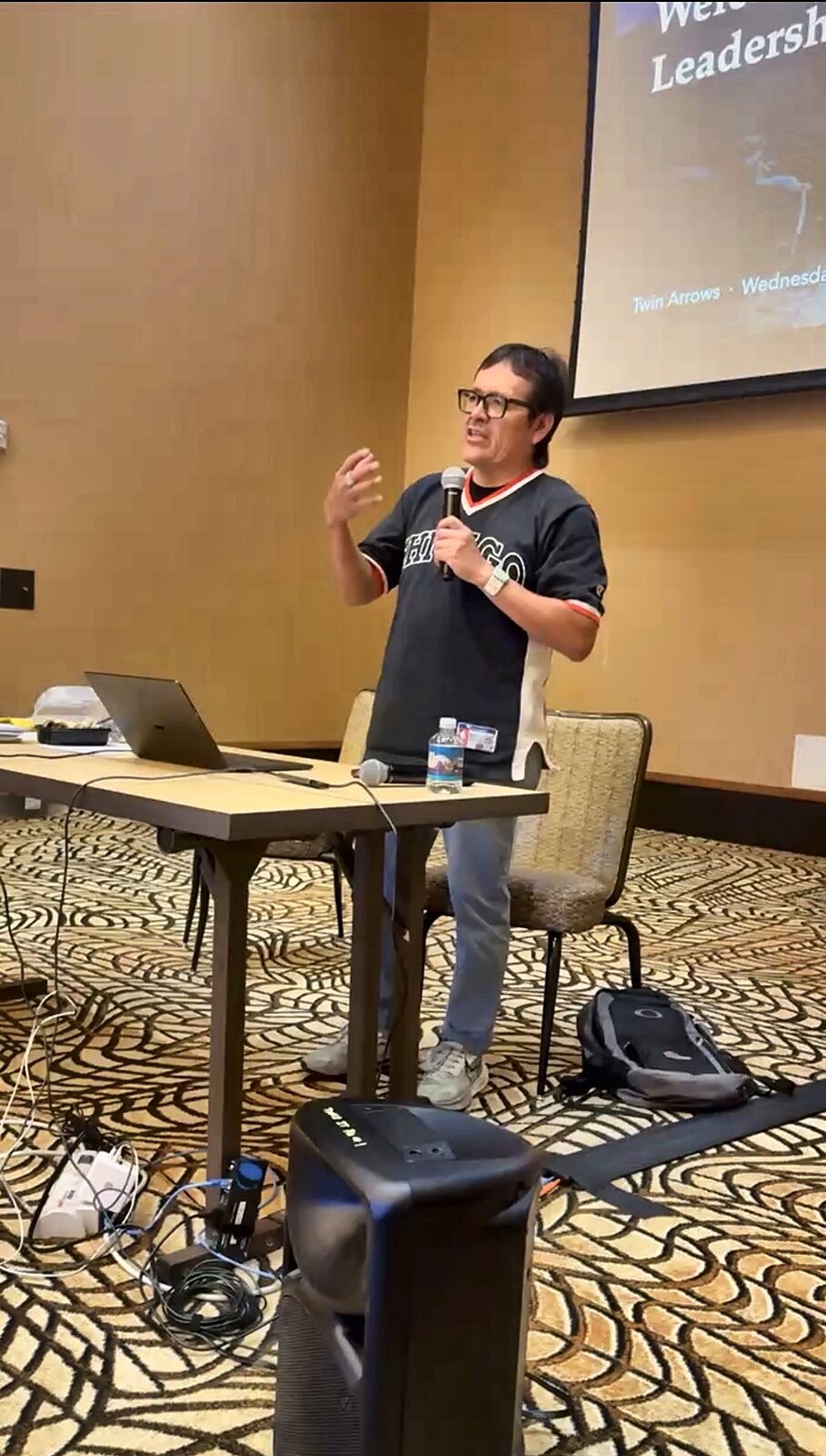
On the fourteenth of October I led a full day at Hopi, hosted by the Department of Health and Human Services, at Twin Arrows. In the room were tribal managers and village administrations, and the legislature was invited.
I build tools for crossing hard ground. I test them in my own body first, then in my own writing, and then I carry them into rooms with people who are further along than I am.
The doctorate is part of the same work — sustainable development education, with a focus on human performance and intergenerational healing, and dissertation rounds ahead. The books are where a tool goes once it holds.
The privilege is the company. Diana, Deoné, Rene and Debra are experts in their own disciplines, each of them deeper in theirs than I am in mine, and a day like this one is the chance to stand in a room with them and go all the way down. I teach this in a few places now. A faculty appointment at 1440 Multiversity, in the redwoods above Santa Cruz. Lectures in Mexico, with more next year. Sessions in other parts of the world and with First Nations. Every room has made the tools sharper.
And then Hopi. To be invited to work alongside a people this disciplined, this honed, this honorable is the thing itself.
The Hopi did not arrive here. They emerged here, and they made a covenant with Màasaw, the caretaker of the earth, to be the stewards of this land. They have kept it since time immemorial. The migrations that fulfilled the first part of that covenant left footprints across the whole of this country — the ruins, the springs, the trails, the shrines. Any number of years I could put on that would be my framework and not theirs.
And village administration is not an org chart at Hopi. It is the governance of those villages, carried the way it has always been carried. To be asked into a room holding that, as a Diné man, and to be asked to lead the day, is not a booking.
It is a nation opening its door to healing. That is a rare thing and I do not take it lightly. A people who keep their ways and take the sacred seriously decided that the work of settling the body, and of teaching leaders to carry weight without breaking, was worth a full day of their directors' and administrators' time.
So this is the whole of what we carried in. I am writing it out in full because it belongs to more than one room.
Why we call them far messengers
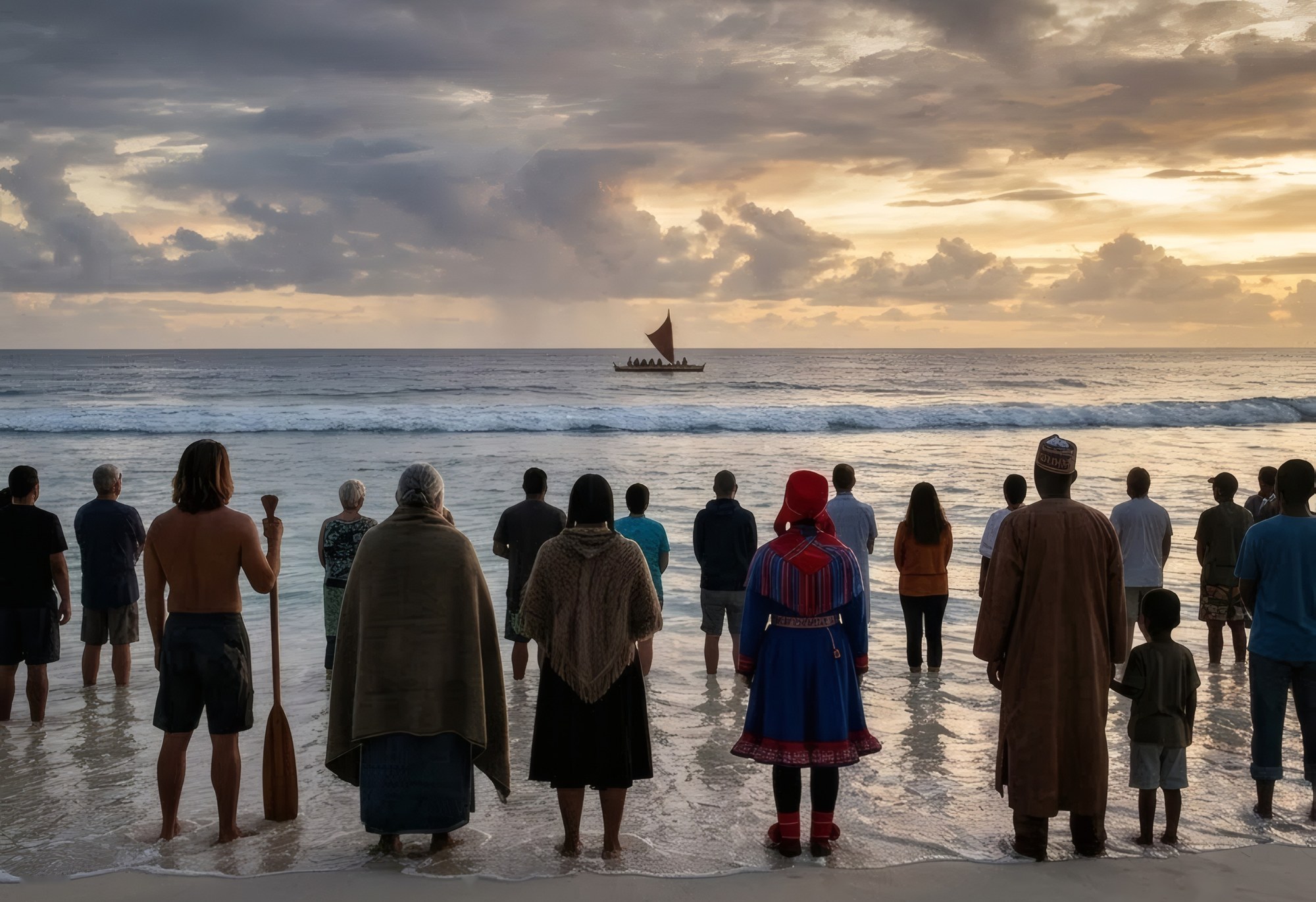
Every people on earth had them.
When a message had to cross four hundred miles of hard country, the old peoples did not send the fastest runner. They sent the one who could arrive whole. The elders had a sentence for it, and the entire day was built on it.
A message delivered by a broken person arrives broken.
The sea peoples read the swells instead of fighting them. The desert peoples, four days from the next well, sat down at a dry spring, softened their eyes, counted their breath, and remembered where the water was. The mountain peoples locked their breath to their stride, hour after hour, and did not spend themselves on the first climb.
Not the fastest. Not the strongest. The one who does not startle.
And the messenger was never alone. There were watchers, who noticed what was changing in the weather and the water and the people. There were keepers, who held what could not be allowed to drop. A far messenger was the product of a whole community. Fed by it. Housed by it. Given the time.
This is the frame, and it is why I built the work around it. Intergenerational healing is a phrase that lands differently in every room, and in some rooms it lands as an accusation. But every people on earth raised far messengers, and every one of them called it the highest work there was. A Lithuanian grandmother understands it. A Hopi village administrator understands it. A seed keeper in the Andes understands it. It is not borrowed from anybody, because it belongs to all of us.
It is also how civilizations were actually built. Not by the fastest. By trained people who could carry what mattered across country that would kill an ordinary person, and arrive with it undamaged, and then raise the ones who would do it next.
And we may have to do it again. Not as a metaphor. Several hundred years from now somebody will have to carry what we know across ground we cannot see from here. The question is whether we will have raised anyone who can.
The Carry and the Cargo
There is a harder version of this argument, and I have written it out properly as a working paper, because I think it is the most important thing I have to say.
Here it is in short. Everything we now call resilience is built outside the body. Seawalls, grid redundancy, satellite warnings, the phone in your hand. All of it useful, and all of it a single point of failure nobody has mapped. We have moved from internal capacity, which I call the Carry, to external retrieval, which I call the Cargo. A navigator who has never had to hold a map inside his own head has no map when the signal drops.
And it is worse than that, because most people's nervous systems are already spent. More than half of American adults say they live paycheck to paycheck, in a low-grade fight-or-flight that never switches off. An exhausted nervous system cannot hold complex knowledge, cannot read a changing country, and cannot organize anything. It is busy surviving Tuesday.
That is why the far messenger matters as more than a story. Before the printing press and the cable and the chip, every piece of human knowledge that crossed any distance crossed inside a trained person. The desert navigators, the ocean wayfinders, the mountain couriers and the songline keepers all arrived independently at the same physiological methods — and those methods map onto three specific pathways in the brain that we can now name and measure.
I am writing that argument out properly as a working paper, called The Ancestral Carry. It carries the neuroscience, the citations, and an honest reckoning with the charge that work like this extracts from the traditions it draws on. It is still in testing and not published yet. Most of this work comes out of my novel The Council Fire, which came out last week.
The question that lit the room
I did not open with a framework. I opened with a question.
Remember your best day. What was it about it? What state were you in? How could you have more days like that?
That question did more than anything we said. People wrote. Then they turned to the person beside them and talked, and strong, well-spoken leaders in a room full of their peers started telling each other about a day when everything flowed.
Here is why it works. Most of us cannot describe the state we want, so we cannot aim at it. But everyone has been in it at least once. Ask a person to go back there and they are not learning a technique. They are remembering a capacity they already have, and that holds much better.
Because most of us are carrying something before the day has even started. For a lot of people it is money, and that is not a small thing. For a lot of communities it is cultural. It is the kids. It is an elder who needs more than there is. And then there is the feed, where people spend the day tearing at each other, and whether you are doing the tearing or only reading it, it gets in.
Braced is a physiological state, not a mood, and it is expensive. It narrows what you can see. It shortens what you can plan for. And if you lead anything, your state is in the room whether you name it or not. People feel it when they walk in.
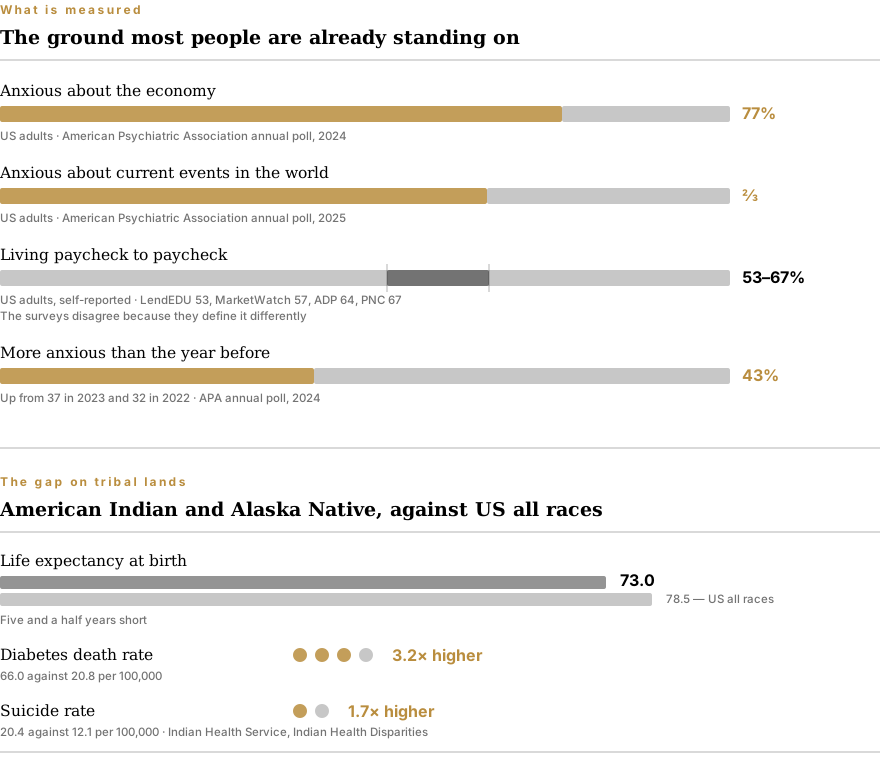
And on tribal lands you have to add the part no national survey captures: intergenerational trauma, carried in bodies and in families, on top of rates that are already higher for almost everything. A room of tribal managers is not starting from the same line as a room in a corporate office, and pretending otherwise is useless to them.
The team that learned to breathe
Then we told the Bulls story, because it is the clearest version of this that most people already half know.
For six years the Chicago Bulls had the greatest player anyone had ever seen, and for six years they did not win. Then Phil Jackson arrived. He gave a whole practice over to silence. He turned off the gym lights so they would stop leaning on their eyes. He had learned a good deal of it from Lakota friends at Pine Ridge, and when we said that, the room recognized it at once. There was a lot of laughter.
Michael Jordan, the best in the world, learned to pass. Scottie Pippen did the work nobody cheers for. Dennis Rodman, the man nobody could manage, became the team's warrior, because Phil gave him a job instead of treating him as a problem.
Six championships in eight years.
The part people leave out is that Jackson was not only coaching basketball. He was working on nervous systems, and he was doing it as a team rather than one player at a time.
That is the teamwork lesson, and it is the one I most want leaders to take. You cannot regulate a department one person at a time. Every role is the job. Watchers, keepers, messengers. Coach, carrier, steady one, warrior. Give each person a job, and make room for the one nobody else can manage.
What the research actually says
I will not put anything in front of a room of tribal leaders that I cannot stand behind. So we said out loud which parts the trials support and which parts are tradition, the same way our reader does.
Slow breathing is the best-documented piece of the whole practice. Near six breaths a minute, with the out-breath longer than the in-breath, moves the nervous system toward the settled side. Zaccaro and colleagues reviewed the evidence in 2018. Vickhoff and colleagues showed the cardiac effects in 2013. Our stone breath is four in, four hold, six out, four hold, and the long exhale is doing the work.
Naming what you feel is the fastest tool in the kit. One sentence to yourself, with no argument attached, and the alarm quiets in about two seconds. "I am wound up." That is the whole technique. We taught it as naming the monster, because the room asked what the monsters were, and the answer is that they are what happens inside us under pressure. The racing heart. The ego. The pride that arrives exactly when you need to be listening.
Gratitude holds up well under testing, but the strongest effects show up when it is said to a specific person rather than written in a notebook. Emmons and McCullough, 2003. Seligman and colleagues, 2005. That is why the afternoon ended with people walking across the room and handing their message to another table out loud, instead of reading it from their chairs.
Then at ten to three we went into an hour of sound, and many people lay down on mats. The research here is better than most people assume and much worse than the marketing claims. In the meta-analysis of natural-sound exposure, water produced the largest effect on health and positive affect of any natural sound, and in a lab comparison against birdsong, water gave the highest cortisol recovery. Slow tempo in the sixty to eighty beat range tracks with increased parasympathetic activity, although a study testing literal heart-rate entrainment found the heart does not actually lock to a musical pulse. The calming is real. The lock-step is not. A six hertz theta binaural beat is the one technique here with well-replicated entrainment evidence, confirmed in a 2025 randomised study across eighty participants and sixteen configurations, with a meta-analysis of thirteen trials finding reduced anxiety and improved episodic memory.
And here is what we deliberately left out. No 528 hertz, no solfeggio tuning. The claim that 528 hertz repairs DNA comes from numerology, not biology. One nine-person study found cortisol down and oxytocin up, and in all the years since nobody has replicated it at any scale. I would rather hand a nation something smaller that is true.
Abundance, which is not what people think
Abundance thinking gets sold as a feeling about the future. It is not that.
Grateful for what is. Clear-eyed about what is coming. No longing in between.
Abundance is not the feast waiting for you. It is what you bring to it.
The middle part is the discipline. Wanting is not a feeling, it is a heart rate. You walk into a room needing something from it, and the room can tell, and the room moves away from you. The practice is to arrive already full. Not performing full. Actually full, because you did the work before you came through the door.
My grandfather herded sheep, grew most of what he ate, and lived to a hundred and three. He gave us one teaching and he repeated it until it stuck: think positive. I spent years assuming that was simple. It is not simple. It is a trained state, and he trained it every morning of his life.
The stone, and what it came through
Then we had them picture a stone. Not one in the hand. One in the mind, chosen off a streambed and picked up, which is how the practice travels when there is no creek in the room.
Imagine a pebble out of a streambed and you are holding something that has been moving for thousands of years.
Time shaped it. The water shaped it. The rolling shaped it. It was probably lava once. It broke off somewhere and started down the canyon, and you can read in it everything it came through. The seasons. The floods. The long dry years.
It has travelled maybe hundreds of miles. Maybe thousands. And it is here, in your hand, and it is beautiful. It has history. It has memory. And it is lying among others that are not the same color, because they all came from somewhere else.
You have come through many things. Many things shaped who you are, sitting here today. And you are here.
The stone was not afraid of the stress. It kept rolling, and the rolling is what made it worth holding.
The afternoon, when the room stood up
After lunch the room split into five groups of five, and the parts were picked fast. Phil the coach. Michael the carrier. The steady one. The warrior. The eagle.
Each table wrote a message for a far community. Three sentences, something true. Then they carried it across a story of dry springs and monsters, and at the end they stood up and delivered it to another table, out loud, across the floor.
By the middle of the afternoon the room was on its feet. Tables of five were acting, moving and laughing. Leaders who speak for a living were playing it big in front of each other.
And one group, delivering theirs, said the line I have not been able to put down since.
That is the message. It is not mine. I only carried it.
That is the entire teaching in three short sentences, and it came out of the room rather than from me.
Why the acting works
People take the afternoon for an icebreaker. It is the opposite of an icebreaker. It is the most serious hour of the day, and it does four things that nothing else in the day can do.
It takes the risk out of speaking. The moment a person is handed a part — Phil the coach, Michael the carrier, the steady one, the warrior, the eagle — whatever they say belongs to the part. A director who would never tell a room full of her own peers "I am the one who holds this together and nobody notices" will say exactly that as the steady one, in character, inside of a minute, and laugh while she says it. The role is cover. Cover is what lets a true thing out.
It gives everybody a job, which solves the room. Sit five leaders at a table with no parts and one will carry it while four defer. Assign the parts and the quiet one has work to do and the loud one has a constraint. That is the Rodman lesson from the morning arriving in the afternoon as practice instead of a story. Give each person a job, and make room for the one nobody else can manage.
The laughing is the medicine, not a break from it. This is the part I most want people to understand. When a room laughs together it has settled together — laughter is the loudest thing a settled nervous system does, and it is the social end of the same system the breath work reaches. So the openness does not come first and the laughter second. It runs the other way. The room laughs, and then the room will tell you the truth. Every time I have watched people open up, the laughing came first.
And the body keeps what the chair loses. Sit a room down and talk at it and you are asking memory to hold a slide. Stand the same room up, give it movement and voice and a part to play, and the teaching binds to all of it at once. That is how the songlines worked — the landscape triggering the verse, the walking and the singing and the seeing locked together so the knowledge could not come apart. Our tables are a small version of the same thing, which is why people are still using the stone breath three months later and could not tell you a single bullet point from the morning.
Then they carry it across the floor and hand it to another table, out loud, standing up. That is deliberate too. Gratitude and acknowledgement hold up under testing, and they hold up best when they are said to a particular person rather than written down for nobody. Walking it over is the active ingredient. Reading it from your chair is not the same exercise.
What all of it adds up to is permission. Strong, well-spoken leaders spend their working lives being careful. For one hour they were not careful, and what came out of that room was better than anything careful would have produced.
The team we pulled together
A day like this is never one person. I pulled together a team of practitioners and friends, and most of us came out the night before and stayed at Twin Arrows. We set up three rooms, worked with the tech crew on sound, and in the morning, before anyone sat down, I settled the team outside with the sacred San Francisco Peaks in view. We breathed together there and spoke words of abundance over the day. The old pattern held: a far messenger was never alone. There were always watchers and keepers around the one who carried. For one day, this team was that.
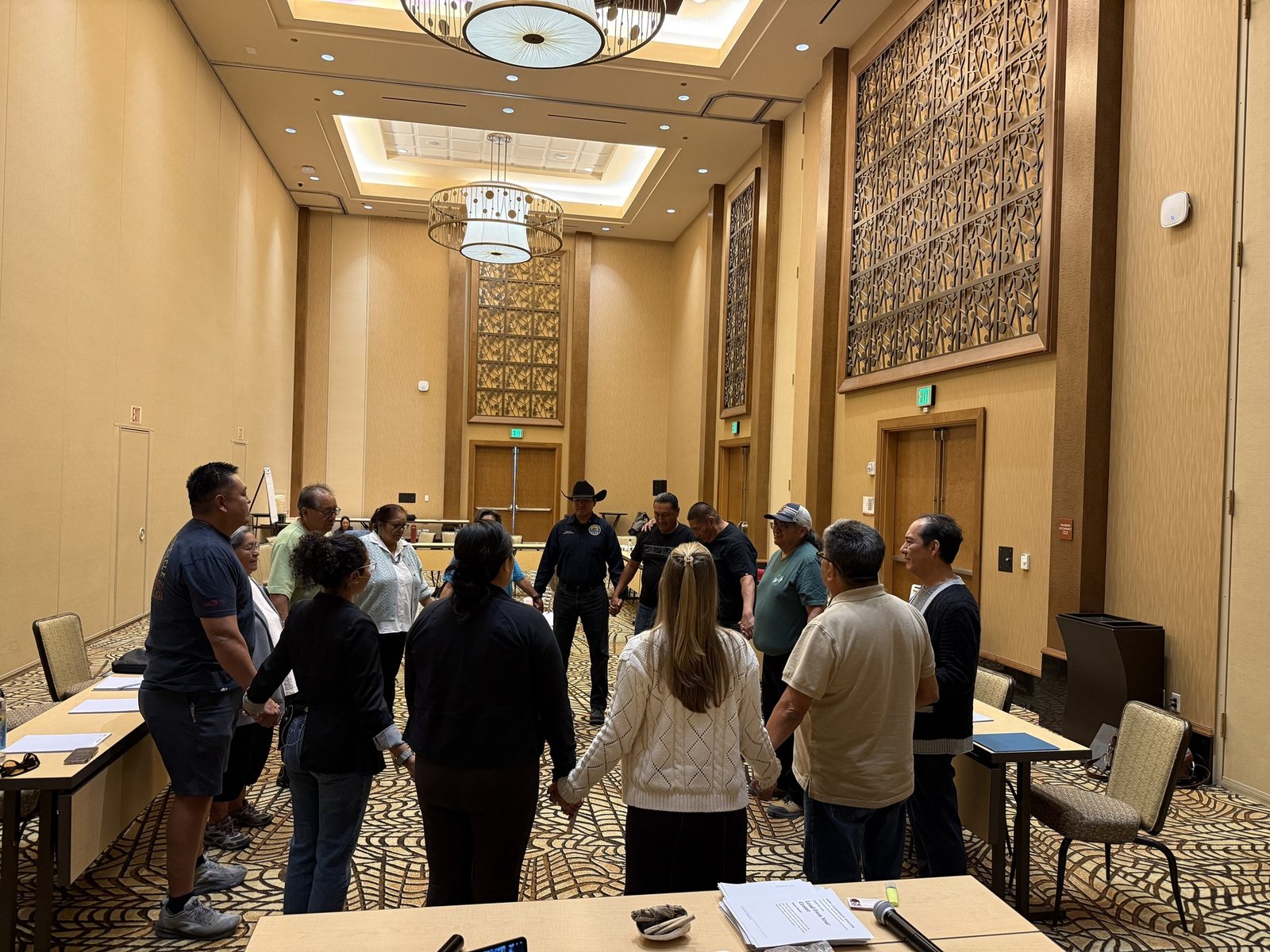
By the afternoon, the whole room was on its feet.
Diana brought the whole room into the body and made every minute count. Deoné opened the day with sunrise yoga at seven and then led the Arc of Life at the tables, where people stood up, worked in pairs, and opened up. Rene filled the tuning-fork room — fifty years of practice in one hour — and stayed after to tune a few more people. Debra’s hour of sound began at ten minutes to three, right on time; people lay down and let go, and many carried their mats home to keep the practice going. Sabio made the whole setup easy. Renee was part of a table all afternoon, laughing and building with everyone.
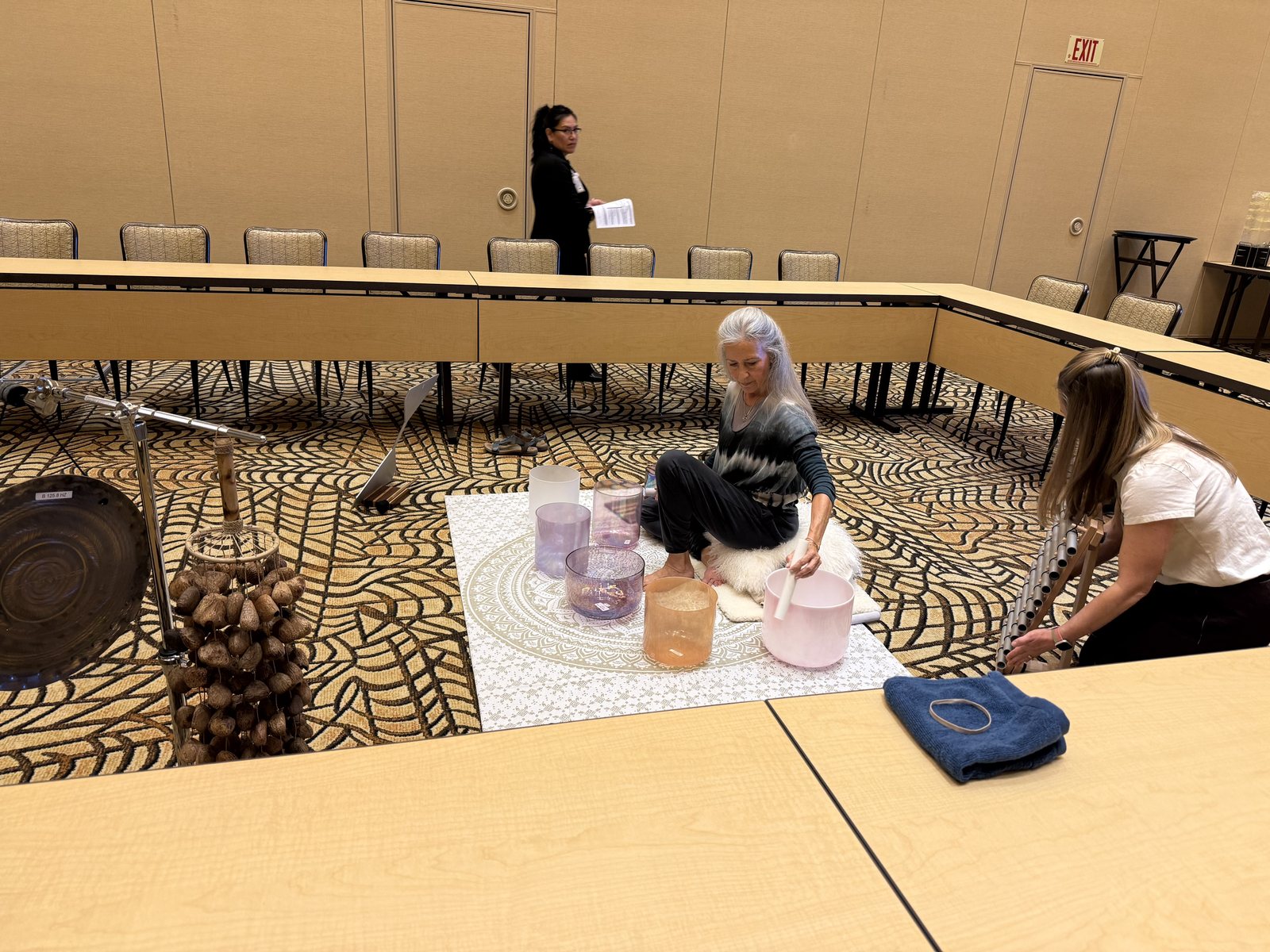
Debra’s hour of sound, ready for the room.
Shelby captured the day. The photographs on this page are Shelby’s, and they are the memory we all get to keep. And Chris brought a film — In Between Worlds — and shared it with us, a filmmaker’s gift set down in the middle of a working day.
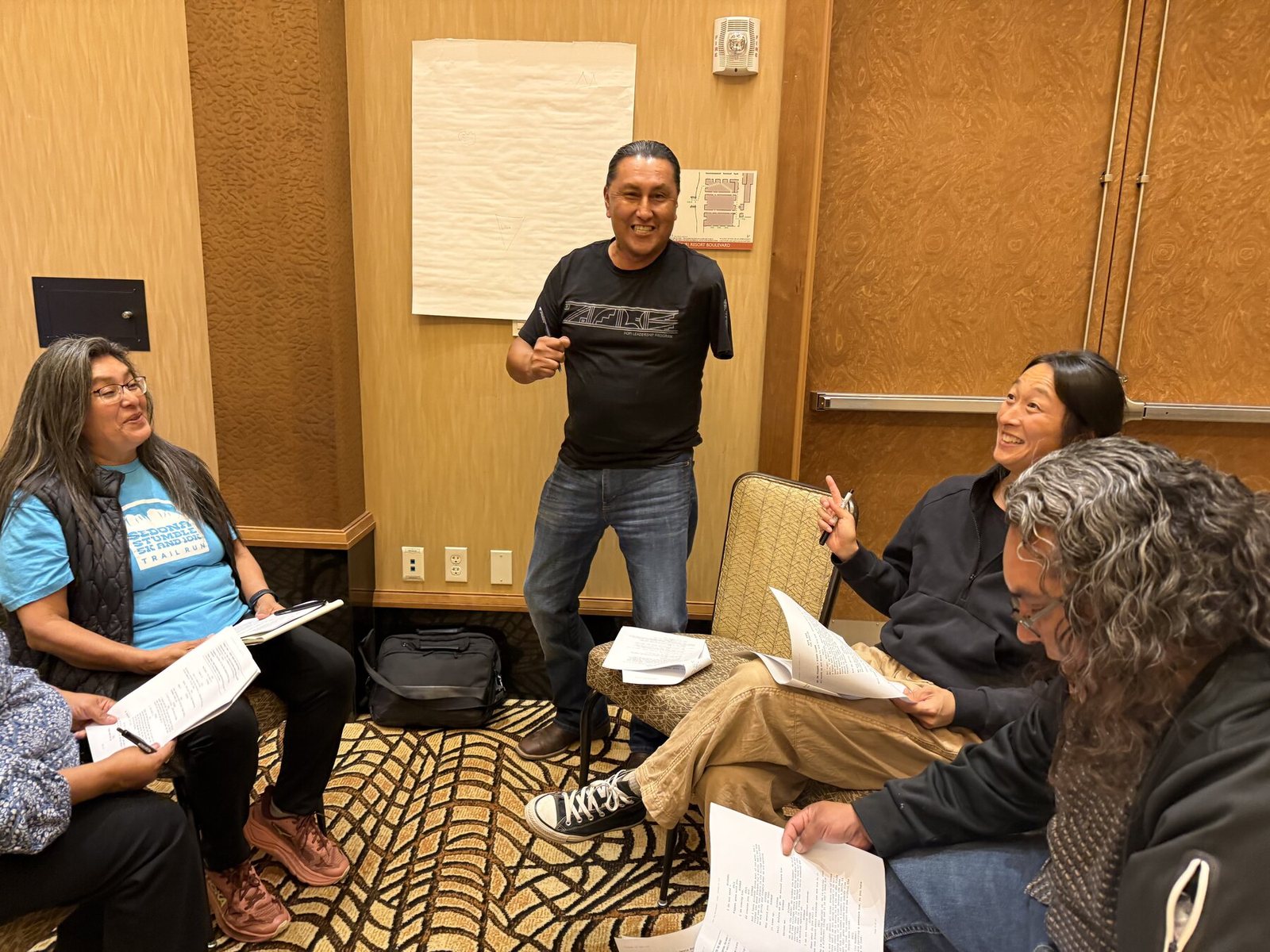
The afternoon scripts: tables of five, acting, moving, laughing.
In a lot of ways the day was healing for our own group too. Every one of us joined a table in the afternoon, acted, laughed, and carried a message. That is how friendships get built.
The same work, in the books
The fiction and the sessions are one body of work, and The Council Fire is the book most of this comes out of. Twelve keepers from twelve peoples find each other as the old world goes quiet and build the thing that carries what a people knows across to the other side. The twelve roles at the tables, the crossing, the message handed on — all of it was in that book before it was ever in a room. It is here.
What the rolling years were for
I have spent most of my working life with tribal communities. Fourteen years directing a Native America program. Three terms as a chief executive in tribal government, across different realms of a nation's work. A decade convening Indigenous elders across the Americas. A governance restructuring that forty-five communities adopted.
I am grateful for those years, including the hard parts, and there were plenty of those.
Because I had to go on that journey in order to understand this one. I had to go through the challenges. I raised a family in the middle of it. None of it was a detour on the way to the work. It was the shaping.
That is what I want a person to hear while they are holding the pebble. You are not behind. You are not damaged by what you came through. You were rolled, and you are a different color than the one lying next to you, and both of those things are exactly the point.
One body of work, and it is a wonderful journey
People ask how the pieces fit, so let me lay them side by side, because they are not separate things.
The doctorate is at Prescott College, in sustainable development education, with that same focus on human performance and intergenerational healing. I am about to enter dissertation rounds.
The rooms are where the tools get sharp, and they get sharp because the people in them are better than the tools. A room of tribal managers and village administrators, on their own ground, at nine in the morning, will tell you in about four minutes whether a practice carries weight.
So the three things are one thing. The doctorate is where I read and argue and get held to a standard. The rooms are where the tools are tried and corrected, in company with people who know their discipline better than I know mine. The books carry what holds to somebody who will never be in a room with me at all.
The books are the same work in long form. Stone Breath and The Council Fire are out, with more coming in the series, and they are not illustrations of the teaching — they are how it travels. A story crosses a border that a framework cannot. Somebody in Vilnius or Kyōto will never attend a session of mine, and they do not need to. The book arrives instead, and the practice is printed free in the front of it, before the story starts.
And then there are the buildings. I manage planning and capital projects for NATIVE HEALTH, an urban Indian health center in Phoenix. Our campus sits directly across the street from the Phoenix Indian Medical Center, which is going into a long renovation. Dental and pediatrics will go off line while that work runs, and thousands of patients will need somewhere to go. So we are standing up dental and primary care capacity to meet them.
That is the same question as everything else, in concrete and steel. Can a people take care of its own through a hard passage? Not in theory. In October, with real chairs and a real schedule and somebody's grandmother needing a tooth pulled.
The doctorate asks the question. The books carry it. The buildings house it. The sessions teach it.
For a long stretch this looked like three terms of hard government work and a lot of road. Now it looks like one thing. I would rather be doing this than anything I have ever done. It is a wonderful journey and I am grateful to be on it.
What is growing from it
The day did not end at Twin Arrows. With Chris and Renee, we are working to create a seedlands project in the Sedona country — a program that holds land, season, and seed together with the night sky that told our peoples, for generations, when to plant and when to harvest. We are building it the slow way: relationship first, protocol first, elder to elder. When there is more to tell, I will tell it here.
Carry it home
These are the tools. They cost nothing and they do not require me.
The stone breath. Hold a small stone. Jaw soft, shoulders down. In for four, hold for four, out for six, hold for four. Use it before a hard conversation.
The short crossing, eight minutes. Settle, with feet flat and jaw loose and the stone in hand. Breathe, eight rounds. Name it, one sentence, no argument. The ground: picture today's hard country with soft eyes, weather and not insult. The spring: find one good thing you walked past, and hold it three breaths. The handing over: the one thing you carry today, and who it goes to. Then arrive — three slow breaths, eyes to the whole room, and go in already full.
Your best day. Write down three days that went right. What state were you in? How could you have more of them? Keep the list, because it is proof.
Name the monster. When panic or ego or pride shows up, name it to yourself, and then decide.
Every role is the job. Give each person a job, and make room for the one nobody else can manage.
And for the pocket: become the one who does not startle. Read the weather, not the insult. Hold the abundance first. What you know, you owe. Teach one person this month.
The last word
Without tools, stress is something to run from, and hard moments arrive as fear and anxiety and sometimes panic. Once you have the tools you build a relationship with the hard moment instead. That is the whole difference, and it is trainable.
The Hopi people keep their ways and take the sacred seriously. It was an honor to serve you.
With gratitude to Joyce Hamilton and the Department of Health and Human Services, to Twin Arrows, and to Diana Munger, Deoné Newell, Rene Shepley Ragan and Debra Fleeger, who carried the day with me.
To everyone who was in that room: thank you. I will not forget it.
The practice is written out in full, free, in the front of Stone Breath, before the story even starts. The Council Fire is the one most of this work comes out of. And The Far Messengers is out now.
Tony Skrelūnas is Diné (Navajo) and Lithuanian. He writes The Ancestral Watch — Stone Breath, The Amber and the Stone, The Council Fire and The Far Messengers — and the working reader, Living as a Far Messenger. He is a PhD candidate; his dissertation looks at human and organizational performance through three ancestral lenses: Diné, Lithuanian and Japanese. He holds a faculty appointment at 1440 Multiversity, where teaching is the center of the work now. He runs at dawn and hikes with a corgi named Roper.
Last reviewed October 2026.