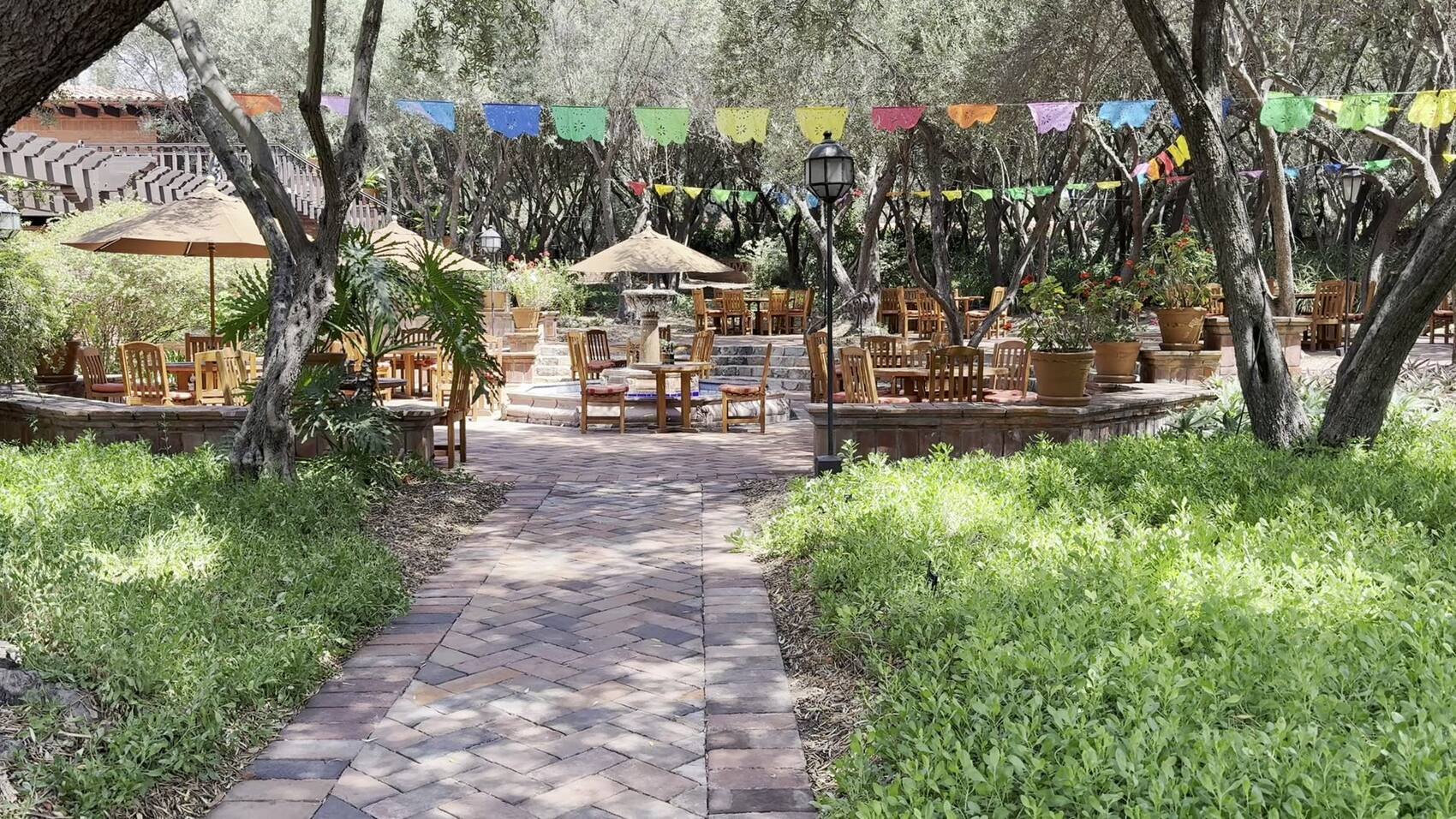
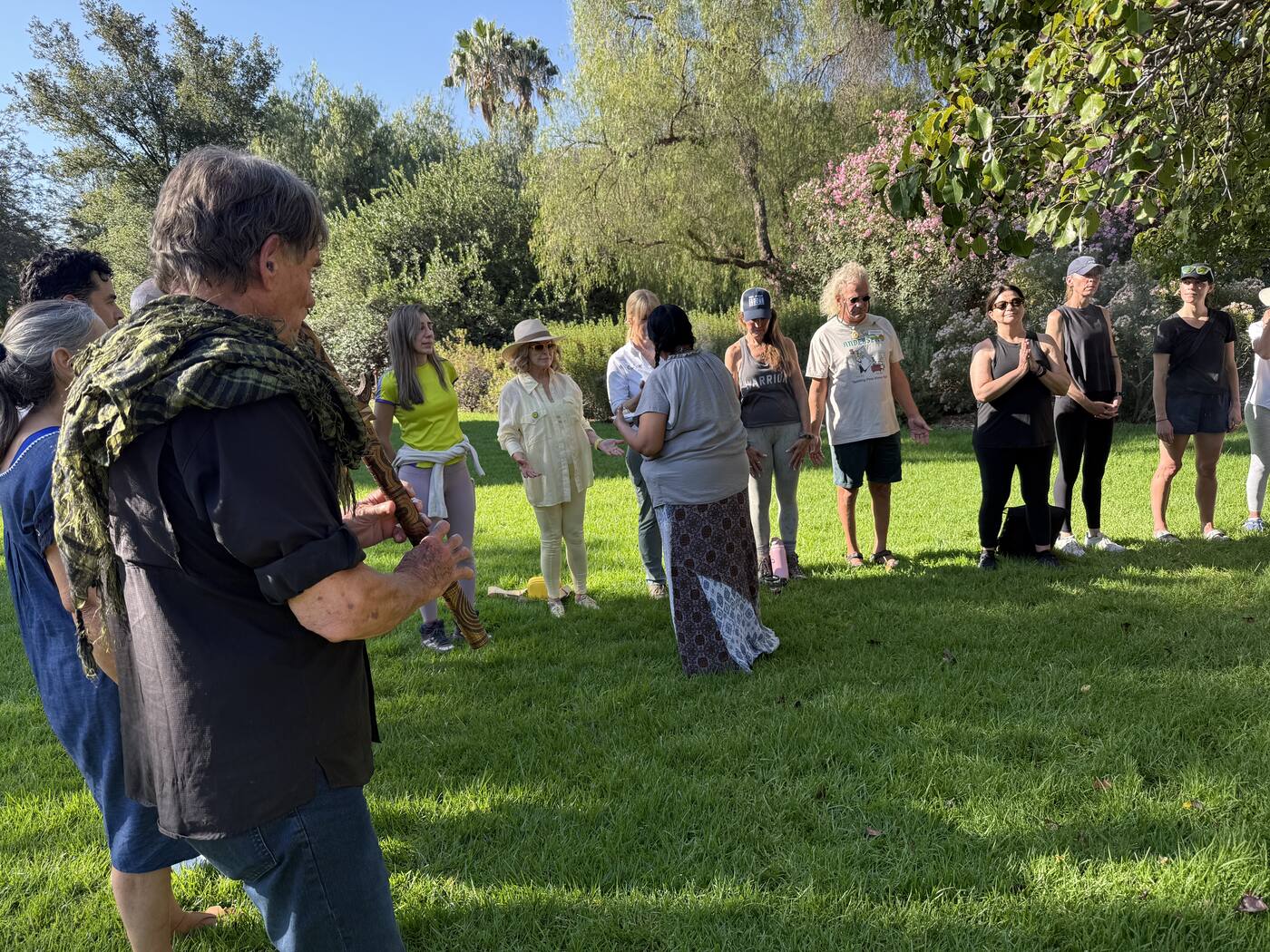
There is a mountain in Baja California that the Kumeyaay call Kuchumaa, and at the foot of it there is a lawn where, in the morning, people gather in a loose circle to be walked into the day. On the second of August I stood in that circle while a man played a wooden flute into the cool air, and I thought about my great-grandmother.
I have presented at Rancho La Puerta four times in the last three years, usually bringing a group and building the session with them. This time was different. This time I was invited — to Nurturing Abundance Week, and specifically to meet Tom Blue Wolf and Pat Mitchell.
The invitation came out of the writing. Metamodernism, and how we prepare people to be far messengers: nervous-system control first, then the long work of building a future our seventh generation can stand in, with everything happening in the world right now happening anyway. That is The Council Fire, more or less. Rancho asked me to come and to sit down for Resonate, their broadcast, which is not a thing I take lightly.
That matters, because it changes what you see. A guest arrives at a place like this to be restored. I arrived to study how restoration is made — how a room is held, how a week is built, what happens to a person on the Tuesday after they leave.
What I did not have was any way to prepare for a lunch table.
The table
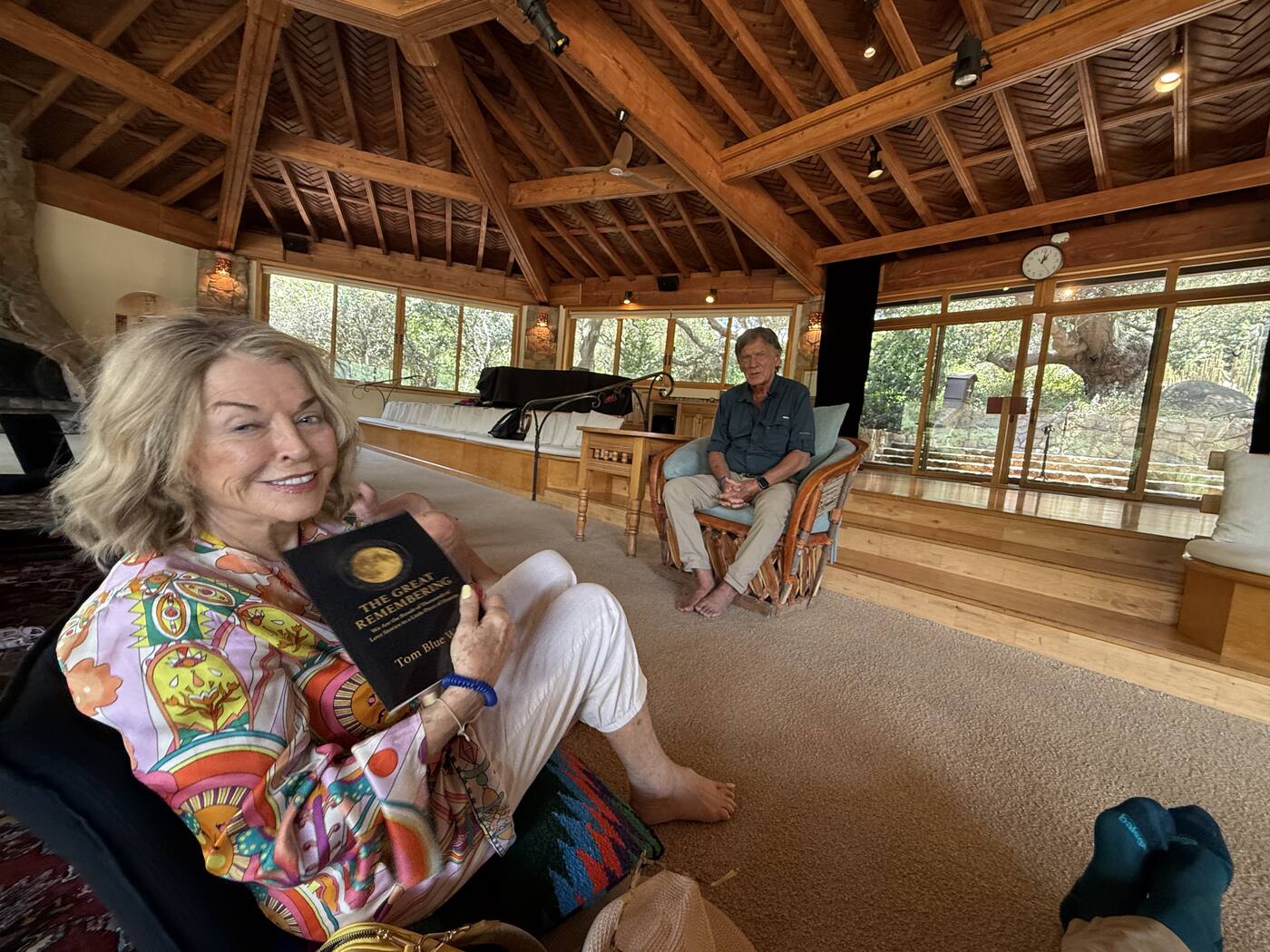
His name is Tom Blue Wolf. Muskogee Creek elder, founder of EarthKeepers, which he has run as a nonprofit since 1970 — fifty-six years, begun the year after he came home from Vietnam. He turns eighty-one in February. He is the only person I have met in a decade who does not carry a phone.
It was an honor to meet him.
We sat under the papel picado for the better part of an hour, and the conversation went where conversations go when nobody is performing. It started with names. How did Crazy Horse get a name like that? Tom explained: the real name was closer to one whose horse is crazy. And then he told the part I hadn't heard — that Crazy Horse once set out to find the white buffalo, was gone two years, came back empty-handed, and they took his name and gave him a new one. Little Worm. He was humiliated. So he turned around, went back out, and came home with a white buffalo robe. They gave him his name back.
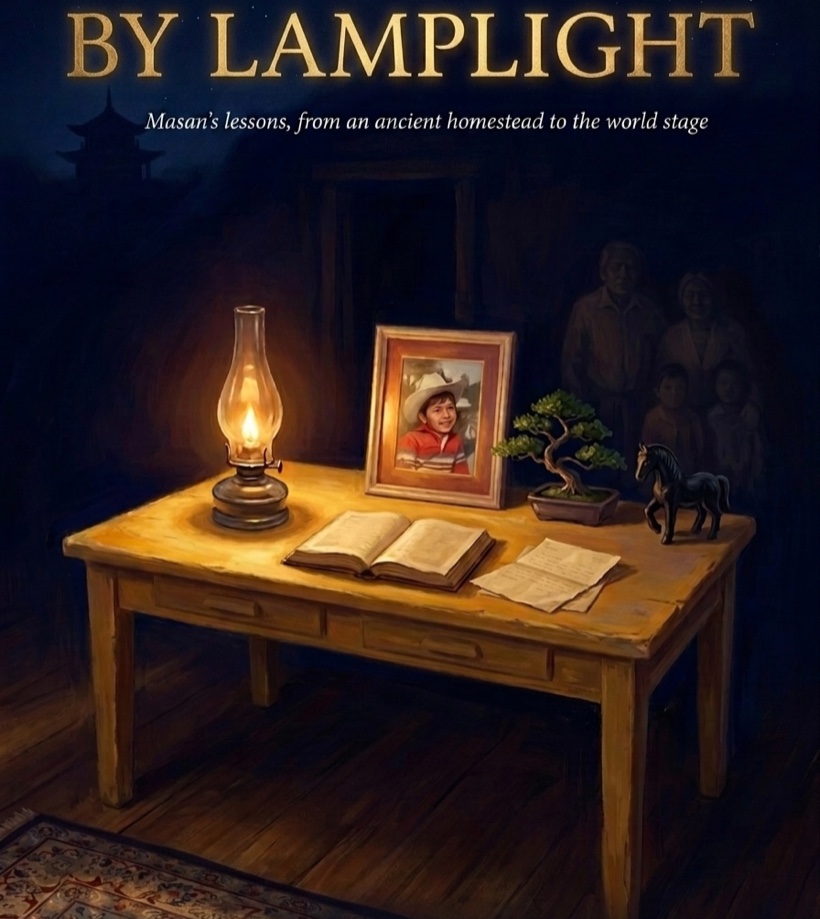
I told him about my great-grandmother. She raised me. My great-grandfather was a Hogan builder and was rarely home, so it was her and me and the sheep. She taught me essentially everything I know. She had a kerosene lamp, and that lamp is where I learned to read. Years later I found the old table we used to sit at in that Hogan. I repaired it. It is my desk. I write on it every day.
Tom listened to all of that the way people listen when they aren't waiting for their turn.
Then he said the thing I have not been able to put down since.
"The chances of me and you sitting at this table are one in a trillion. Your ancestors and my ancestors avoided the genocide long enough for us to walk on the earth."
Tom Blue Wolf
He said he gets tears in his eyes when he thinks about it. So do I. Because the sentence does something precise: it takes a pleasant coincidence — two men from two nations meeting at a health resort in Mexico — and reveals it as the improbable output of a very long survival. Neither of our lines was supposed to make it. We are the part that made it. And therefore, as he put it, "we carry the torch, so we're going to be the ancestors of the future."
What he actually teaches
It would be easy to file Tom Blue Wolf under wisdom, which is a way of admiring something so you don't have to use it. He is more useful than that. He has a working theory of what went wrong and a practice for fixing it.
The theory: humans were designed to be the earth's immune system. Shepherds, stewards, caregivers. "When we abandoned that post, everything went to hell." He is not being metaphorical about the stakes. He cited the number that has been sitting in my chest since: forty years ago, roughly half of the animal life on earth was humans and our domesticated animals, and half was wild. This year the figure is ninety-six percent to four.
The practice is smaller and stranger and better. He takes young people — including kids sentenced to him out of an adolescent substance abuse program in Atlanta — into the forest, takes their devices, and teaches them what is food, what is not food, what is medicine. Then he teaches them the song of the food.
"Because plants will treat you different. Just like dogs — when you sing to them."
He explained the mechanism the way a physicist would, if physicists were allowed to be lyrical. Starlight enters the leaves. The tree carries it down as sap into the roots, and the roots hand the energy and the information to the mycelium, and the mycelium is the nervous system of the mother. Touch the earth anywhere, she feels it everywhere. Which is why ceremony works at all: you don't have to scratch the whole body to make the whole body feel better.
The coyote and the heart
The line I will steal, with permission and attribution, is this one.
Tom says we think the coyote lives in the head. The coyote is a good talker. He knows what you want to hear and exactly how you want to hear it. But the coyote does not care whether it is true.
"He's like AI. He don't care if it's true or not. He just tells a good story. The heart may not tell a good story — but it's always true."
I build things for a living — governance structures, mostly, and lately tools. I have spent this year with my hands inside systems that are extremely good at telling a good story. To hear an eighty-year-old man in the forest name the failure mode that precisely, without ever having owned a phone, was the single most clarifying thing that happened to me in Baja.
His practice, then, is to take a young person out of their head and drop them into their heart. Sometimes literally. He described tying a kid who was giving him static to a rock in the middle of a creek and leaving him there all day. "By the end of the day he's cooing like a dove."
I laughed. Then I stopped laughing, because he told me about Zimbabwe.
There is a village that has stood for a thousand years, where everyone knows everyone and everyone's relatives. One day a boy was fighting with another boy, knocked him down, and the other boy hit his head on a rock and died. It was the first death like that in a very long time.
So they took the boy, tied him to a chair in the center of the village, and blindfolded him. And then everyone came out and sang him his song — because there, you are given a song when you are born. They sang him his song. They told him about his ancestors. They told him about his mother and father. Hundreds of people, all day long. He cried like a baby.
By evening, in one of the huts, a girl was giving birth. They led him in, still blindfolded, and the baby came out of her and into his hands.
That morning he took a life. That evening he delivered one.
"He cried like a baby. He went into a fetal position, and became a priest."
Tom's summary: "That's rehabilitation. You could have put him in prison for ten years, he never would have come to that realization." Ours is a country with more people in prison than most of the rest of the world combined. Penalization, he says, doesn't rehabilitate anybody — you send someone away for twenty years, they come out better at corruption. "We think you need to be healed if you do something wrong."
Love is the healer. Forgiveness is the medicine.
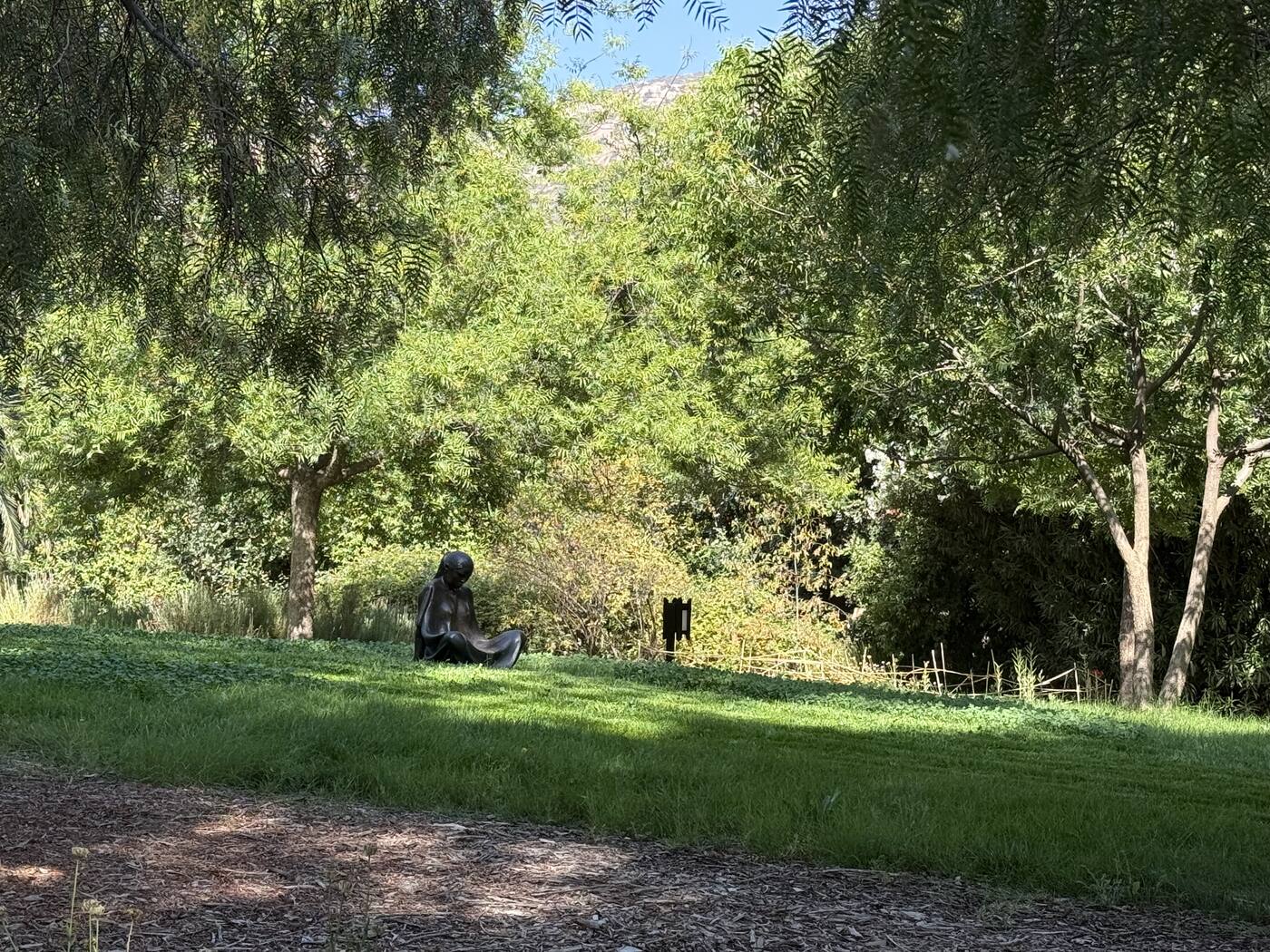
The oak tree's timeline
On Monday night he gave the eight o'clock talk. At Rancho La Puerta that is the marquee slot — nothing else is scheduled against it, the whole house comes. The room is called the Oaktree.
He opened by saying he'd walked the property that day listening, and it had brought tears to his eyes. The foliage singing to the water, the water singing to the people. "I don't know if the people hear it, but the songs are awesome. They're celestial."
Then he said he found it interesting that he'd been asked to speak in a room called the Oaktree, because some time back he had traded his own timeline for an oak tree's.
He'd been thinking about light. They say it takes light from the sun eight minutes to reach the earth. "No," he said. "It takes us eight minutes to see it. It's here all the time."
So he asked the oak tree about time. And the oak tree said: Give it up, Tom. Don't measure your life by time spent. Measure it by distance traveled.
"Do you know how far I've come? In your world, I've been here three hundred years. In my world, I've traveled over a hundred billion miles. And as long as I have a community to care for, and as long as there's a community to care for me, I will remain here — until the distance is right."
The oak tree, as reported by Tom Blue Wolf
I have been trying to build institutions for twenty years, and I have never heard a cleaner statement of what an institution is for. Not duration. Distance. And the condition of continuing is mutual care in both directions — I have a community to care for, and a community to care for me. Take either half away and the tree comes down.
He added, almost as an aside, that it is probably no accident that somebody once decided to call this place the universe. It means one song. Which is why, when a child is born, you give them a song — because they don't have one yet, and these days there is so much static in the atmosphere that it's become hard to find the one inside you.
Somebody who knew somebody
Partway through he did the arithmetic that reorganizes the room.
His great-grandfather was born in 1837, on the Trail of Tears, on the way to what is now Oklahoma. He lived until 1954. He was a hundred and sixteen years old when he died. Tom was eight.
"So now you all know somebody who knew somebody on the Trail of Tears."
That is two handshakes from a forced march to a wellness resort in Baja, and he laid it down without any drama at all. Then he kept going: go back seven generations and you have twelve hundred ancestors. "So our people say you walk around with twelve hundred ancestors inside of you all the time. Guiding you. Protecting you. If you're able to receive."
And then the turn, which is the whole talk: "You're going to be an ancestor forever. You might only be here for less than a hundred years."
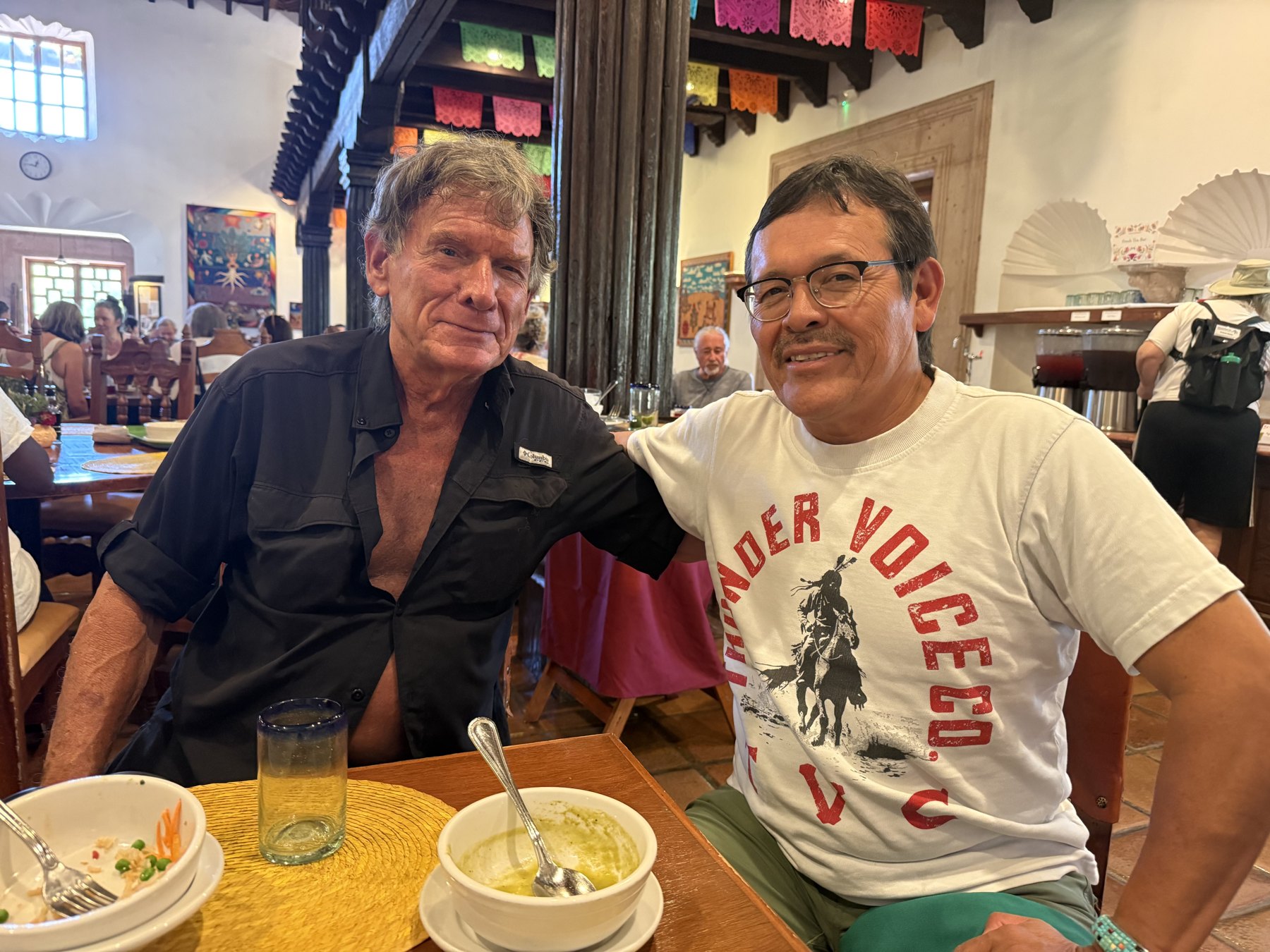
How do we stay resilient?
Near the end of the evening someone asked him the question I had come to Baja carrying: How do we stay resilient as we become the storytellers — as we become the messengers?
He answered by describing the sweat lodge. Four rounds.
The first is about waking up. "A lot of people don't realize some of us are sleepwalking." You wake up, and you become the one you dream of. "Heroes aren't out there. They're in there. We have to wake them up."
The second is healing, growth, transformation. The third is honoring the ancestors — and here he made the move he keeps making: when we honor them, we are also honoring the ancestor in us, because one day we will be one. It is not a backward-facing ritual. It is rehearsal.
And then, he said, the ancestors enter the lodge with us and give us strength and courage. Which he defined precisely, and not the way I expected:
Strength is knowing how to love somebody very deeply. Courage is knowing how to receive love.
"Some people can give you love but don't know how to receive it. Some people can receive your love but don't know how to give it. You've got to be both."
That is his answer to burnout among people who carry messages. Not discipline, not boundaries, not any of the vocabulary I would have reached for. The capacity to receive.
The rest of the week
I don't want to leave the impression that five days at Rancho La Puerta is one long conversation with an elder, though that would have been enough.
It was Nurturing Abundance Week, and the week had a spine. Dr. Sharon Horesh Bergquist gave Living Abundantly, making the case that the body is built to be challenged — that stress in the right dose, recovered from, is the actual mechanism of regeneration, and that three one-minute bursts of vigorous effort a day measurably move your mortality risk. Tracey Lukes was the one I kept going back to. I sat in three of her sessions and would have sat in more. Reclaiming Your Joy & Purpose, where she asked a room full of accomplished people what actually gets in the way and got back fear of conflict, time, and you forget how to enjoy. Then Intuition as Your North Star, which is the harder of the two, because it asks people who have built whole careers on analysis to admit they already knew.
She gave the room two tools I have kept. The first is three levels of listening. Level one is the conversation inside your own head — judgment, assumption, the story you are already telling. It is where most people spend most of their lives, including in conversations with people they love. Level two is sharp attention on the other person, the kind where you lose track of time. Level three is the unspoken: the energy, the culture, the room. Her point about level three is the one that stuck — you are affecting it whether you intend to or not. There is no neutral setting on a person in a room.
The second is what she calls the magic of a hundred. Write down one hundred things you want to be, do or have. You exhaust the obvious ones around fifteen, and everything worth knowing about yourself shows up after that. Then circle exactly one and take a single small action on it inside seven days. Not a plan. One action. I have watched a lot of strategy sessions in my life and that is a better instrument than most of them.
There was also a private session — Morning Mastery, taught by a trainer who came as Pat’s guest — circulation, activation, mobilisation, meditation, manifestation — which was world class, and which I did not expect to be the best thing in a week that included everything else here. It begins before your eyes are open, with a thank you, said lying down, before the day's first input can reach you. Then you tap your own body awake, following the creases where the body folds, saying out loud every cell in my body is well — and her instruction on that was firm: say it with passion, or say it silently, but you must believe it. It closes by wishing every being safe, well, loved and free.
Roughly forty minutes at full length, and everything before the meditation is preparation for the meditation. I have done some version of it nearly every morning since. Her own account of where it came from is a promise she made when she closed her business — that the only way to serve other people is to serve yourself first, at the highest level, and then open your heart outward. She called the program sacred to her. It is not mine to hand out, and I would not want to; some things you have to be in the room for. But the shape of it is not a secret, and the shape is most of it.
The one that took the top of my head off was Inner Fitness: The Art of Receiving Abundance. It was on the card as Laura West’s; Tracey stepped in and taught it, and her title slide says what it is about better than I can: expanding your capacity to receive more of what matters — joy, support, love, creativity, opportunities, resources.
She started by fencing the subject off from the thing it gets confused with. Abundance is not pretending the problems are not there. It is not bypassing reality. It is not trying to manifest harder. It is not thinking positive thoughts at a situation, which she named plainly as toxic positivity. I have sat through a lot of rooms where nobody was willing to say that out loud, and the whole hour changed once she did.
What it is, on her slide: the ability to see possibilities where scarcity only sees limitations, and the ability to receive — joy, support, love, creativity, resources. Receiving is the verb. That is the part almost nobody trains.
Her four keys are simple enough to be suspicious of and hard enough that most people fail them daily. Develop trust that things work out. Open to the belief that good things happen. Set the intention for good things to happen. And open to the idea that there is enough love, beauty, money, joy to go around. That last one is the whole argument. Scarcity is not a bank balance. It is a posture, and you can be carrying it while sitting on plenty.
Then she ran an exercise I am going to steal. Pick an area where you would love more abundance — relationship, work, money, time, energy, joy, travel, fun, friendship. Then a circle divided in four, and in each quadrant you answer as something else entirely: your favourite place at the Ranch, an animal, a favourite household item, a type of car. It sounds like a parlour game. It is a way of getting a straight answer out of a person who has learned to give careful ones. The metaphor talks before the professional does.
That class is the reason I keep saying resilience is not a solo sport. Everything I teach is about what you can carry. She spent an hour on what you are willing to be given. You need both, and I have been better at one of them than the other for about thirty years.
There was breathwork that ran long enough to stop being a technique, and a sound bath in the evening — singing bowls, lie down, head toward the bowl so the vibration travels the length of you. That one I cannot transcribe. It is not made of words.
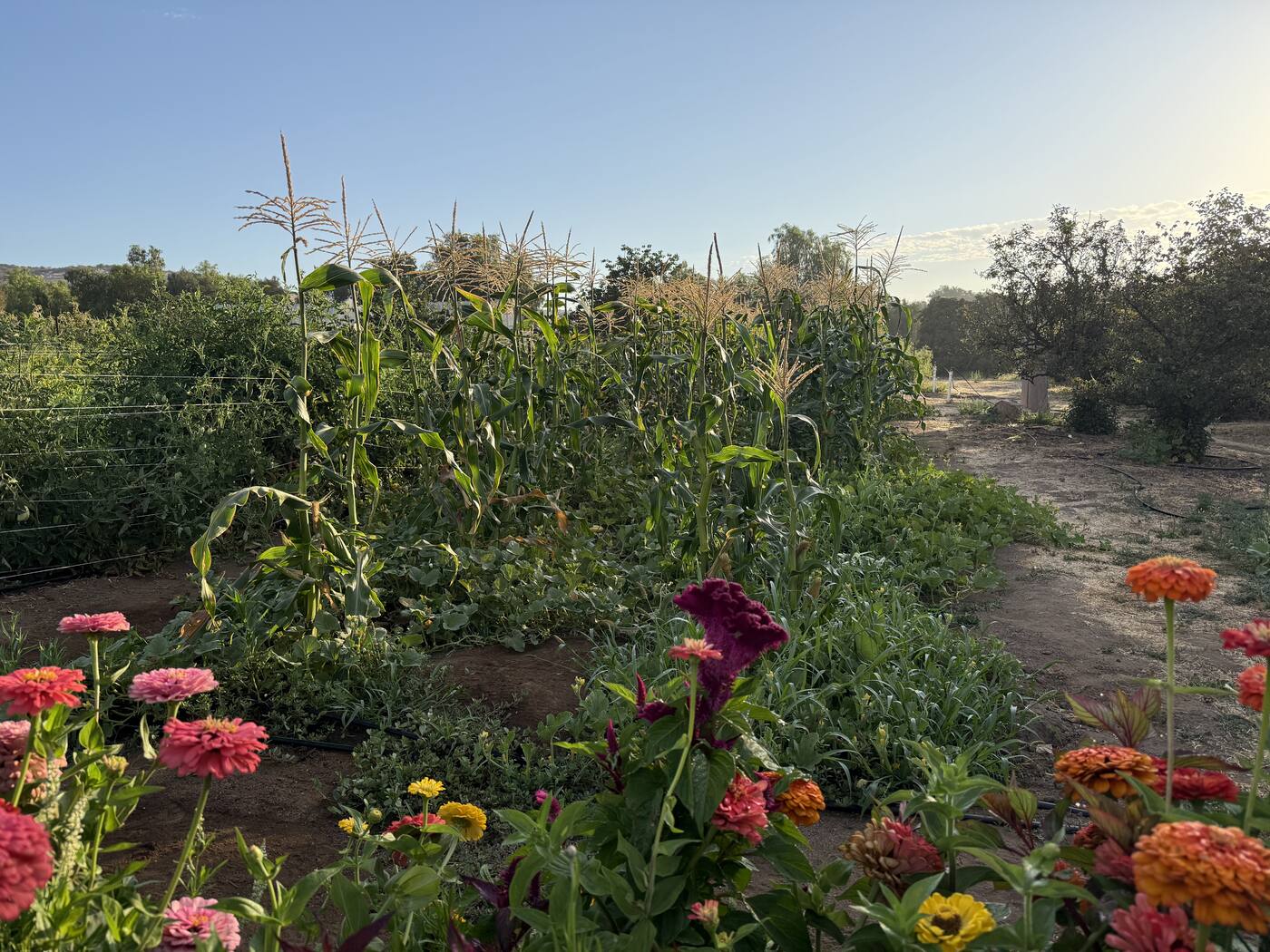
And on the last morning we walked out to Tres Estrellas at six — the organic garden breakfast hike, four miles through the zinnia rows and the corn and the animals, to eat what the place had grown. A working farm at dawn is the whole argument of the week, made without a slide.
And there was Pandora Thomas, who runs EARTHseed Farm in Sonoma County, telling a room how her mother Frances was born into sharecropping in South Carolina, moved north at three in the Great Migration, and still taught her daughter to love the land that had been used against her family.
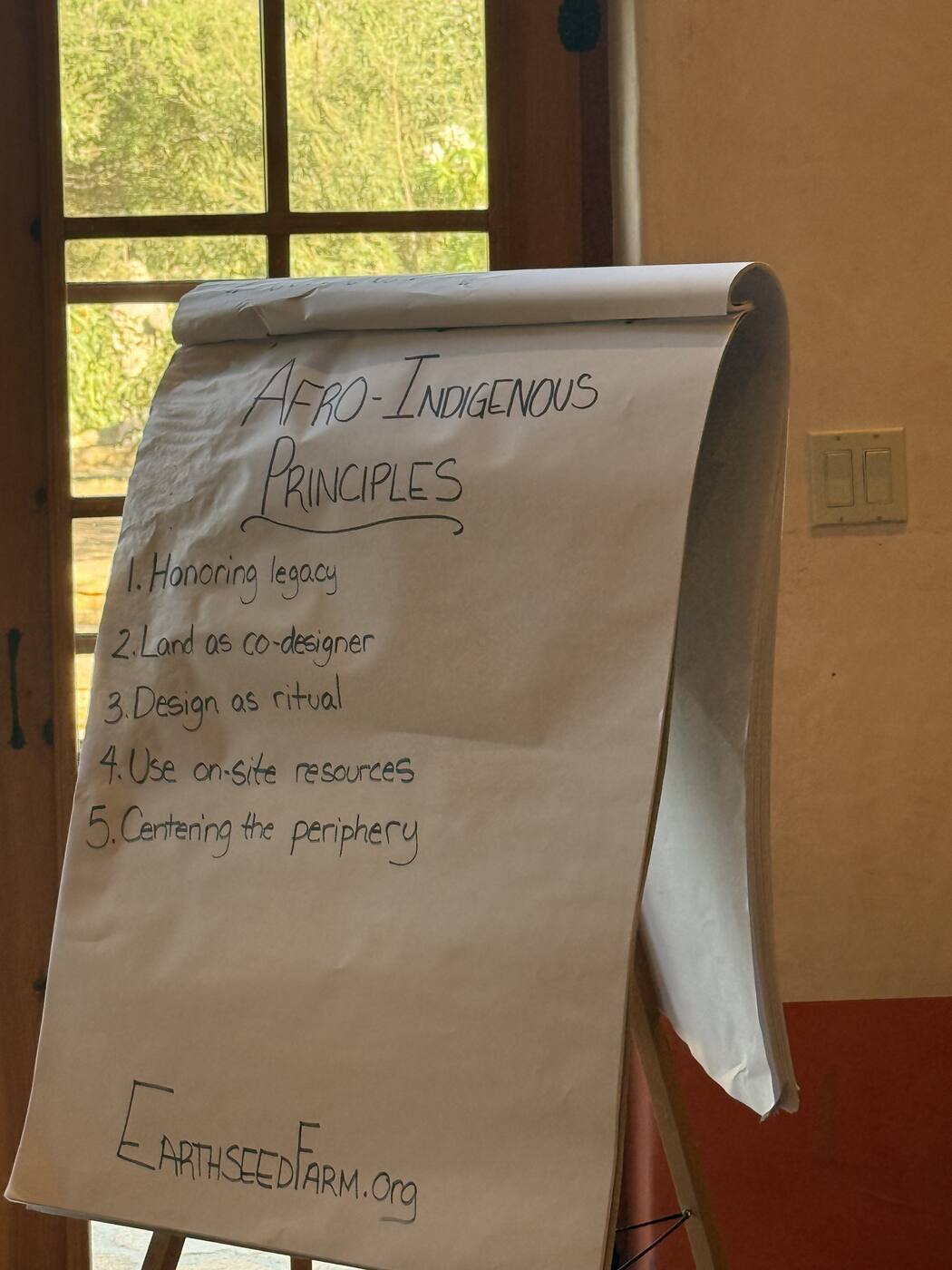
Pandora opened by asking us to turn to a neighbor and name an ancestor. Go back and fetch. That is what Sankofa means, from the Akan: go back and get it. The past isn't behind you. It's a resource you're allowed to use.
That is the exercise where I told a stranger about the kerosene lamp.
What I'm taking
Tom gave the room one concrete protocol, and it is almost embarrassingly simple. Remove gossip, rumors, criticism and judgment from your conversation. Replace them with dreams, ideas, visions and solutions. "That's a good start on altering the course of humanity. It's got to start somewhere. I would say it starts right here."
Kuchumaa was a gathering place long before it was a resort, and the people who governed here answered to a council. That is not decoration; it is the actual precedent for the thing I keep trying to build. Individual healing, on its own, will not save us. You need the container too. You need a fire that people sit around, and enough of them to constitute a council.
I went to Baja with a call sheet and a strategy. I came home with a collaborator. What Tom and I do together is not defined yet — international work, perhaps a book — and we are in no hurry to define it. I also came home with a sentence I intend to live inside.
"The world is perfect. There's just a lot of people having a bad conversation."
He says it before ceremonies. Then he asks everyone present to make one vow to the universe: to raise the level of our personal poetry, so that everything we say to each other reflects what we hold dear about what it means to be the people.
The thing I cannot stop thinking about
Tom is in his eighties. He still travels the world running ceremony, still takes kids into the forest, still teaches. Pat Mitchell and her husband are in their eighties too, and they are still moving — still making the film, still on the plane, still putting the thing in front of people who need to see it.
Nobody in that room was winding down.
I write a great deal about long life, and about the peoples who reach a hundred, and about the shape of a day that gets you there. I have never seen the argument made as plainly as it was made at that ranch by three people who could reasonably have stopped a decade ago and did not. The work is the practice. Not the reward you get after the practice, and not the thing the practice lets you retire from. Purpose is the load-bearing wall. Take it out and the house comes down, no matter how good the diet was.
My great-grandfather lived to a hundred and three, and he was still out with the sheep. I did not understand until Baja that I had been looking at the same evidence my whole life. I have written the long-life part out properly here.
We should all be inspired by this. I am.
One in a trillion, that table. I'm not going to waste it.
Pat Mitchell, and the film
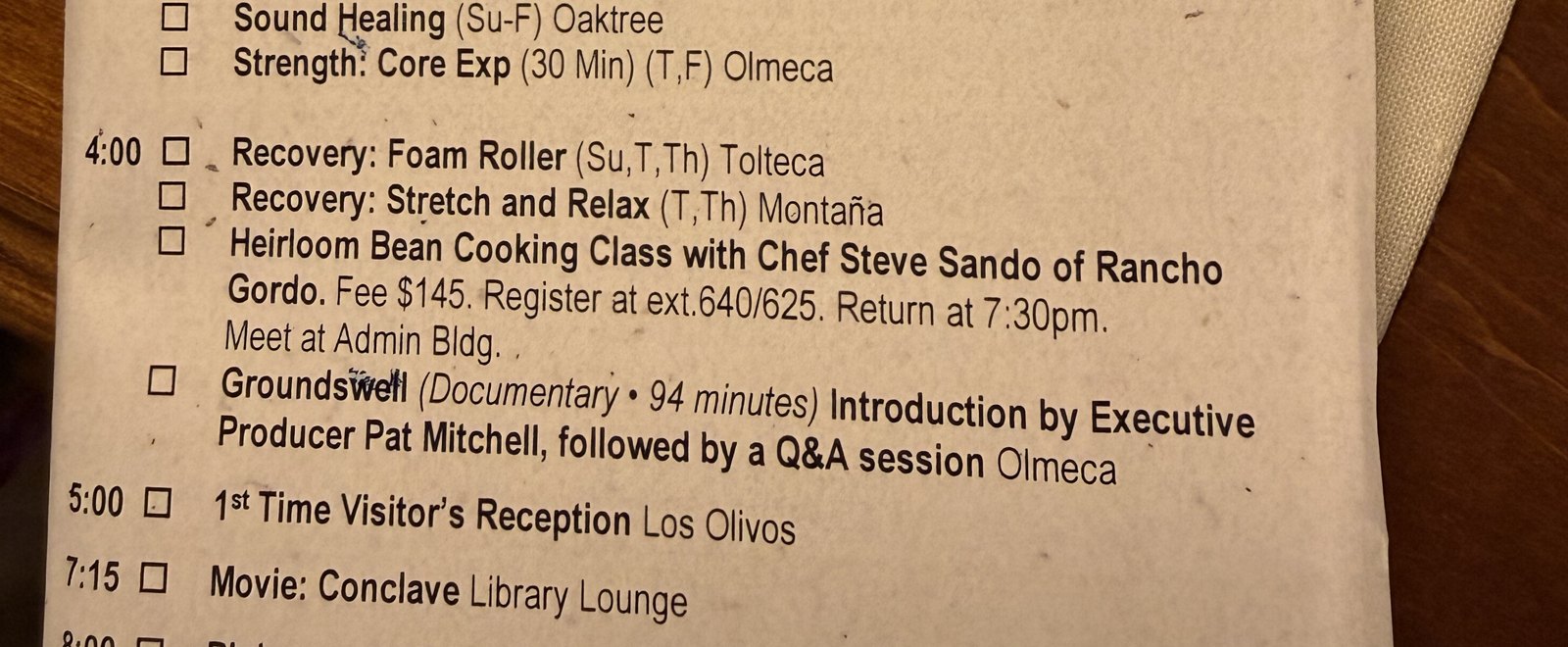
It was an honor to meet Pat Mitchell that week too. She was the first president of CNN Productions and the first woman to run PBS as president and chief executive, and she has spent a career deciding which stories a country gets to see. She is an executive producer of Groundswell, the documentary about regenerative agriculture that premiered at Cannes in May, and she introduced it at the Ranch and took the room's questions afterwards. A film about putting carbon back in the ground, shown to people who had spent the week being told the same thing in older words.
I take notes in every session I sit in, which is a habit rather than a discipline, and it means I can tell you what the film actually argues rather than what I remember of it.
It is the third of a trilogy — Kiss the Ground in 2020, Common Ground in 2023, and now this one — and the numbers across those six years are the reason to pay attention. In 2020 there were fewer than five million acres in regenerative agriculture in the United States. Today the film puts it at 250 million acres globally. The target is a billion, which is roughly ten per cent of all farmland on earth, and at that point it stops being a movement and becomes the default.
The number that ought to end the argument is the other one. There are fifty-five to sixty years of soil left on this planet for agriculture. Not water, not oil. Dirt. Sixty harvests, give or take, and we are spending it like it renews on its own.
It does renew, is the thing. That is the whole film. A ranch team in Montana went from four inches of topsoil to six feet of it in four years — dig down with a front-end loader and there are roots and earthworms and held water all the way down, in some of the hottest, driest ground there is. The Great Green Wall is doing the same thing across the Sahel. Nature can heal herself, as the film puts it, but she cannot do it alone.
And it will not be done without animals, which is the part that gets people who mean well. Bison in North America, wildebeest in Africa — they grazed in hordes and moved on and let the land rest. Take the herds off, or hold them in one place, and grassland becomes desert. Egypt was grassland. So was much of the Middle East. We did not lose those to drought. We lost them to a change in how the animals moved.
The line I keep turning over came from a spiritual leader in India, who at sixty-five rode a motorcycle from London to southern India — a hundred days, thirteen thousand kilometres, six hundred and ninety-one events across twenty-seven countries — to get ordinary people to say out loud that they cared about soil. This is what he said:
“Soil is not your property. It is a legacy you received from previous generations, and it is your fundamental responsibility to pass it on as a living entity to the next.”
That is the seventh-generation teaching, arriving from the other side of the world, in the language of a different tradition, and landing on exactly the same sentence. I sat in a dark room in Baja and heard a Diné idea I was raised inside come back to me in an Indian accent, three days after a Muskogee Creek elder handed me the same thing in Georgia English.
Here is why I care about it beyond the climate arithmetic. This is a food sovereignty argument. A community that can feed itself from its own ground, with its own seed, by its own methods, is a community that cannot be starved into a bad deal. Every community I have worked with lost its food system before it lost anything else, and got it back last. Cool the earth, grow real food, own your own ground — those are not three campaigns. They are one thing, and the old people ran it for ten thousand years without a name for it.
Afterwards the room stayed and talked. Not about policy. People told their own stories about ground they knew.
About the place, since it matters
It is worth knowing what Rancho La Puerta actually is, because it changes how you read everything above.
Edmond and Deborah Székely started it in 1940 at the foot of Kuchumaa. It is generally credited as the first modern destination spa anywhere — the place the whole category was copied from. That alone would be enough of a claim.
The part that interests me more is the ground. They put in an intentional organic garden in 1940, before the Rodales planted theirs in Pennsylvania, which makes it the first on this continent. Tres Estrellas — the six-acre farm we walked out to at six in the morning — was regenerated in 1984 by Sarah Livia Brightwood, who runs the Ranch now, third generation. Three generations of one family, on one piece of land, farming it the same way for eighty-six years.
That is why the Groundswell screening was not a guest appearance. It was a homecoming. A great deal of what the regenerative movement now presents as new was being run as ordinary practice in that valley before most of the movement was born. They were not early adopters. They were the ones the adopters were watching.
Eighty-six years is four generations of continuous practice on one piece of ground. That is the thing I keep trying to describe to communities, and it is easier to point at than to explain.
The book this came out of
The whole reason I was at that table is a novel called The Council Fire.
It imagines the keepers of many peoples’ oldest knowledge drawn to one fire as the systems running the modern world reach their limits — and then it does the unusual thing of showing, in detail, what they build afterwards. The council. The four capitals. The company chartered by the people who live with what it makes. A future that a seventh generation could actually stand in.
I wrote it as fiction. Then I sat down under the papel picado with a Muskogee Creek elder and a woman who has spent fifty years deciding which stories a country gets to see, and it stopped being fiction for an hour. That lunch table was a council fire. Small one. Real one.
Stone Breath comes first — it is the practice, carried as story, and it is where the count in this piece comes from. The Amber and the Stone is the crossing. The Council Fire is what gets built. And Far Messengers, book four, is the role itself — the oldest human job, and why we have to take it back up.
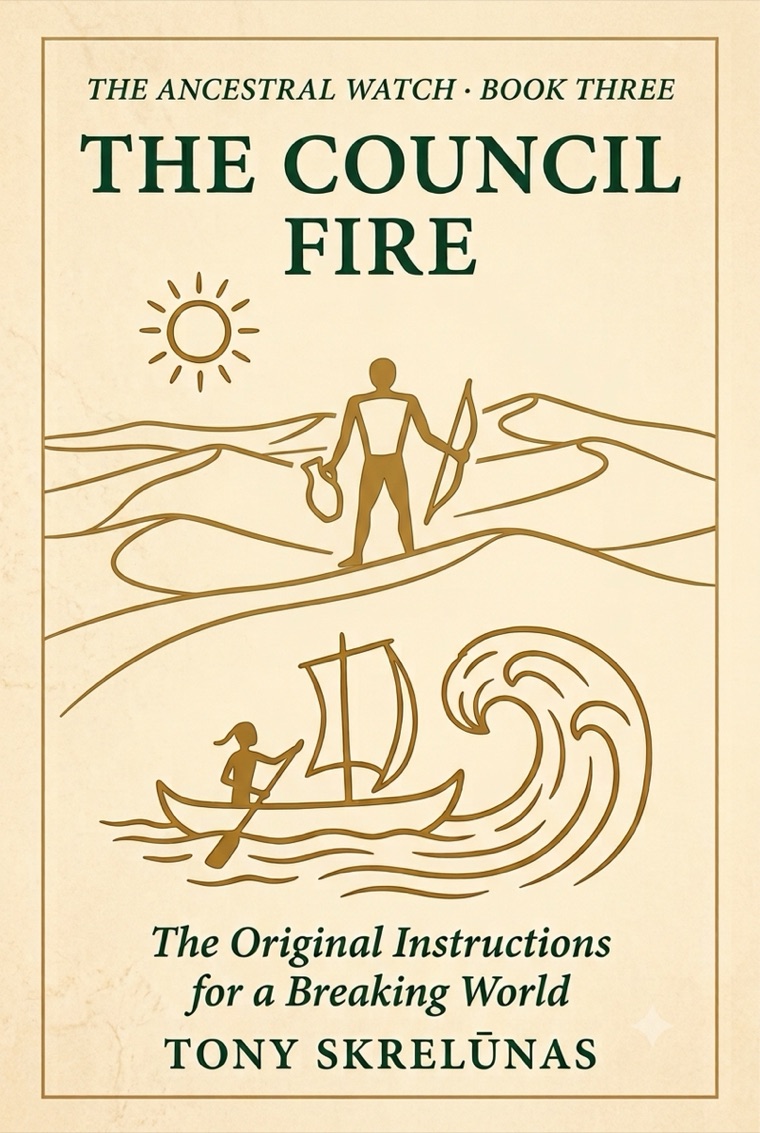 The Council FireWhat they build after the fire is lit.
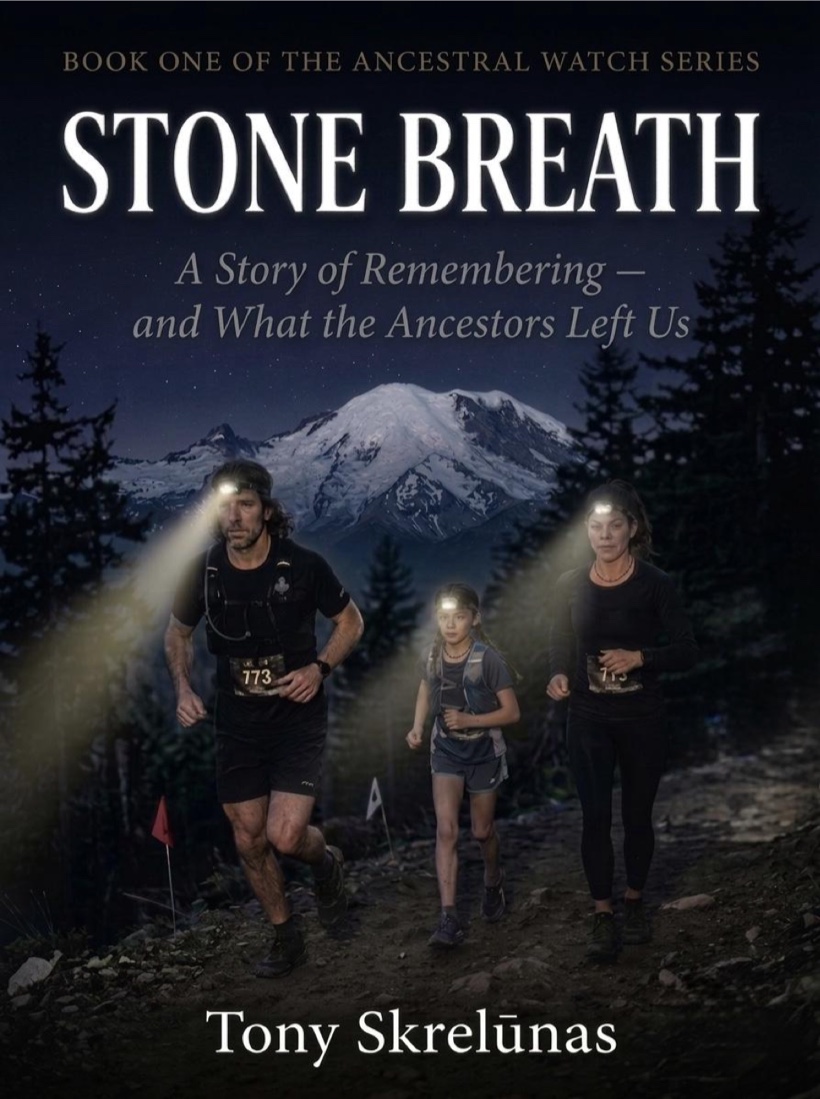 Stone BreathThe practice, carried as story.
 The Amber and the StoneThe crossing, and the scarf in Vilnius.
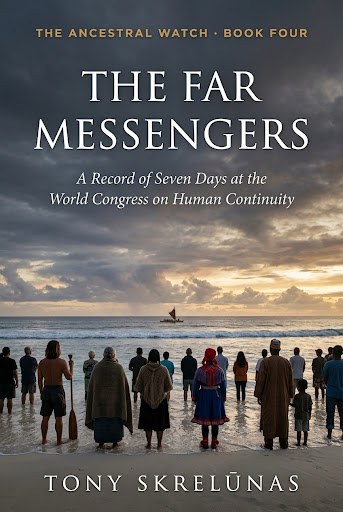 Far MessengersThe oldest human role, and why we have to become it again.
The Ancestral Watch series lives at ancestralwatch.com.
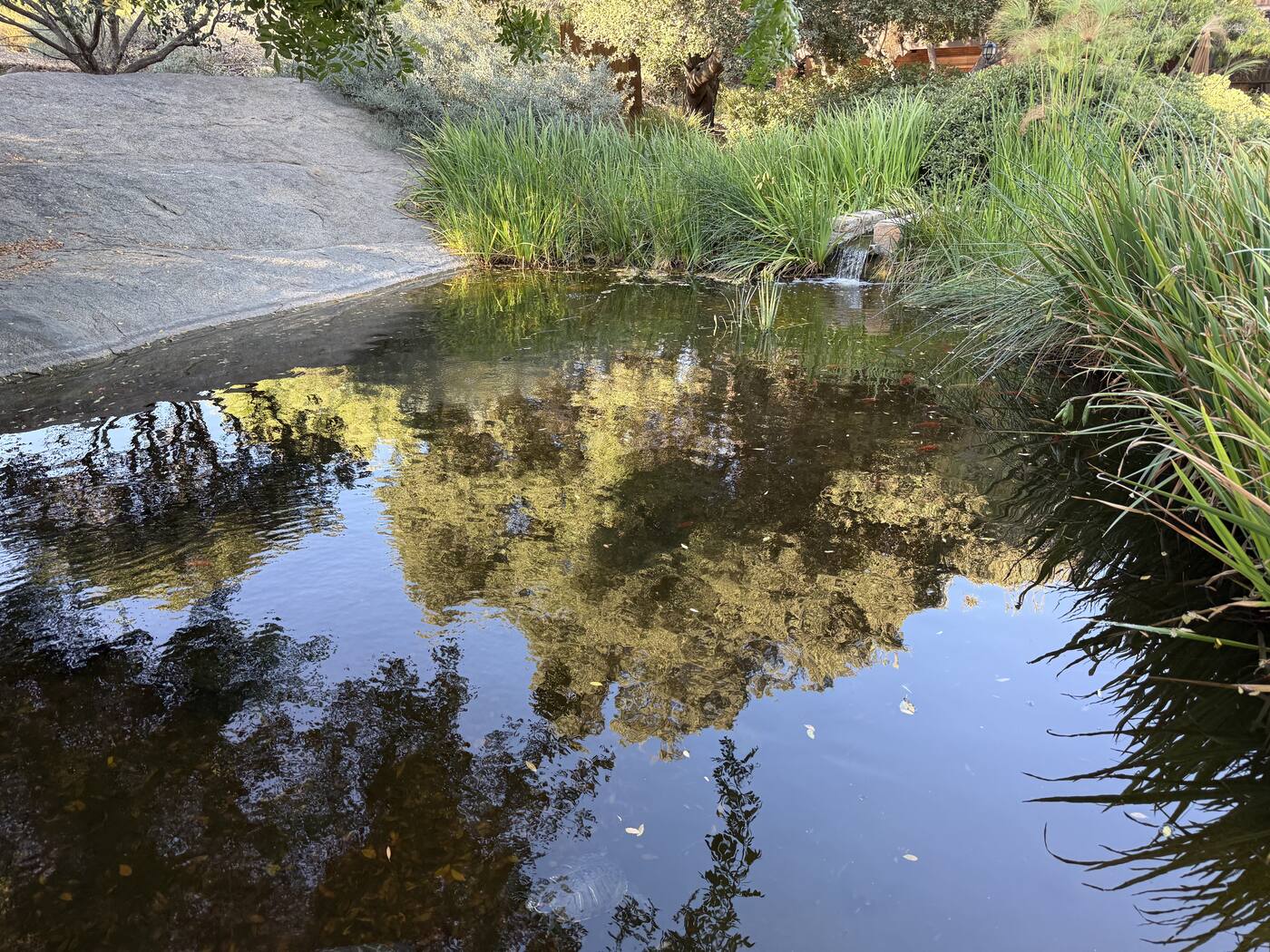
The place itself
A few more, because the ground does half the work.
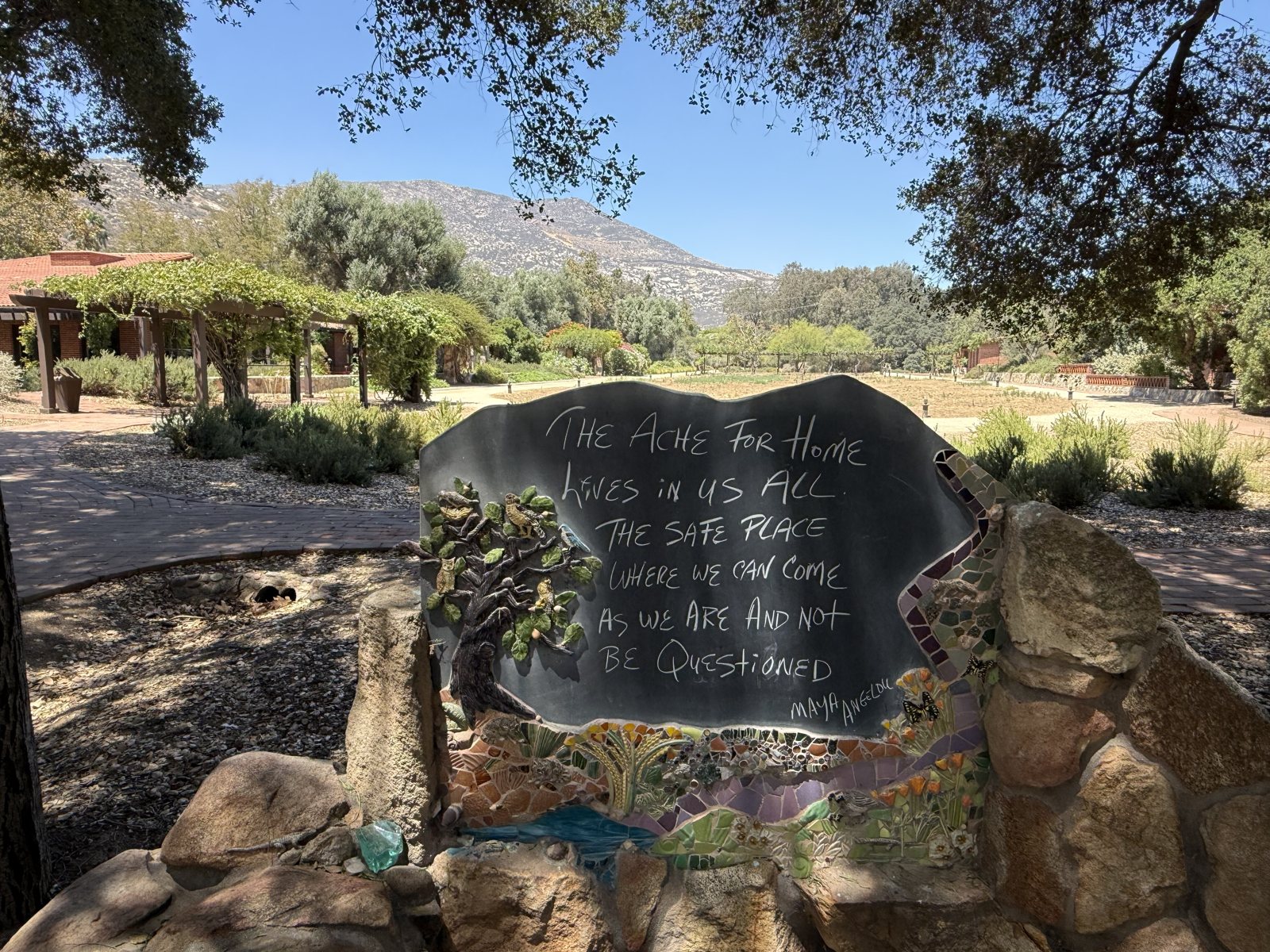
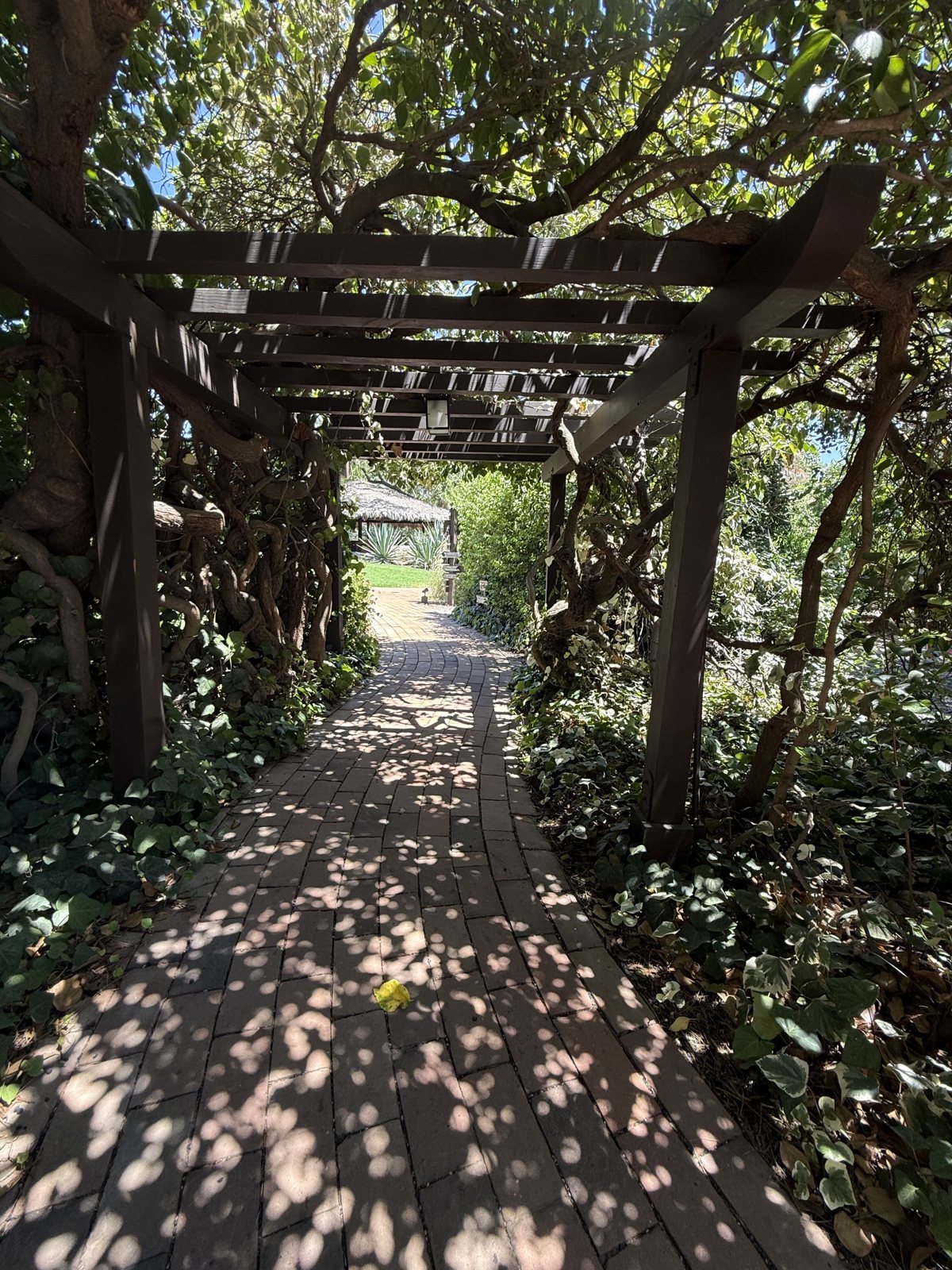
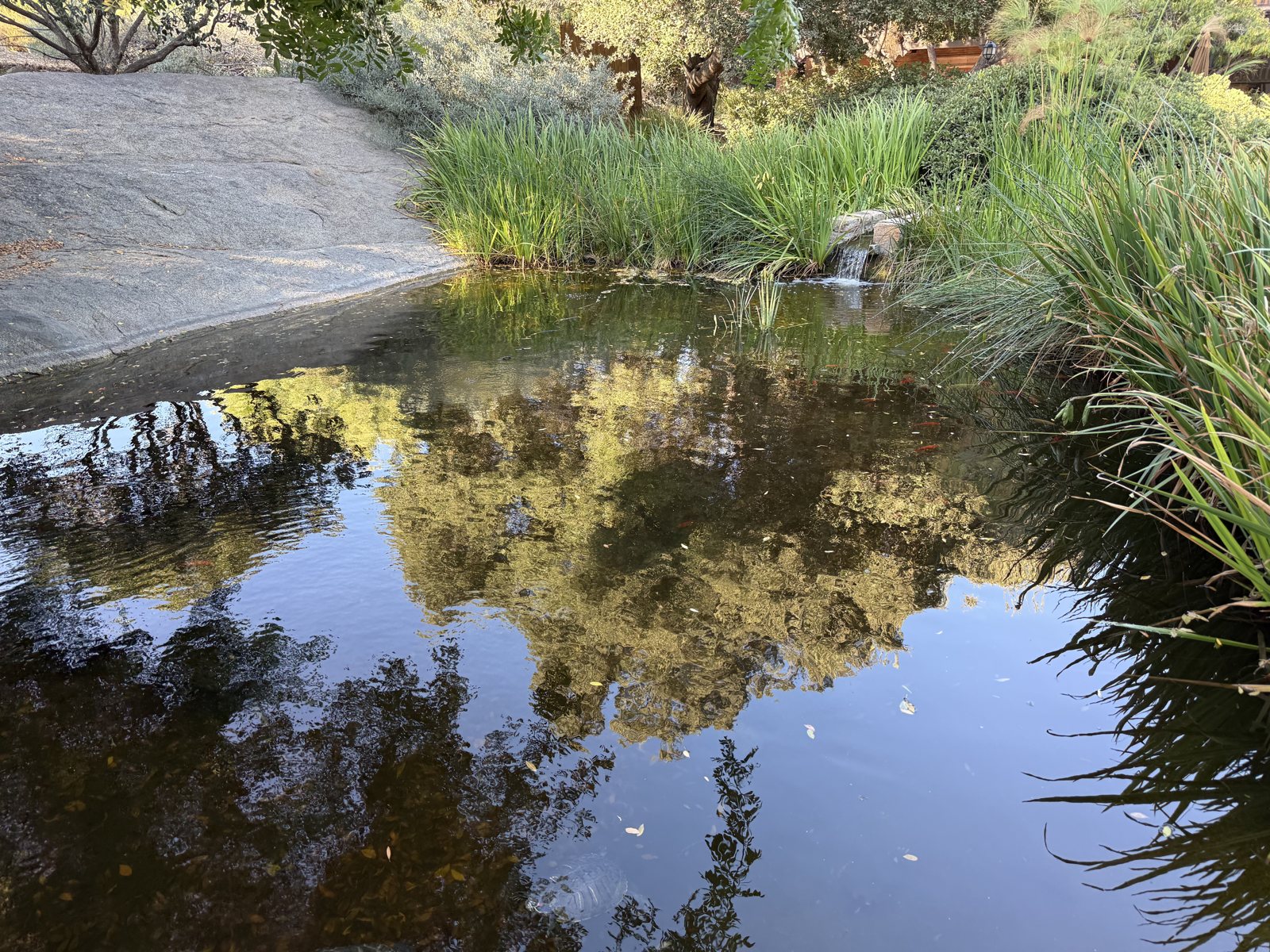
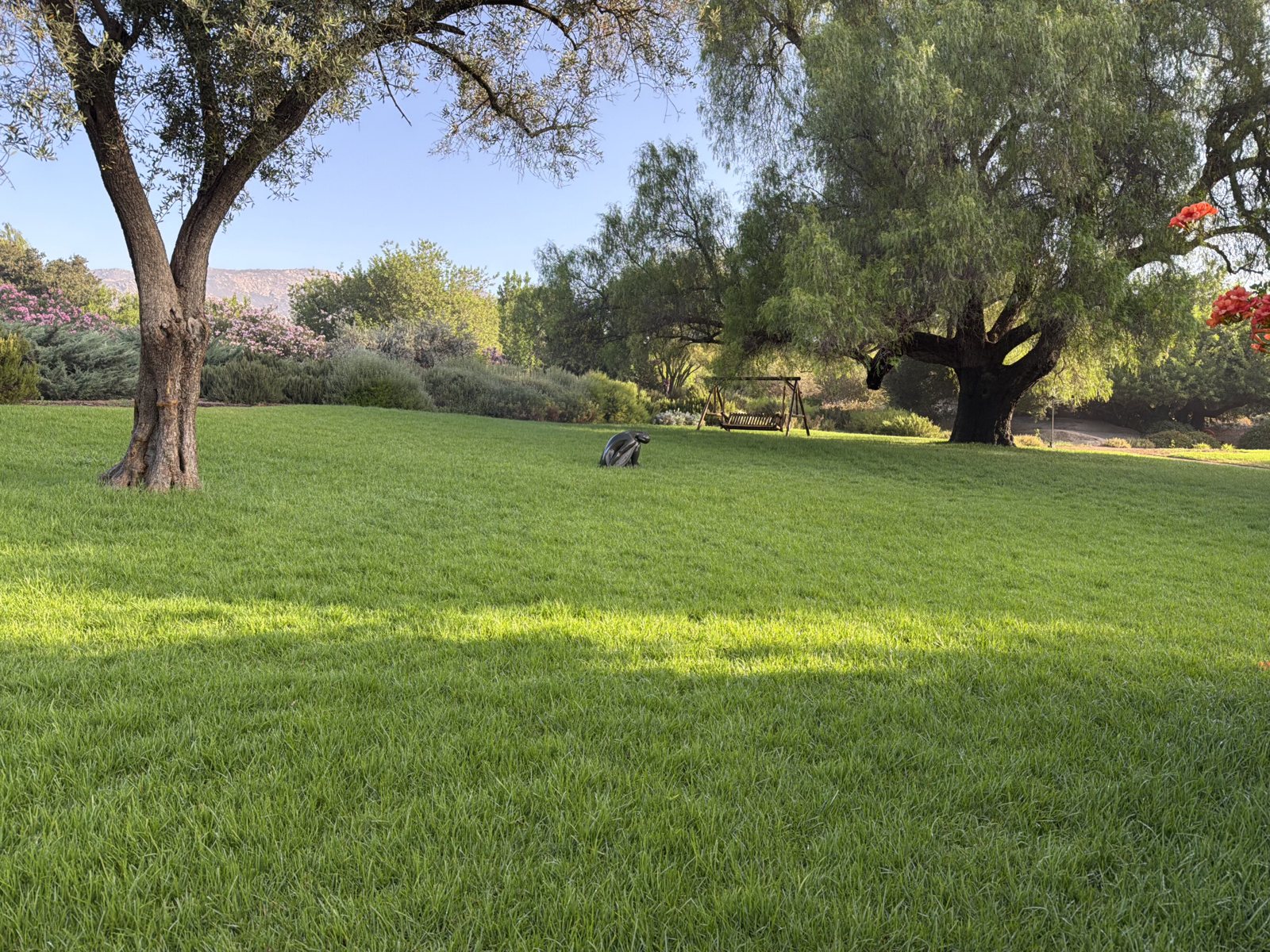
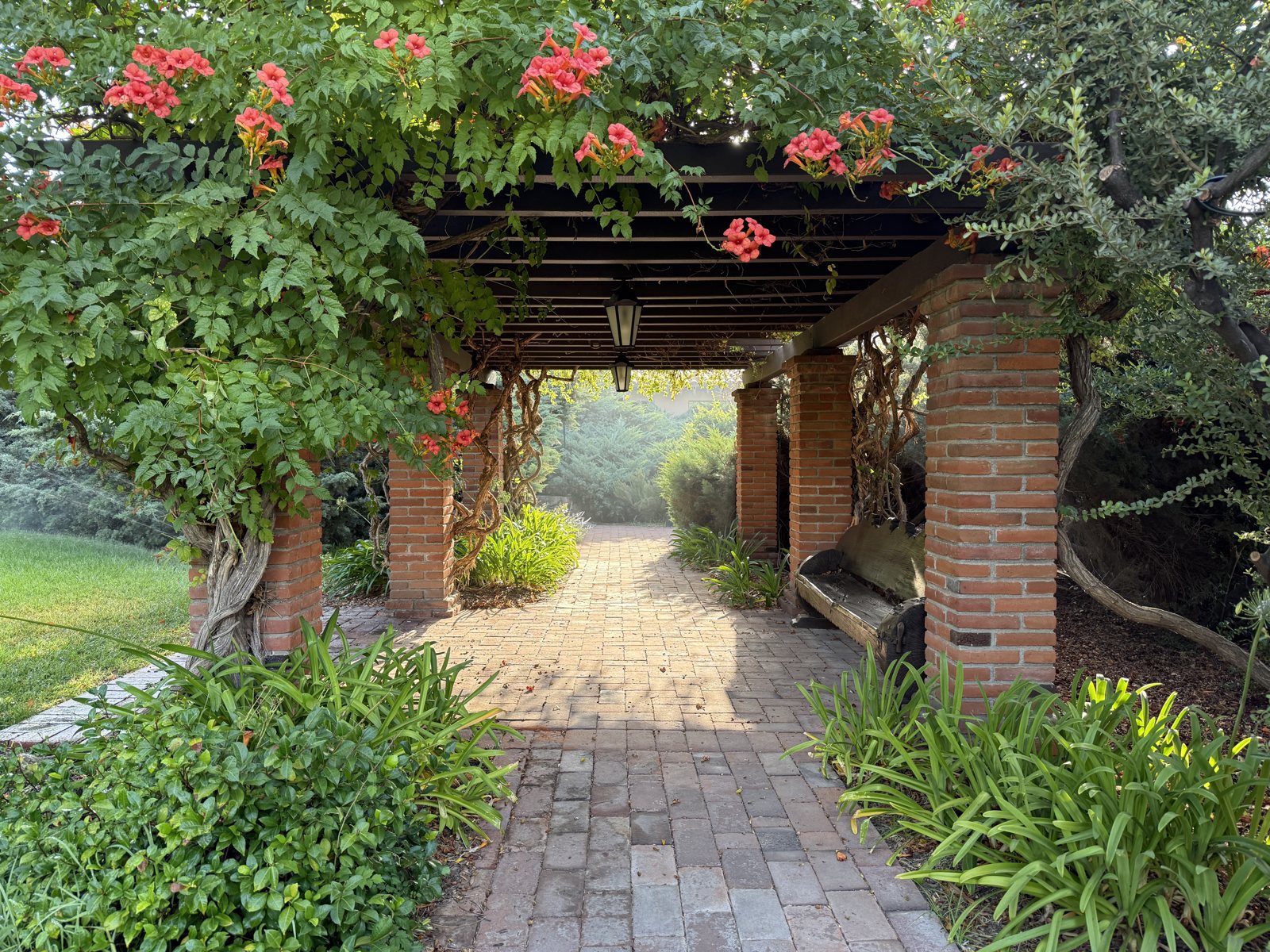
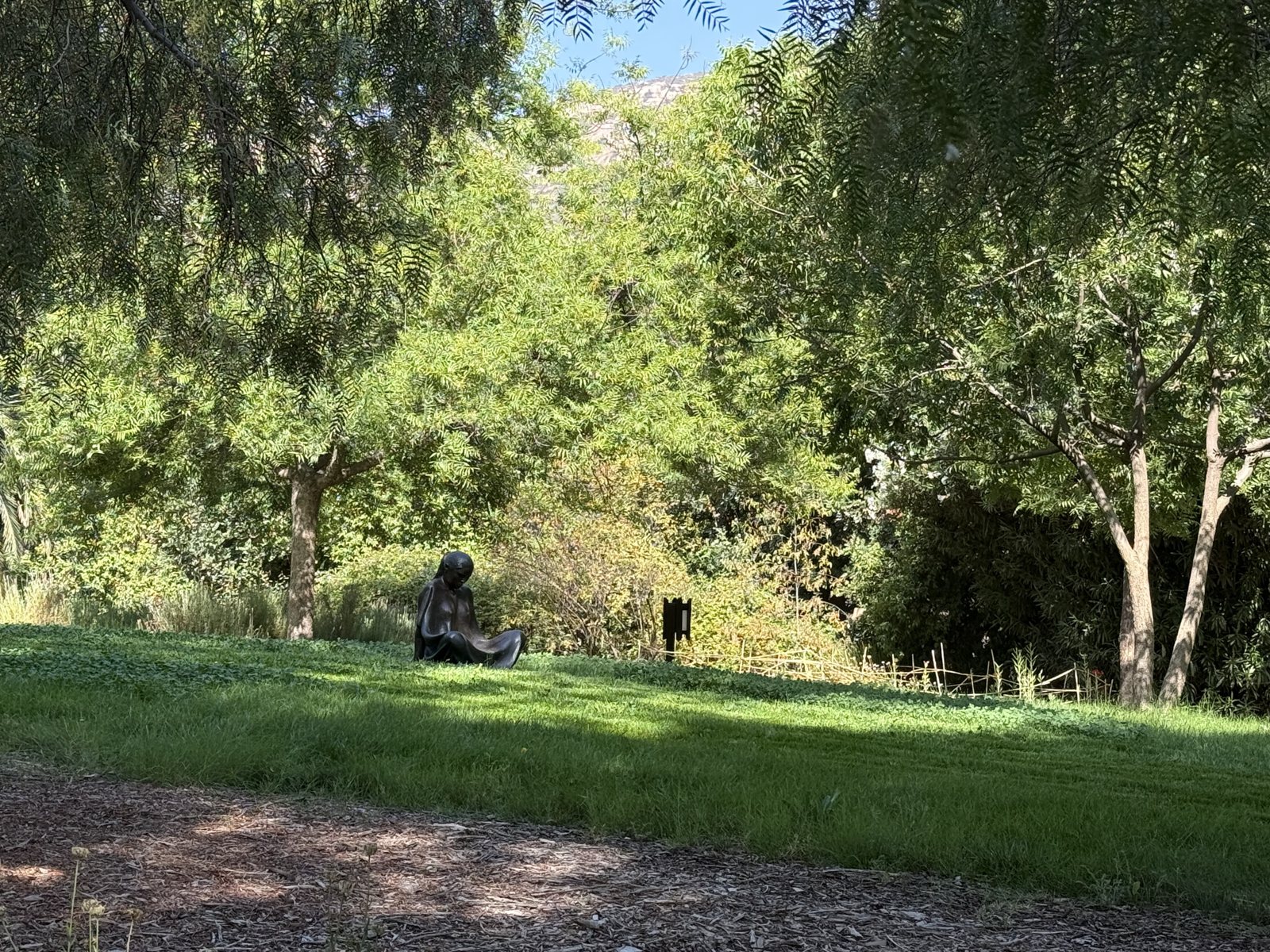
Rancho La Puerta · Tecate, Baja California · August 1–5, 2026. Quotations from notes and recordings made on site, with permission. Photographs by the author.