 Tribe
I was at Prescott College on Tuesday evening as part of my doctoral independent study, and to meet the students who may come to Kenya with me.
Next spring I will be teaching a course on resilience there. This was the evening where people find out what it is and decide whether it is theirs. I have been reading and writing about how peoples carry knowledge across hard ground for a few years now. This was the first time I laid the whole thing out for students who might actually go.
A colleague opened the evening before I did. He had spent time with Indigenous communities in southern Mexico, people building their own governance, their own schools, their own agriculture. He said something about the language there that I have not stopped thinking about.
In Tzotzil you cannot speak of anything as an object. Everything has its own subjectivity. And when people greet each other, a common greeting is not how are you. It is what does your heart say.
You can answer that my heart is in pieces. You can answer that my heart is whole.
I want you to sit with how different that is. In one greeting, a whole society has agreed on something. If you are not well, that is the concern of everyone, not a private matter you carry alone. The language will not let you pretend otherwise.
I had come to talk about far messengers. That greeting turned out to be the shortest way into it.
Where I come from
I was raised by my great-grandparents. My grandfather was Lithuanian. So I was this odd little kid out in the country, Diné and Lithuanian at the same time, and a lot of the time my grandfather and I could not understand each other’s words at all.
My great-grandparents were settled. People hear that word and think of rest. Settled means you work without stopping. Hundreds of sheep. Cornfields. Training horses. Singing ceremonies. Visiting your brothers and sisters, who are all in their seventies and also not resting. There is no such thing as retirement in Navajo.
They sang to everything. They had songs for the sheep. Songs for the medicines. Songs for the corn. Every time we crossed the river, a prayer. Several prayers a day. I can still see my great-grandmother with her corn pollen, her scarf, her skirt. She was a weaver and she wove the old way.
My great-grandfather was called Big Lakes. We make names for people, sometimes several across a life, and the later ones describe who you turned out to be. He was boisterous. He built hogans and trained horses and kept the finest cornfield I have ever seen, and I have worked with a lot of farming people.
He wore cowboy hats. He told me to dress with honor no matter what. That is why you will always see me in a hat.
In all those years I never once heard him say an unkind word about anybody.
There is no word for leader
Later I led the effort to restructure the Navajo government toward something more culturally grounded. We worked with our medicine people and our historians, and we wrote a history from our oral tradition. It begins with checks and balances, and with the separation of power between Mother Earth and Father Sky.
We were surrounded by help. Universities, professors, attorneys. But it was our traditional leaders who drove it.
They set one condition I did not expect. We could write the high points. We could not write the whole thing. Whoever truly wants to learn it can come and listen. That was the first time I understood there was something deep here, and that writing is not the only way a thing survives.
We studied how leaders were chosen long ago, and found that the question itself was wrong. There is no word for leader. There is Natani. A Natani is one who understands the rhythm of the world and offers guidance. Something is happening with the weather. Something is happening in the wind. I think we should go this way.
They were chosen for what they knew, and for how they lived, and for one thing more. Calmness in extreme situations.
Why a people sends travelers out
My grandmother used to tell me to go running early in the morning. She said the breathing and the discipline would make my mind stronger. I was a kid. I thought she was talking about my legs.
She was describing a system for raising calm people who could carry things.
Out here everything is far. Our communities sit a hundred, a hundred and fifty, two hundred miles apart. And a society still has to get what it needs. Minerals. Argillite, which came from near Prescott. Shell and minerals from the ocean. Feathers. Salt. Water from distant sacred springs. All of it on annual cycles, which means somebody has to go.
But the deeper question is the one that keeps me writing. How does a society learn anything new? New ways of healing. New thought. New ways to tell its own emergence story. Someone has to travel, and arrive well, and come back whole.
The man who gave it away
I told them about Mau Piailug.
He was born on Satawal, in Micronesia, on an island about a mile across. His grandfather began training him as an infant. He was a master navigator by eighteen. No writing, no chart, no instrument. Hundreds of stars, and which house of the sky each one rises in, all of it held in a body.
In the 1970s, serious people still argued that the Pacific had been settled by accident. Canoes blown off course. No navigation at all. So a canoe was built the old way to test it, and then came the problem: nobody in Hawai’i could navigate her. That knowledge had been gone six hundred years.
They found Mau. He was not Hawaiian. These were not his people, not his ancestors, not his argument. He sailed about 2,400 miles to Tahiti and arrived in thirty-three days, with no compass, no sextant, no chart and no clock.
From a canoe you can see three miles. By the time you see an island you are nearly on it. So he read the birds, and the light on a cloud that would not move, and on dark nights he lay in the hull and read the swells through his hips. He could tell in the middle of the night that they had drifted off course, by feel alone.
Here is the part I keep returning to. That voyage was hard on him. He was not treated well by everyone aboard, and when they reached Tahiti he got off and went home without sailing her back. He had just proved their ancestors right, and he left.
And then he came back and taught them.
He taught people who, by the rules he himself had been raised under, had no claim on that knowledge. He did it because it was dying in his own islands too, and he decided that losing it entirely was worse than breaking the rule about who was allowed to hold it.
That is the whole thing in one man. The carry is not a reward for good conduct. You hand it to whoever will actually carry it.
The pebble
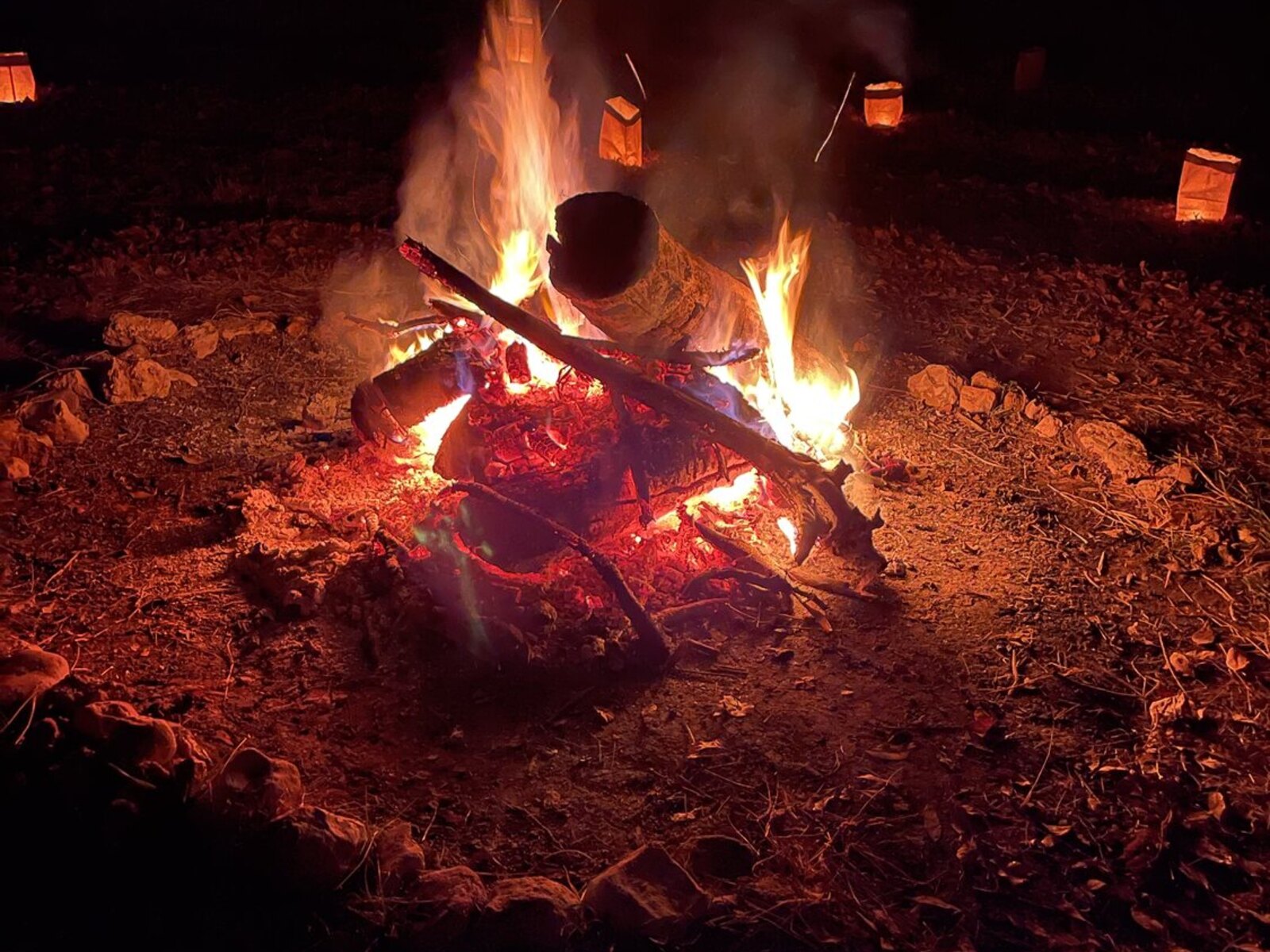
We ended outside, around a fire.
I taught them what my great-grandfather did, and what the old runners did. You put a small pebble on top of your tongue, and you keep it balanced there. You cannot lean forward. You cannot tip your head back.
Try it and you will find you have no choice about the rest. Your jaw releases. Your face releases. Your neck, your shoulders, your arms, your hands. Your breathing slows and evens out on its own, because it has to. And you feel the ground come up under your feet.
That is not a charm. It is a piece of equipment. One small stone that regulates a nervous system so a person can run a long way and arrive able to deliver what they were sent with.
My great-great-grandfather was a runner. My great-grandmother used to say: pick up a pebble as you run, go toward the east, run with the Holy Beings in the morning. Her father raced against other peoples at the big gatherings, where the Hopi and the Zuni and the Choctaw and the Chickasaw and the Plains nations came together for days. Those races were ceremonial. If you came unprepared, they could take everything out of you.
So you prepared. The breath. The pebble. The sweat. The songs.
What I told them at the end
We have some difficult ground ahead. I am not going to pretend otherwise, and I do not think anyone needs me to.
But you can look at the bad news, and there has always been bad news, or you can look at where the good energy is. Both are real. Only one of them is any use to you on the journey.
What we need now is resilience, because that is how a people continues. Not for my children and their children. For generations down the road, and for a thousand years, which is the timeframe my great-grandparents thought in without ever calling it that.
The deserts and the oceans are going to be harder than they have been. I do not think we are ready for them yet.
That is why I teach this. And that is why I was glad to be at that fire with students who are going to carry things.
So — what does your heart say?
Mine is whole.
A note on timing. That evening landed in the same stretch of days as both books. The Council Fire had just been released with its new cover. And Stone Breath went out internationally — it is now out in Europe and Japan among other places. I wrote it through a multicultural lens, with Diné, Lithuanian and Japanese characters, and I had it checked by people from those traditions before it went anywhere. I did not plan for the books and the recruiting to arrive together. But two books about carrying what matters across hard ground, going out into the world in the same stretch of days that I stood at a fire teaching students how to do exactly that, is the kind of coincidence I have learned to simply notice and be grateful for.
Tony Skrelūnas is Diné (Navajo) and Lithuanian. He writes The Ancestral Watch — Stone Breath, The Amber and the Stone, The Council Fire and The Far Messengers — and the working reader, Living as a Far Messenger. He is a PhD candidate; his dissertation looks at human and organizational performance through Diné and Lithuanian ancestral knowledge and the Japanese practices he has long studied. He holds a faculty appointment at 1440 Multiversity, where teaching is the center of the work now. He runs at dawn and hikes with a corgi named Roper.
Last reviewed October 2026.