I carry two bloodlines that were each supposed to disappear. Neither one did.
I write often about one side of me — the language, the sheep, the ceremonies that outlasted the people sent to end them. But today I am standing in a solstice festival far from that homeland, weaving crowns and singing the old songs of my other lineage, and I want to tell you their story. Because it is one of the most stunning survivals in the world, and because it belongs to you too.
This is not a contest of who suffered most. I don't believe in that. Suffering isn't a competition — it's a brotherhood. What I believe is this: when you see how many peoples were nearly erased and came back anyway, you stop feeling alone in your own history. You realize survival is the human inheritance. So let me show you theirs.
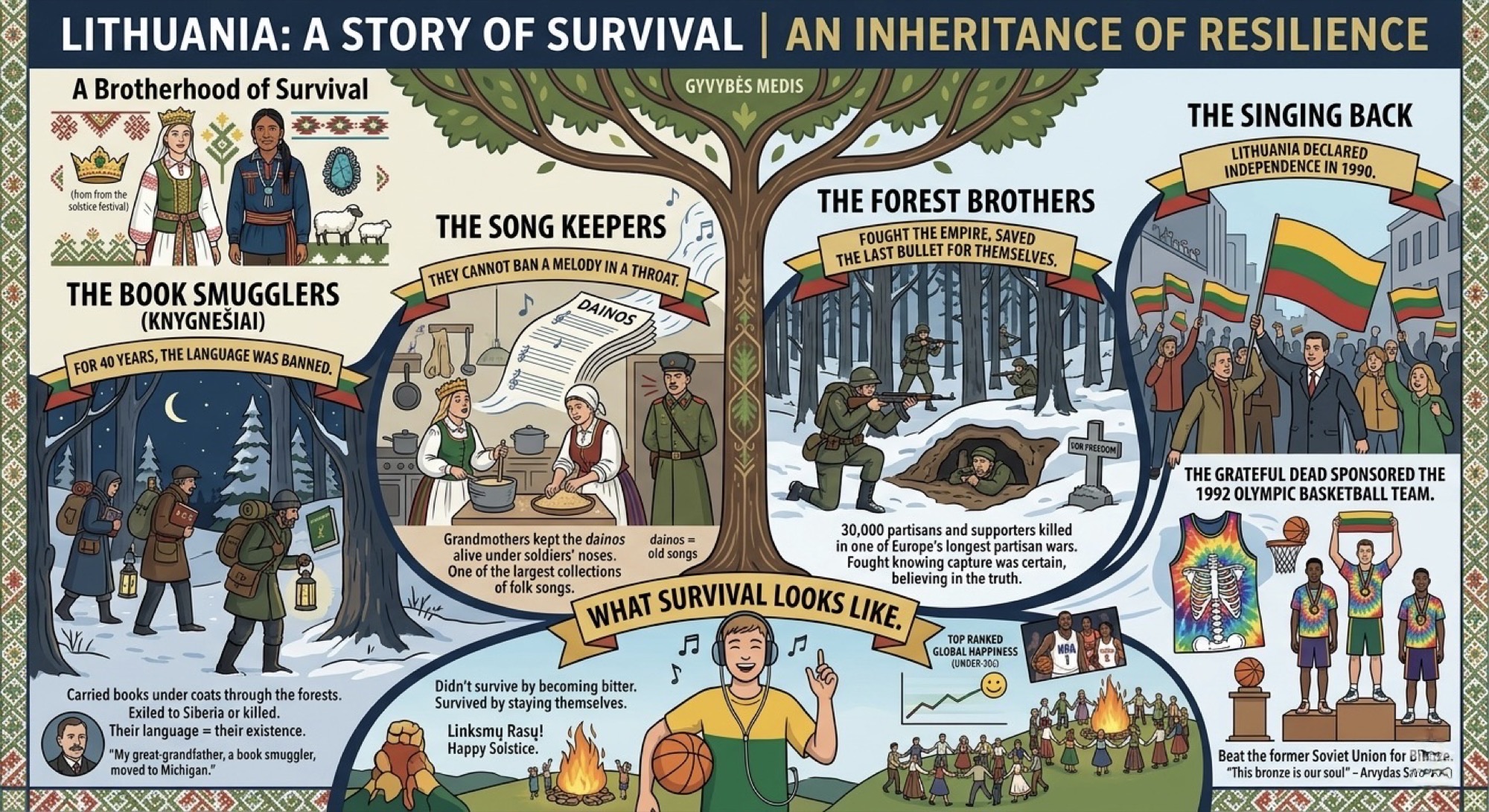
The Book Smugglers
For forty years, it was illegal to print a book in the Lithuanian language. The empire banned the Latin alphabet itself — trying to dissolve a people by dissolving their words. Teach a child to read their mother tongue and you went to prison. Smuggle books, and you could be exiled to Siberia.
So they smuggled the books anyway. They were called knygnešiai — "book carriers." They walked through forests at night with Lithuanian books hidden under their coats and beneath the hay in their wagons. Some were caught. Some were killed. They kept walking. Because a book in your own language isn't paper and ink — it's a declaration that your people still exist.
I think about them when I think about why I write at all. A book carried through the dark is a wager on the future — a message sent ahead to the great-grandchildren, saying we were here, and we chose you.
The Song Keepers
You cannot ban a melody that lives in a throat. You cannot confiscate a rhythm that passes from mother to daughter while they grind grain together.
So when the books were banned, and later when the occupation came, the grandmothers kept the dainos — the old songs — alive in kitchens and fields, under the noses of the soldiers. This small nation holds one of the largest collections of folk songs on earth: hundreds of thousands of them. They survived because women refused to stop singing.
The Forest Brothers
Then came the worst of it. After 1944, the empire swallowed the country whole. And thousands of ordinary people — farmers, teachers, students — picked up rifles and walked into the forests to fight one of the largest powers in history.
They were called the Forest Brothers. They waged guerrilla war from 1944 to 1953 — one of the longest partisan wars in Europe. An estimated 30,000 partisans and their supporters were killed. Another 60,000 died in Siberia in the early post-war years. It is said the fighters always saved the last bullet for themselves, knowing what capture meant.
They fought, knowing they would almost certainly lose, for one reason. As the survivors put it: they believed in the ultimate victory of the truth. And decades later, free citizens thanked them simply — for the chance to speak their own language without fear, to travel where they wished, and to choose whom to vote for.
And Then — They Came Back Singing
Here is where the story turns, and why I love these people.
The nation declared independence in 1990. Almost immediately, it wanted to send a basketball team to the 1992 Olympics — to play under its own flag for the first time in fifty years. But the new country was broke. They announced they would have to withdraw. No money. No sponsor.
Then the strangest, most beautiful thing happened. The Grateful Dead — the American rock band — heard about this freshly independent country that couldn't afford to send its team, fell in love with the underdog, and sponsored them. The band's artist designed tie-dye shirts in the national colors — yellow, green, and red — with a skeleton dunking a basketball.
And then they beat the former empire to win the bronze medal. They climbed onto the podium — playing for their own flag for the first time in half a century — wearing tie-dye. "We cried," one player said. "It was from joy. Words cannot express it." The great Arvydas Sabonis, comparing his old gold medal to this new bronze, said it best: "The medal in Seoul was gold, but this bronze is our soul." That tie-dye skeleton jersey is now iconic around the world — a symbol of freedom, born from a people who refused to disappear.
What Survival Looks Like
This is a tiny nation — fewer than three million people, with a huge diaspora scattered across the world (which is exactly why we gather at festivals like the one I'm standing in today). And yet:
This people who were banned, occupied, deported, and nearly erased are today, by the most recent global happiness research, home to the happiest young people on earth — their under-30s top the world. They produce athletes who fill professional leagues, and musicians and dancers and performers far beyond what a country their size should generate. And every summer solstice, on the hills, they light the fires their grandmothers lit, and they sing.
They didn't survive by becoming bitter. They survived by staying themselves — and then they multiplied.
This is the thing I most want you to carry, whoever you are, whatever blood runs in you: many, many peoples have walked through the fire of erasure — and so many more than we ever name. Saying so isn't a competition. It's a brotherhood. And the ones who make it through teach the same lesson, in every language on earth: you don't survive by forgetting who you are. You survive by refusing to.
The book smugglers carried paper across borders. The song keepers carried melodies across generations. The forest fighters carried the truth into the trees. My grandfather carried himself across a continent to sit with a boy in a sheep camp on the other side of the world.
Same thing. Different words.
If you are standing in your own history right now, wondering whether the line ends with you — hear me. You are not alone; the circle holds. It is not too late. The fire is still lit. It is you.
Happy solstice. 🔥🌿