I have spent a long time describing a future in argument. Governance that fits the people. Wealth that stays home. An economy that counts four accounts instead of one. Decisions weighed against the seventh generation.
It is a hard thing to make people see, because it sounds like philosophy.
Regenerative agriculture is the same future, and it is already measurable. That is why I keep coming back to it. It is the one place where you can put a shovel in the ground and settle the argument.
Where this is coming from
Two things put this in front of me in the same week, and they arrived from opposite directions.
The first was a film. Groundswell is the third of a trilogy — Kiss the Ground in 2020, Common Ground in 2023 — directed by Josh and Rebecca Tickell, narrated by Demi Moore and Woody Harrelson, following farmers, ranchers, scientists and Indigenous leaders across five continents. Pat Mitchell is one of its executive producers, and she introduced it and took the room’s questions afterwards. Its own tagline is a living blueprint for global renewal, which sounds like a lot until you watch it.
The second was an eighty-one-year-old Muskogee Creek elder named Tom Blue Wolf, at a lunch table, who has never owned a phone and who arrived at the same conclusions from the other end entirely.
I want to put both in here, because between them they cover the whole of it — the measurement and the meaning — and neither one is sufficient on its own.
What is actually being claimed
Farm the way industrial agriculture farms and soil is a substrate — something inert that holds a plant up while chemistry does the work. Farm the way the old people farmed and soil is a living body: a carbon sink, a water bank and an information network, running underneath your feet.
The claim is that this is reversible, and fast. A ranch team in Montana went from four inches of topsoil to six feet in four years. Dig down with a front-end loader and there are roots, earthworms and held water all the way down — in some of the hottest, driest ground in the country. The Great Green Wall is doing the same work across the Sahel, band by band.
The other number is the one that should stop the conversation: there are fifty-five to sixty years of soil left on this planet for agriculture. Not oil. Not water. Dirt. Sixty harvests, and we are spending it as if it renews on its own.
It does renew. That is the whole point. But not while we are farming it the way we are.
The four accounts, on a farm
In The Council Fire the keepers refuse the single number. They keep four accounts at once and a thing is only rich if all four are growing — the money, the people, what is remembered, and the land. I wrote that as fiction. Here is what it looks like as agronomy.
The money. A regenerative farm earns without the inputs. Fertiliser, herbicide and diesel come off the ledger as the soil starts doing the work again. That is not sentiment; it is the margin that lets a family stay on land instead of selling it to somebody who will farm it harder.
The people. This work cannot be done by one operator on a big machine. It needs hands, knowledge, neighbors who share equipment and observation. It rebuilds the middle of a rural economy, which is the part that died first.
What is remembered. Almost none of this is new. Cover the ground, keep roots in it, move the animals, let the land rest — every one of those is a recovered practice, not an invention. The research is catching up to the memory.
The land. Which is the account the old economy wrote down as zero, and which turns out to be the one that makes the other three possible.
Four accounts, all rising, on the same acre. That is not a metaphor for the argument. It is the argument, with a soil test attached.
The animals are not optional
This is the part that catches out people who mean well.
You cannot restore grassland without herds. Bison here, wildebeest in Africa — they grazed in hordes, tore it up, fertilised it, and moved on, and then the land rested for a long time before they came back. Take the animals off and the grassland dies. Hold them in one place and it dies faster.
Egypt was grassland. So was much of the Middle East. We did not lose those to weather. We lost them to a change in how the animals moved — a management decision, made slowly, over centuries, by people who did not know they were making it.
My great-grandmother ran four hundred sheep on Black Mesa and moved them by season, because that is what you do. Nobody called it carbon management. It was just how you kept the land able to feed you next year.
What Tom says the soil is
Tom Blue Wolf has run EarthKeepers since 1970, the year after he came home from Vietnam. His working theory is that human beings were designed to function as the earth’s immune system — shepherds, stewards, caregivers. “When we abandoned that post, everything went to hell.”
He is not being poetic about the stakes. He cited a number that has been sitting in my chest since: forty years ago, roughly half the animal life on earth was humans and our domesticated animals, and half was wild. This year the figure is ninety-six per cent to four.
Then he described the soil, and it is the best description I have heard from anyone, in or out of a laboratory. Starlight enters the leaves. The tree carries it down as sap into the roots. The roots hand the energy and the information to the mycelium, and the mycelium is the nervous system of the mother. Touch the earth anywhere and she feels it everywhere.
Which is why ceremony works at all. You do not have to scratch the whole body to make the whole body feel better.
Set that beside the agronomy and they are the same claim. The soil scientists say a mycorrhizal network moves carbon, water, nutrients and chemical signalling between plants across a whole field. Tom says the mycelium is the nervous system of the mother and she feels it everywhere. One of those sentences will get you funded and the other will get you a raised eyebrow, and they are describing the identical thing.
His practice follows from it. He takes young people into the forest — including kids sentenced to him out of an adolescent substance-abuse program in Atlanta — takes their devices, and teaches them what is food, what is not food, and what is medicine. Then he teaches them the song of the food. “Because plants will treat you different. Just like dogs — when you sing to them.”
You can file that under folklore if you want to. Or you can notice that birdsong opens certain flowers, the opened flowers call the pollinators, and the whole system is already singing to itself without asking our permission. He is not being mystical. He is describing signalling in a system, using the words his grandfather gave him.
Rancho La Puerta, which has been doing this since 1940
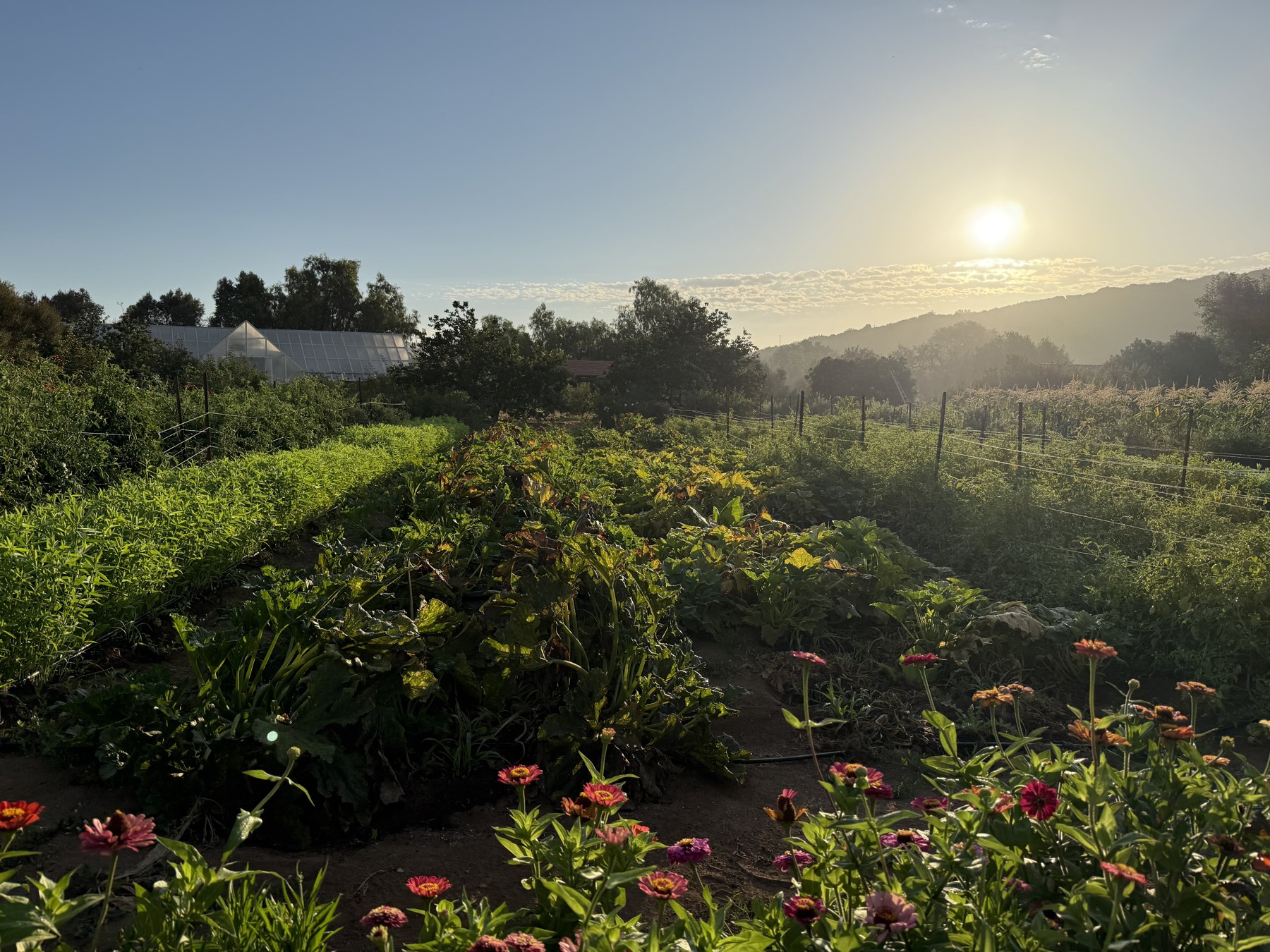
I spent five days in August at Rancho La Puerta in Tecate, and the reason it belongs in this argument is chronology.
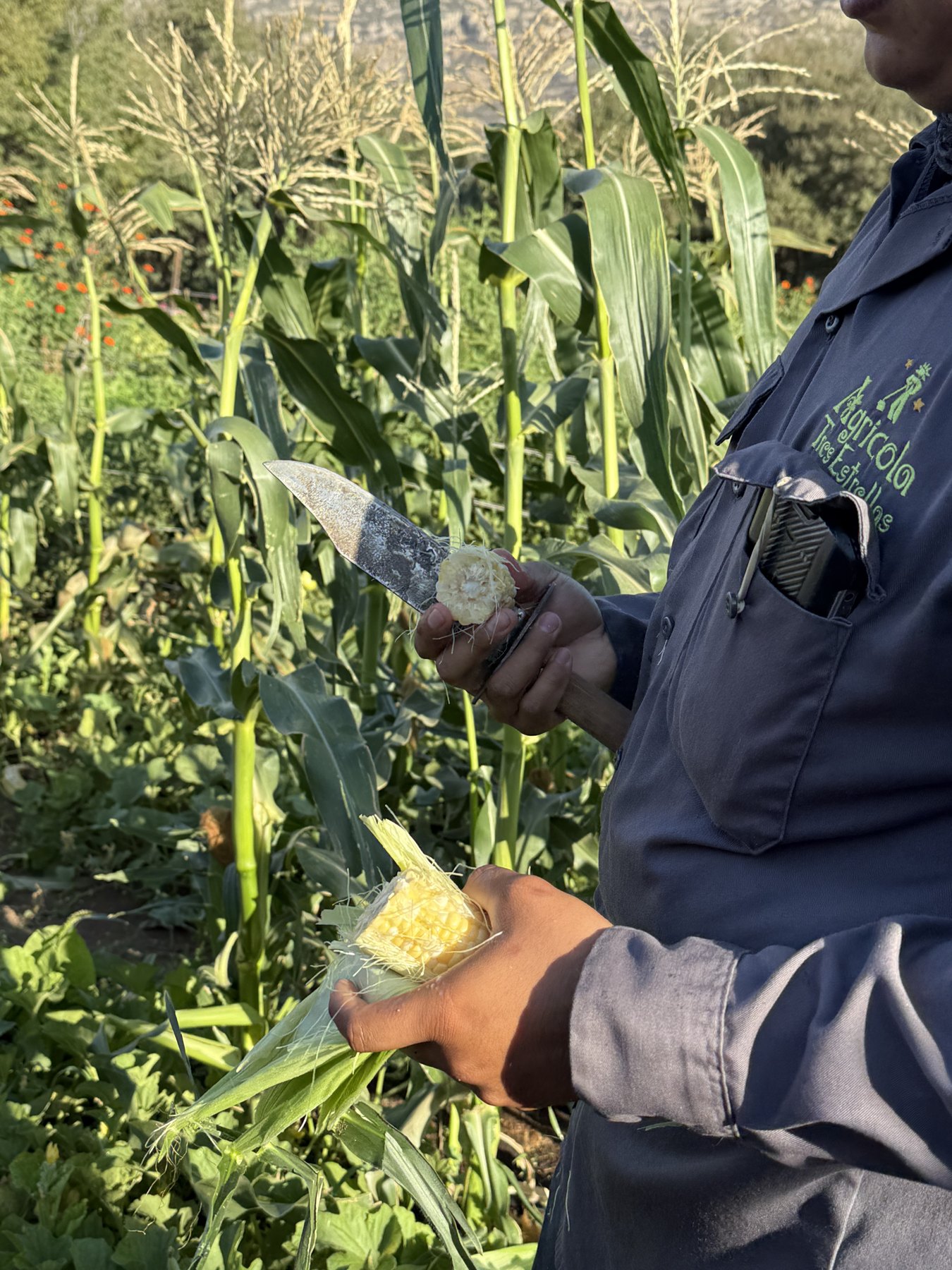
Edmond and Deborah Székely started the place in 1940 at the foot of Kuchumaa, and they put in an intentional organic garden that same year — before the Rodales planted theirs in Pennsylvania, which makes it the first on this continent. Tres Estrellas, the six-acre farm, was regenerated in 1984 by Sarah Livia Brightwood, who runs the Ranch now, third generation.
Three generations of one family, on one piece of ground, farming it the same way for eighty-six years.
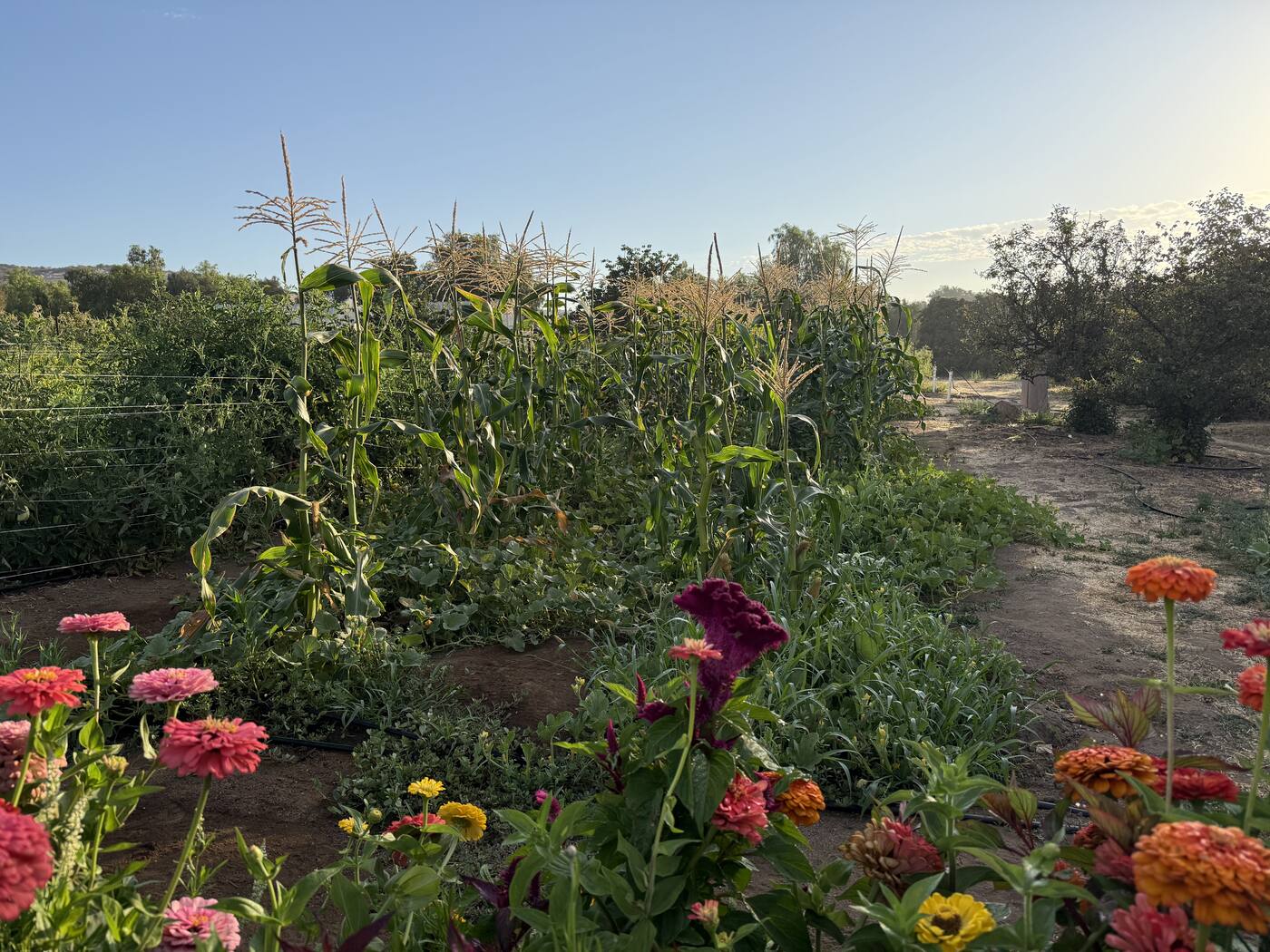
That is the thing I keep trying to describe to communities and cannot make sound real. It is easier to walk somebody out to Tres Estrellas at six in the morning, through the zinnia rows planted for the pollinators, and let them eat breakfast out of the ground they are standing on.
They were not early adopters of the regenerative movement. They are the ground much of it was copied from.
Sonoma, and going back to fetch it
The other half of this arrived on the last morning, from Pandora Thomas, who runs EARTHseed Farm — fourteen acres in Sonoma County, an Afro-Indigenous farm — with Tarah “Rah” Hines.
She told the room about her mother, Frances, born into sharecropping in South Carolina, moved north at three in the Great Migration, who still taught her daughter to love the land that had been used against her family. Sit with that for a second. The land was the instrument of the harm, and she handed her child the love of it anyway.
Their session ran on five design principles, and I am writing them down because they are the best short statement of this work I have seen:
- Honoring legacy. Who came before, and what they carried.
- Land as co-designer. They spent four years on the farm before imposing any design at all. First, learn what the land has to say.
- Design as ritual. Everyone is a designer. Designing together is a sacred practice and a form of belonging.
- Use on-site resources. Sun, rainwater — and the knowledge the group already walked in with. Every curriculum opens by asking what people already know.
- Centring the periphery. Design by and for the people usually left out. She named it directly in that room: at the Ranch, the Mexican community who live and work there are also leaders.
Read those again and tell me they are about farming. Principle two is a consultation doctrine. Principle four is an asset-based development strategy. Principle five is a governance rule. She is describing how to build an institution, using a farm as the worked example.
The session is called Sankofa — from the Akan of Ghana: go back and fetch it. It opened by pairing off and naming an ancestor aloud, human or more-than-human. That is the far messenger idea in a different language. The past is not behind you. It is a resource you are allowed to use.
Why this is the example
Every community I have worked with lost its food system before it lost anything else, and got it back last. First the food, then the language, then the governance, then the young people. It goes in that order almost every time.
Which means it can be rebuilt in that order too.
This is a food sovereignty argument before it is a climate argument. A community that feeds itself from its own ground, with its own seed, by its own methods, is a community that cannot be starved into signing a bad deal. Everything I write about governance depends on that, because a people negotiating on an empty stomach will sign anything, and historically has.
And it is happening at a rate that should embarrass the people who called it romantic. Under five million acres in the United States in 2020. Two hundred and fifty million acres globally now. The number the movement is working toward is a billion — roughly a tenth of all farmland on earth — at which point it stops being a movement and becomes the default.
A spiritual leader in India put it better than I can. At sixty-five he rode a motorcycle from London to southern India, a hundred days and thirteen thousand kilometres, to get ordinary people to say out loud that they cared about dirt:
“Soil is not your property. It is a legacy you received from previous generations, and it is your fundamental responsibility to pass it on as a living entity to the next.”
That is the seventh-generation teaching. Same sentence, different continent, different tradition, arrived at independently — which is usually the sign that something is true rather than cultural.
Will this ensure our future generations live in harmony and resilience with each other and Mother Earth?
On a regenerative farm, that question has an answer you can dig up and hold.
It is the only place I know where the whole argument — the four accounts, the seventh generation, the community that owns its own future — can be settled by a man with a shovel in four years. Which is why, when people ask me where to start, I have stopped saying governance.
Start with the ground. Everything else grows out of it, in the literal sense.
Tony Skrelūnas writes The Ancestral Watch — Stone Breath, The Amber and the Stone, The Council Fire and The Far Messengers — and the working reader, Living as a Far Messenger. He is a PhD candidate; his dissertation looks at human and organizational performance through three ancestral lenses: Diné, Lithuanian and Japanese. He holds a faculty appointment at 1440 Multiversity, where teaching is the center of the work now. He runs at dawn and hikes with a corgi named Roper.
Last reviewed August 2026.