You have been walking for days. You have kept your breath light and your jaw relaxed, and you have kept your eyes on the whole vista instead of one little area, taking in the beauty, not missing a home, not missing anybody along the way. The songs told you there would be water at this spring. You come up to it and it is dry, and it looks like it has been dry for a year or two.
That is the first test in the long abundance meditation, the one I made for driving and working out, and on a Saturday evening this October I recorded its ending. The meditation is a crossing. You take the journey, you express gratitude, and the eagle is up there the whole way, looking out for you. You hear noises in the bushes and you do not panic. You think only the best.
We were taught to prepare for a crossing like that. You do the saunas. You change your diet to a really healthy one. You meditate and you learn to relax. And you learn the path stories, the journey songs that hold where certain things are: certain springs, certain plants, certain foods, certain animals. In the old way a traveler did not carry a map. He carried the songs, and the songs were the map.
And on the way, you laugh. You recite your humorous stories, the crazy events in your community and in your family, the jokes you have learned, the stories of Coyote, and you laugh at them as you walk, because that is how we are taught to take this journey. People hear that part as decoration, a little lightness for the road. It is equipment, as necessary as the water you are walking toward.
What you do at the dry spring
Here is how I said it on the recording. I don’t panic, we don’t panic, you don’t panic. You keep going. You settle your nervous system, you tell yourself a joke, you take it in, and you sit down. Notice the order. The joke comes before the thinking. You reflect only after you have laughed and sat down, because a frightened body has a hard time remembering anything, and remembering is what gets you to water now.
So you sit, and you remember the stories and the teachings, and then you remember a song. It says there is a fork in the canyon, and to go to the other side. Over there are rock outcroppings where you can dig, and there is always water there, because there is an underground spring. You take the extra few miles. Sure enough, there is water, and you celebrate, and you express gratitude.
I keep thinking about whoever made that song. Somebody, long before you were born, must have stood where you are standing and watched the near spring fail. So they put the far water into a song and handed it down, generation to generation, so that a descendant who had never walked that canyon would know which way to turn. The dry spring was never the end of what they knew. It is the exact place their song was made for.
On a September morning in Flagstaff I recorded the same moment from the inside. You see the markings along the way, the little piles of rock, the cleared path, the artwork that shares the journeys of thousands and thousands of years before you. And all of a sudden, intuition. You know where the springs are. It is like it was always in you, this knowledge, always in your energy force. You only had to be calm enough to hear it.
Most of us reach a dry spring at some point: a job, a plan, a place we counted on to hold water, dry for a year or two by the time we arrive. The panic says the teachings let us down. The teachings say more than that. There is a fork in the canyon. Go to the other side. Dig at the rocks. It costs a few extra miles, and the water is there. The tools were never lost. They were set down.
That evening, at the water
And you settle there. That evening you think about the journey and about where you are headed, and you envision your ancestors: your great-grandparents, the elders of your family, your grandparents, and the mentors in your life, the people who have guided you.
For me that includes older professors. There were a few Native American kids in the College of Business who were really driven when I was starting my career, and a lot of professors looked out for me. Even now, as I work on my PhD, they still are. You express gratitude for them too, by the same water, on the same evening.
You say to them, “It’s good to see you, grandmother, grandfather. Thank you. Thank you for raising me. Thank you for having teachings, for positivity, for teaching health and prosperity and wisdom, for going to ceremonies, and for keeping our family resilient so we can survive and grow in abundance.” Then you tell them where you are at in life, and the wisdom and the guidance you seek, and you listen. It comes as an intuition.
What they say back is the heart of the recording. “Thank you, grandson. Taking the journey, taking the hard road. And being brave. You run into all kinds of challenges, all kinds of monsters, but yet you kept your nervous system. You kept your calmness. You kept your vision. You kept your mental strength.” And then, three times over: “Keep it up, grandson. Keep it up. Keep it up.”
That exchange is intergenerational healing as I understand it, held in one evening beside the water. The ones before you left the song. You carried it all the way to the dry spring and kept your calm long enough to hear it. Their thanks and yours meet in the middle, and the line between you holds in both directions. The water was underground the whole time.
The next morning there is morning breath, morning meditation, morning gratitude, all the good things in your life, and you take the journey again. You lean at your ankles, your head relaxed and balanced, no longing and no fear. You are not wanting this walk to be over. You are enjoying it. There is meaning in every step, meaning in every hour, meaning in every sunset.
I put this same knowledge into Stone Breath. Tonas is on a ridge in the Swiss Alps at midnight, seventy miles into a race, when a memory comes to him. He is seven again, on the dirt floor of the hogan, and his great-grandmother Masan is stirring a pot and telling him about her father, Keh Yazh, who won the first Gallup Ceremonial foot race.
“He knew every spring between here and the finish line, and he knew which ones would have water in August and which ones would not.” That is the inheritance, carried in one sentence, and Stone Breath is the story of a man remembering it.
The last thing on the recording is a set of instructions, and I will leave them here the way I said them. Always, always work to correct your thoughts, to correct your words. You don’t have to impress everybody. You don’t have to long for anybody. Do not have ego. Always be considerate of others, in all forms of life. Keep up the wisdom. Keep up the good work.
Some years the spring is dry. The song was made for those years.
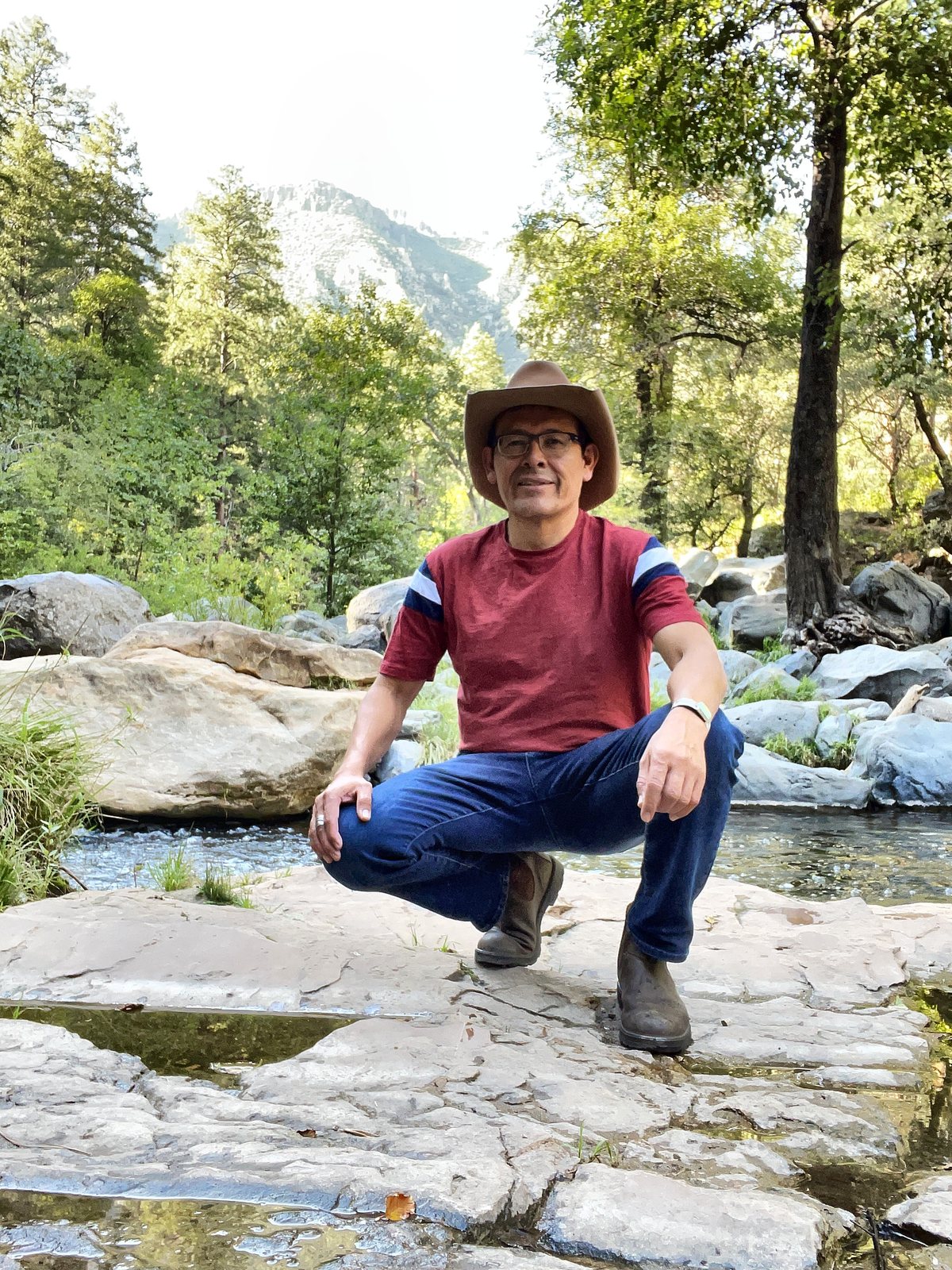
Tony Skrelūnas is Diné (Navajo) and Lithuanian. He writes The Ancestral Watch — Stone Breath, The Amber and the Stone, The Council Fire and The Far Messengers — and the working reader, Living as a Far Messenger. He is a PhD candidate; his dissertation looks at human and organizational performance through Diné and Lithuanian ancestral knowledge and the Japanese practices he has long studied. He holds a faculty appointment at 1440 Multiversity, where teaching is the center of the work now. He runs at dawn and hikes with a corgi named Roper.
Last reviewed October 2026.