The oldest trade systems on this land stretched across an entire hemisphere — from the southern tip of one continent to the far north of another. Anthropologists find southern and far-northern goods resting along ancient migration routes, carried hand to hand across distances that would humble a modern supply chain. Some of it dates back more than ten thousand years.
I keep returning to that number because of what it means. Ten thousand years is not an experiment. It is a proof. Whole peoples, across deserts and forests and coastlines, built economies that lasted a hundred times longer than the industrial age has so far managed — and they did it without exhausting the ground beneath them.
As the world now searches for a way through climate change, through pollution, through the slow drying-out of things we once took for granted, I believe there are lessons waiting in these old, time-tested systems. What did the underlying ethic of sustainability actually mean to the people who lived it? What made trade honorable? And here is the harder question, the one that always surfaces when we sit with this: as Indigenous, rural, and transitioning communities work to catch up to Western-style economic development — should a Western-style economy even be the goal?
Trade was about honor, love, and excitement
The great trade web of this hemisphere was not built to maximize shareholder wealth, or to feed an appetite for taxation, or to satisfy an infatuation with getting rich. Trade was about honor, love, and excitement.
A few hundred years ago, peoples were one another's travelers and guests. They visited each other's ceremonies, homesteads, villages, cornfields, and herds. It worked the way it still works when someone you love comes to your door: you bring food, you share your family and your home, you tell the story of your ancestors. You cannot wait to share. You want to show them the spring, the field, the dance that belongs to your place.
And here is the thing worth sitting with — a few hundred years ago, that was nearly all our ancestors had. They only had each other. There were no distant markets to disappear into, no anonymous transaction. So the exchange itself carried honor. Those are the values I want us to look at closely, because we have not lost them; we have only misplaced them.
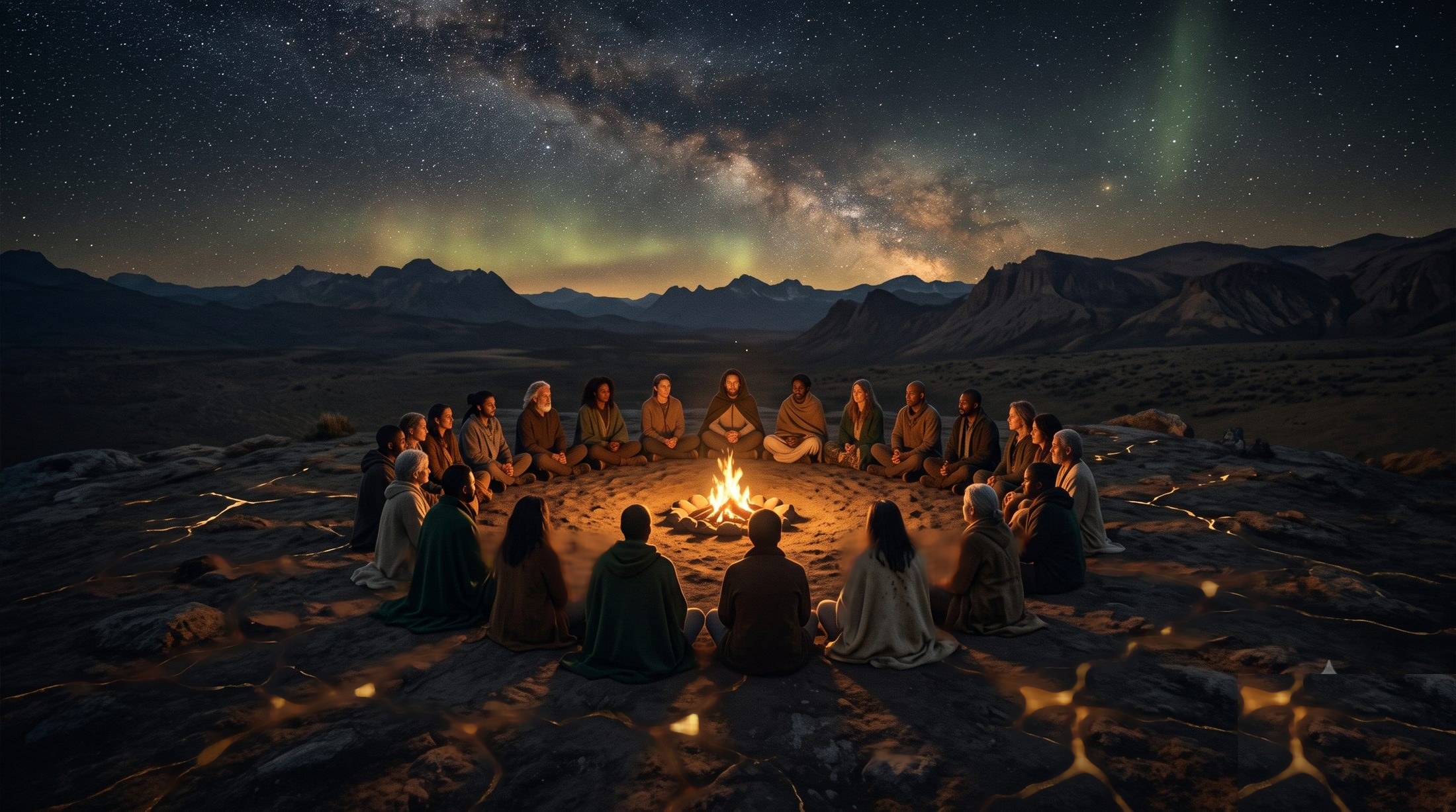
A few years ago I began organizing intertribal gatherings meant to echo the ancient ones. What I was reminded of, again and again, is that peoples carry extraordinary knowledge systems — stories, and brilliant, advanced understanding of natural law, climate, plants, deserts, mountains, oceans, forests, and the long history of the world. Much of it was carried orally, encoded as living law about how to meet challenge and hardship.
The suffering is all of ours
One of the largest challenges facing communities now is climate change — rising heat, unstable rain, violent winds, land drying out, water thinning, soil washing away, the very things we depend on. Some peoples are gatherers, some are herders, some live within the forest. But the suffering is all of ours. And it is worth naming plainly: the scientific, extractive paradigm is what set this catastrophe in motion.
Which is exactly why the past is not nostalgia — it is instruction. The ancestors of this land had figured out how to live sustainably. They built large cities, some holding more than fifteen thousand people. They wove regional trade networks that ran from the far north to the southern edge of the hemisphere.
Intimacy with the land as a technology of survival
People depended directly on what grew and moved around them for food, clothing, and shelter. So each people developed a way of living in concert with its particular place — and those divergent places produced divergent cultures, faiths, and crafts. Every community had to know precisely which plants and animals were available, and when. They held intimate knowledge of their land, their seasons, their neighbors. That knowledge was what made harvesting sustainable — what kept the future generations, and the animals and plants alongside them, alive.
Consider one example among thousands. Over untold generations, the Inuit came to understand the social behavior of the caribou — the role of the elder animals in calming and leading the herd, and therefore the wisdom of hunting the younger ones. That same order of knowledge applied to grasslands, to farmland, to medicine plants.
This intimacy was so critical to survival that it became woven into social structure, spiritual belief, and the ceremonial cycle of the year. A society's continued existence depended on strict, honored rules about how humans and the living world were to meet one another — a relationship with the earth understood not as a resource but as a living being, a mother.
Almost every people shared this one thread: intimacy with the land held as vital to survival, and the land regarded as alive. And around that common thread, whole regional economies could be built. Some specialized in fishing; some in acorn or wild rice; some in agriculture, cotton, blankets, and rugs; others in bowls and food storage, tobacco, hunting tools, medicine and healing, architecture, hides and feathers, or minerals.
The great gatherings
There were famous regional gatherings across the hemisphere. In the Great Basin, the Shoshone hosted one that drew peoples from the Plains, the Great Basin, and the Columbia River. Not far away, for twelve hundred years, the Hohokam traded with central Mexico, the Plains, and the peoples of the far western coast. Twelve hundred years of continuous exchange — longer than most nations have existed.
Difference itself was the engine. Peoples depended on one another's distinct livelihoods and cultures — a kind of cultural tourism woven straight into the economy. Two neighboring peoples who had lived side by side for generations tell of constantly mingling at festivals and dances. The elders of one still miss the times when large groups from the other would arrive for the dances carrying meat, set up camp below the villages, and share their songs and food into the night — and the next day, the hosts would reciprocate. Friendships formed. Interdependence formed.
The two were different in almost every way. One people's life was bound to farming; the other's to the health of their animals — horses, sheep, goats. And that very difference created a complement that pulled them closer: meat and wool traded for corn, squash, and melons. It was a business connection and a social one at the same time, and neither could be pried loose from the other.
The pattern repeats everywhere you look. Mountain peoples hunted, cultivated particular plants, and built housing shaped to mountain life — trading buckskins and pine nuts and acorns. Desert peoples, living among the mesas, specialized in produce, crops, and fruit. Corn moved everywhere and mattered to everyone. Each place made what its place made best, and the whole web grew rich on the exchange.
Will this make the great-grandchildren whole, or hollow them out?
This is the through-line of everything I work on — helping people and whole nations move from extraction toward ownership, keeping wealth and wisdom at home, as the globe itself shifts. And when I sit with these ancient economies, the question they put to me is the same one I ask of every decision: will this make the great-grandchildren whole, or hollow them out?
The ancestors answered that question with ten thousand years of getting it right. That is not a museum. That is a map. It tells us a sustainable path was once achieved on this ground, at continental scale, and can be achieved again — not by copying the past, but by carrying its ethic forward into the systems we are building now.
So the work is clear. We need to tap our elders and historians, to gather the story, to write it down and record it, so the coming generations know there was a road, and that it is still there. If you are reading this and wondering whether the old way is gone for good — it is not too late. The fire is still lit. You are not alone; the circle holds. And the one who carries it forward is you.
This piece belongs to a larger conversation I keep returning to in my books — Stone Breath, The Amber and the Stone, The Council Fire, and The Far Messengers — about how peoples and nations move, gently and deliberately, from extraction toward more nurturing systems as the world turns.
By Tony Skrelunas — founder of the Colorado Plateau Intertribal Conversations and chair of the board of Red Road Journey.