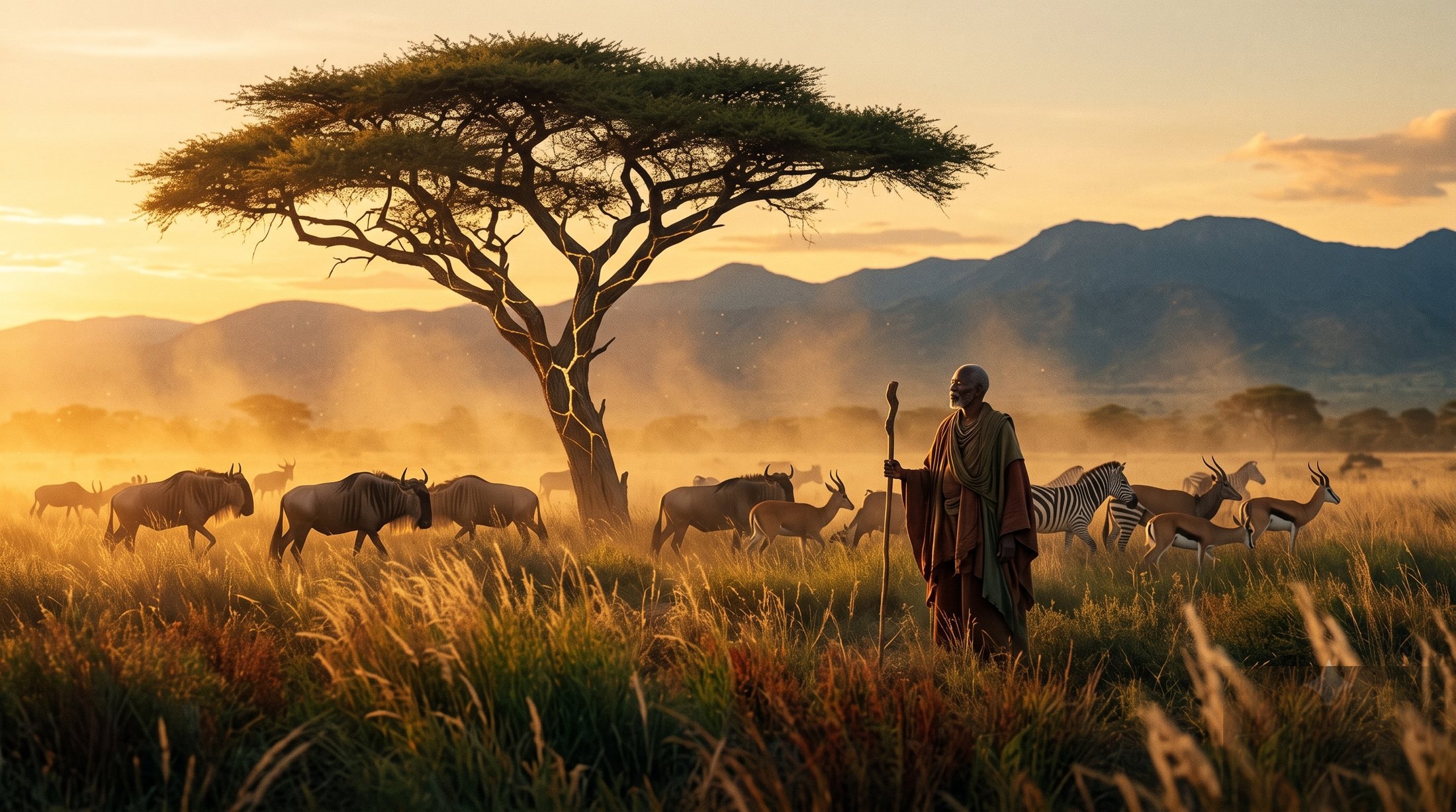
The other day I took my form of a retreat — I went back to the family sheep camp.
For those who have never seen one, it is a homestead out in the open country: a sheep herd raised with care, corrals and grazing land, a herder who carries a lifetime of knowledge of the range, a round house built for living and one built for ceremony, horses, and these days some cattle. It is not much to look at if you are counting square footage. It is everything, if you are counting the right things.
As I worked beside my relatives, we shared stories and laughed in the old language. Digging out the sheep dung, dust in the air, backs bent to the same task, we found ourselves talking about how valuable that ordinary morning actually was — richness in family, steeped tradition, obligation carried gladly, love, humor, ties to the earth, an old tongue still living in our mouths, a meaningful life. These practices, we agreed, were never decoration. They were the load-bearing walls of a society, in every age.
Who is actually rich
Let me say plainly what we concluded in the corral that day: the wealthiest people I know are the ones who still raise their own herds off the land, carefully, and process them with immense respect.
Such a family has extended kin who still help one another across homesteads — often several homes gathered close. There is a structure built specifically for ceremony. There are planting grounds. Many still keep the ceremonies alive and have a healer within the immediate family. A family like this holds standing in the community; it hosts the large gatherings. It still has grazing land wide enough to also give firewood and room to breathe. And by the old law of clan responsibility, it maintains strong ties outward — the kind of obligation that keeps a whole community woven together, so that everyone who needs help receives it.
None of that shows up on a balance sheet. All of it is wealth.
How this becomes an inheritance
So how does a morning of hard work in a corral translate into wealth that outlives us?
Because a family living this way must teach its children to carry the processes and the values forward — ancient knowledge, survival knowledge, ceremonial knowledge, the knowledge of how to live a good life. That transfer is the inheritance. The elders instill the importance of family, of language, of the land under your feet. Most of all, they teach the skills that make a person self-sufficient — and they begin very young.
The children are taught to rise before the sun and run. To pray through the day with carefully gathered pollen and meal. To hold positive thought and positive speech. To keep humor and lightness close. To understand what they owe their family and their community. To put the living things — the livestock, the field, the ceremony — ahead of trivial distractions. They are taught discipline and self-care through a story every child hears: that the early-morning Holy Ones come to the home to see whether we deserve blessings, and they judge by how we tend ourselves, our house, our homestead. If we have let ourselves and our homes fall into neglect, they simply say, this one is already wealthy, and move on to the next home.
That is intergenerational wealth in its oldest form — not a trust fund, but a way of being that guarantees the prosperity of people not yet born.
What it costs, and why it is worth it
Here is how it looks in practice: you are up at five, or earlier, to pray, to run, to tend the herd. You keep your home in order, always. Which means you must carry high energy and a clear, positive mind at all hours — and that is genuinely hard to sustain. So you hold ceremony. You eat well. You keep your distance from bitter people and bitter words. Following the teachings, you build a kind of aura, a shield, around yourself. You raise a strong family that learns to do the same.
And in doing all of it, you have transferred an immense fortune to the generations coming after you.
The wealth the world forgot how to grow
I share this not as a museum piece but as a working economic model — one that Indigenous, rural, and transitioning communities the world over already carry in some form, whether the land grows sheep or rice or olives or reindeer. Every people once knew how to grow wealth instead of extracting it. Every people once measured a life by what it left whole.
The extractive economy asks a narrow question: what can I take, and how fast? The economy of the sheep camp asks a deeper one — the only one that finally matters: will this make the great-grandchildren whole, or hollow them out? Land held in common, language kept in the mouth, ceremony kept in the year, obligation kept between neighbors — these are assets that compound across centuries and cannot be foreclosed on. This is what it looks like to keep wealth and wisdom home, as the globe shifts and the old extractive engines begin to fail.
It is the same fire I tend in Stone Breath and The Council Fire — the long labor of helping people and whole nations transition from systems that take toward systems that nurture; from tenants of our own lives back to owners of them.
If you come from a people who still remember this, you are holding something the whole world is quietly starving for. And if the line feels thin where you stand — if you fear the teachings are slipping — hear this: it is not too late. The fire is still lit. You are not alone; the circle holds. The great inheritance was never money. It was the discipline to rise before the sun, and the love to teach a child to do the same.
It is you. Begin.