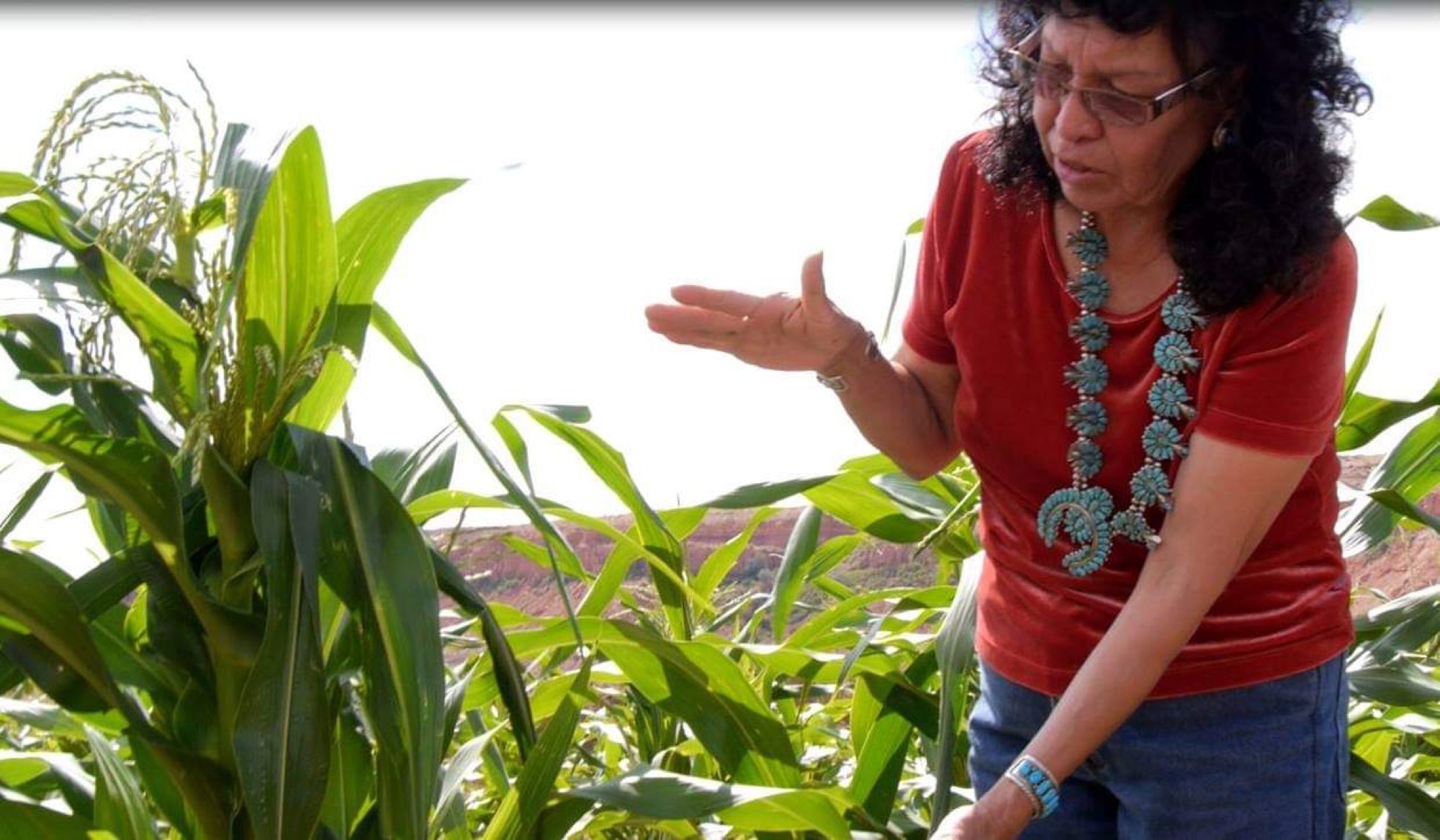
Standing with a shy smile over her family's fields on a hot summer day, Rosemary Williams tells her farming story to a circle of esteemed elders. She remembers how her grandfather woke her and her siblings before dawn, insisting they follow the old teachings — to run at first light among the morning gods, the Haasch'eelti'i. She remembers how hard the disciplined work was: to lay out every field so it captured each drop of water and stood against the wind and the sandstorms, to bank only the strongest seeds, to keep the pests away with medicine the land itself provided.
She speaks of prayer — of the sacred pollen of the corn, yellow and white. She speaks of the songs the seeds themselves long to hear as they grow. And she speaks, honestly, of her younger years: the struggle to stay on that path, the pull of an easier life in the city.
That pull is the quiet crisis of our age. All over the world, the young are being drawn away from the harder, holier work of their grandparents into a leisure that asks nothing of them and leaves them with nothing to pass on.
And yet Rosemary's fields still yield one of the most incredible harvests in the region — the kind people seek out at the farmers market. More than that, she has done something rare: she has turned the tide in one small place. She has poured the same passion and work ethic into her grandson, Richard — strong, poised, and quietly walking her path. One family reached back and pulled the future forward.
The master farmers of the drylands — Diné, Hopi, Zuni, and their kin among rural and Indigenous peoples the world over — are worried about the changing climate. But here is the turn that most of the world has missed: it is precisely their knowledge — of every form of water and wind, of soils and plants and insects, of the ancient songs and prayers — that may offer these lands, and humanity, the best chance to endure what is coming.
We have spent a century treating this knowledge as folklore to be photographed and shelved. We should be treating it as a survival technology. When the rains grow unreliable and the winds grow fierce, the people who already know how to farm on a hard edge become teachers for us all. Extraction built the crisis; stewardship is how we come through it — and stewardship is exactly what these farmers have never stopped practicing.
For years, through the nonprofit work I led, we stood beside farmers like Rosemary — with hands, with resources, with real partnership. We ran a farmers market in the region so the harvest had somewhere to go and someone to meet it. The intent, then and now, was simple: strengthen these farms, help their keepers share their methods, and treat that sharing as a hedge against everything the forecasts warn us about.
In my new work, it is an honor to keep standing with these ancient farmers. We recently helped incorporate the Bikooh farmers cooperative and are backing its push toward genuine economic resilience — a cooperative grocery store, a meat processing center, the beginnings of an economy that keeps wealth and wisdom at home instead of letting both drain away.
This is the whole through-line of everything I write and build — in Stone Breath, in The Council Fire — the slow, stubborn turn from extraction to ownership, from being farmed by distant systems to feeding ourselves again. It always comes back to one filter I cannot put down: will this make our great-grandchildren whole, or hollow them out? Rosemary already answered it in her own field. She kept the knowledge alive long enough to hand it, warm, to a boy who will hand it on again.
If you are somewhere in the world watching your own elders' knowledge thin out, watching your own young ones wander toward the easy life — know this. It is not too late. The fire is still lit. The circle holds, and you are not alone in tending it. The old farmers were right all along, and the work of proving it is still ours to do.
Ahéhee'.