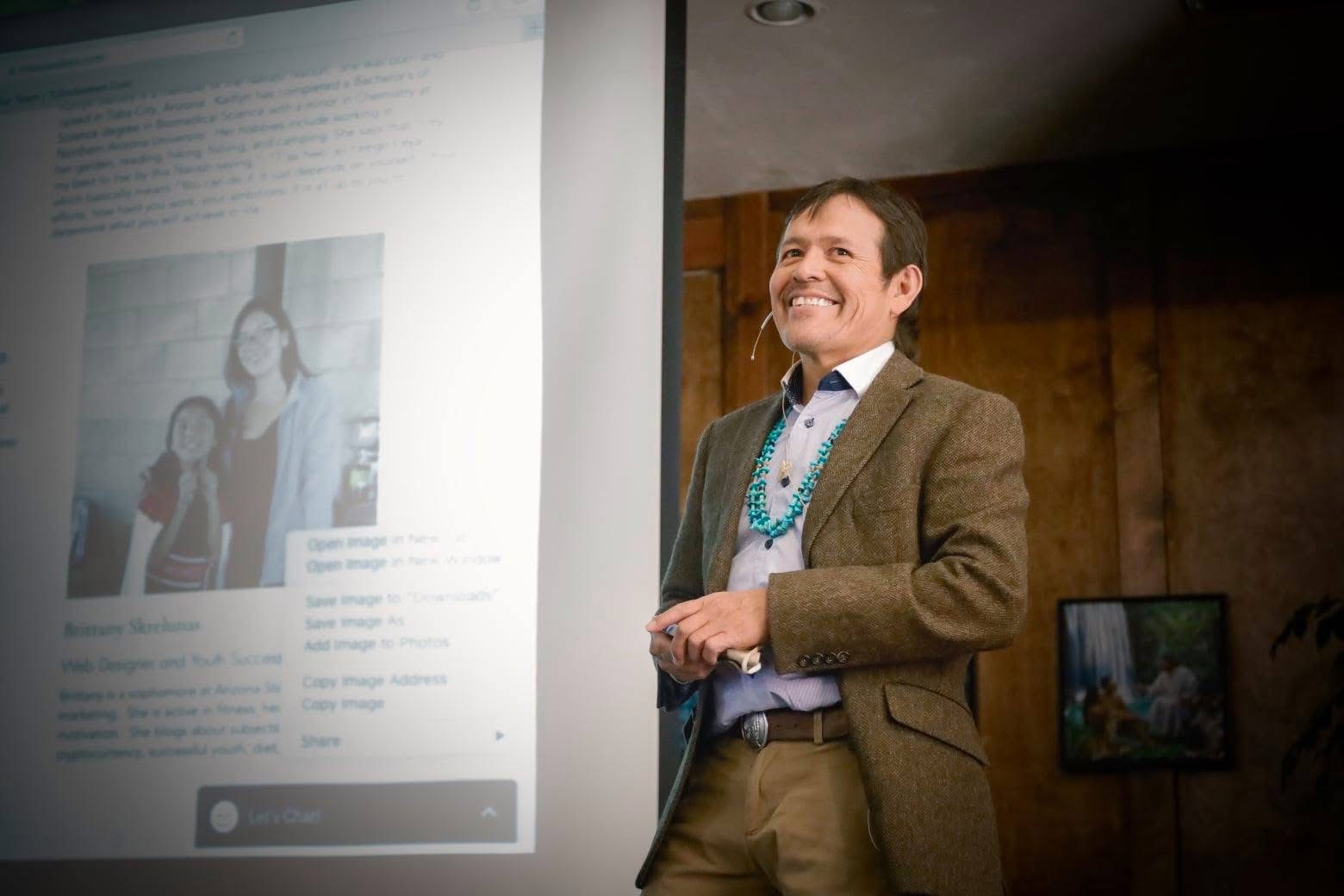
This week I keynoted for a room of school board members serving families across three nations. A last-minute invitation, and I said yes. I always say yes to this kind of work.
Before the call I sat down and did what Masan taught me. Fifteen minutes. Stone breath — the practice her father passed to her, and she passed to me before I could even read. I wasn't nervous. I was ready.
I opened with stories about her, my first teacher.
Big Mountain. No electricity. A kerosene lamp. Four hundred sheep outside every morning. My great-grandmother Masan never once called what she did a "success seminar" — but that is exactly what it was. Every single day. Up before the sun. Prayer facing east. Sweep the floor. Walk the flock. She knew every animal by the sound of its bell. At night there was humor, stories, kinship, relation. Nobody sat alone. Nobody felt lost. That was the classroom. That was the whole curriculum.
I told them about a teacher who saw a kid getting bullied — for being too much of everything at once. Too Indigenous. Too Baltic. Too smart. Too much. And instead of looking away, she went to Masan. That one conversation changed the direction of my life. It sent me to a school called Montezuma. And here is what I want every board member — anywhere in the world — to hear about that place.
Montezuma was not a traditional school. It was a working ranch with an accelerated, mastery-based learning model. You moved at your own pace. You didn't wait for the class. You didn't get left behind. You worked the land, cared for animals, took responsibility for real things — and somewhere inside all of that, your brain woke up. I ran a 4:20 mile there as a freshman. Learned to cliff dive, to kayak, to study. I excelled in ways I never had before. The model worked so well that I returned to ordinary public school and finished before my senior year. By then I was mostly working. The education had already done what it needed to do.
I told those board members plainly: there are high-performance learning models out there that look nothing like a standard classroom and work far better for our children. Mastery-based. Project-based. Land-connected. Accelerated for students who are ready. Look for them. Fund them. Build them.
I told them about the falling-out years, too. Losing my footing after Masan's passing. Coming home. Not knowing what came next. That challenge redirected me to Northern Arizona University, where — three years later — I became Standard Bearer, earned an MBA, and eventually became the first and only Native American inducted into the NAU College of Business Hall of Fame. The Grand Canyon Trust. Co-founding companies. Leading two of a nation's largest community programs. None of it in a straight line. All of it real.
I shared a story of a school that stopped me cold. A language-and-culture school in East Los Angeles. Before my talk, every single student — teenagers, in one of the hardest corners of a hard city — sat in complete silence for fifteen minutes of meditation. No phones. No fidgeting. Just present. It worked. I said to those board members: if it works there, it works here. It works anywhere.
Then I shared my current journey. Twenty-five years ago I began a PhD program at my college. Life had other plans, and I stepped away. Last year that same college invited me back — not as a student, but as the commencement speaker for their PhD program. I showed up. I spent time with the professors and the graduating students. Something shifted. They encouraged me to apply. I didn't know if my old coursework would transfer. Didn't know if they would even accept me. I applied anyway.
I got in.
And this program is nothing like sitting in a classroom. It is weekly writing sessions, collaborations over screens, conferences, presentations, a constant exchange of ideas with some of the most experienced minds I have ever encountered. I look around at my fellow students — most are older, grey-haired, already teaching, already publishing, already leading. Good. That is exactly what makes a great teacher: a life fully lived before you try to explain it to anyone else.
I am on my third book now. The Ancestral Watch Series — Stone Breath, The Amber and the Stone, The Council Fire, The Far Messengers. A wellness framework built from tools my ancestors practiced for thirty thousand years, translated for the modern world. Diné. Baltic. Japanese. Different fires, one flame. Because this is the truth I keep returning to: nearly every people on earth once held a version of these practices, and nearly every people had them taken. What I am building is not mine to keep. It belongs to Indigenous, rural, and transitioning communities everywhere.
All through my life, every single time a door opened, there was a teacher on the other side of it. Every time, they said the same thing: I believe in your potential. I never took that lightly. A professor opened the door to my MBA. Another introduced me to my first major role. I co-founded a thriving company with a professor. The most intimidating professor I ever encountered — the one I was most in awe of — nominated me to lead our graduating class. Every door, a person. Every person, a belief.
This is what I left with those board members:
Our families were always the most sophisticated success seminars ever designed. The traditional home — in the high desert, in a Baltic village, in a mountain hamlet, in a fishing town — had everything. Early rising. Physical discipline. Humor as medicine. Silence as prayer. Songs that encoded identity. Stories that carried wisdom across generations. Kinship systems that made sure no one ever had to figure it out alone. The famous teachers of our age charge five thousand dollars a ticket to teach what our grandmothers taught before breakfast. We did not lose these teachings because they stopped working. We lost them because systems were built — deliberately — to take them from us. Your school is where we take them back.
And the school does not have to look like the one you grew up in. Some of our best students need something different — a working ranch, a meditation room, a cohort of grey-haired writers who meet every week and push each other further than anyone expected. The standard classroom was never designed with our children in mind anyway. Find the models that work. Fund them.
After I finished, people came up one at a time.
"I haven't heard these teachings in a long time."
That is the whole reason I do this. The wisdom isn't new. It just needs someone to keep saying it out loud until it finds the people who need it most.
Every student on your land — on any land — is carrying extraordinary potential right now. What happens in that boardroom decides whether it gets activated or goes quiet forever. So I ask the only question that has ever mattered to me: will the choices we make in that room make our great-grandchildren whole, or hollow them out?
The journey doesn't end here. It just changes phases.
The ancestors are watching. Let's not waste what they built. It is not too late. The fire is still lit. It is you.
Ahéhee'. Thank you.
Tony Skrelūnas · PhD Candidate · Author, The Ancestral Watch Series · Keynote Speaker